How Far Did the Romans Travel?
The Roman Empire is often imagined as a Mediterranean-centered civilization bounded by the Atlantic Ocean in the west, the Rhine and Danube in the north, the Sahara in the south, …
For centuries, King Arthur has stood somewhere between history and legend. The stories describe a great warrior who defended Britain, defeated enemies, and became one of the most famous figures …
Marcus Junius Brutus is remembered primarily as the Roman senator who joined the conspiracy that assassinated Julius Caesar on the Ides of March in 44 BC. Yet reducing Brutus to …
Publius Cornelius Scipio Africanus was one of the most consequential commanders of the Roman Republic. He defeated Hannibal at Zama in 202 BCE, ended the Second Punic War, destroyed Carthage’s …
Quintus Horatius Flaccus, better known as Horace, was one of the defining literary figures of Augustan Rome. Born in 65 BC and dying in 8 BC, he lived through the …
Imperial Rome is remembered for its temples, aqueducts, roads, and monuments. Most Romans lived in a very different environment. At its height, Rome may have contained hundreds of thousands of …
Silbannacus is one of the most obscure figures associated with the Roman Empire. No surviving ancient historian mentions him. No inscription records his name, and no statue preserves his image. …
In 89 BC, a young man entered Rome in chains. He was a captive from Picenum, one of the Italian regions that had rebelled against Rome during the Social War. …
Few monuments demonstrate the scale, engineering ability, and political ambition of Imperial Rome as dramatically as the Baths of Caracalla. Known in antiquity as the Thermae Antoninianae, the complex was …
For more than 1,700 years, one of the most important gatherings in the history of the Roman world has had a missing address. In AD 325, bishops from across the …
Imagine a wedding day in ancient Rome. The house is busy from early morning. Relatives and friends have gathered, preparations are underway, and the bride is dressed in clothing that …
On 24 August AD 410, something happened that had seemed almost impossible for centuries. The gates of Rome opened to a Gothic army. For centuries, Rome had not been captured …
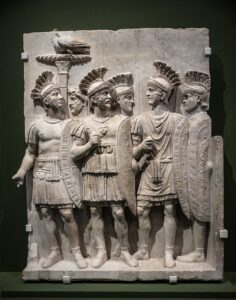
The Roman army was far more than a fighting force. It was one of the principal instruments through which Rome imposed order, projected imperial authority, built infrastructure, collected revenue, and …
Poena cullei, or the “penalty of the sack,” was one of the most severe punishments in Roman law. It was associated primarily with parricidium, especially the murder of a parent …