
You step into a world where strong rule meets deep crisis. You watch power shift as faith, law, and war press on every border. You speak from inside this moment, where clear choices carry heavy costs.
You guide the viewer through early rule shaped by belief, reform, and force. You face unrest at home, danger abroad, and the task of holding the state together while pushing it forward.
Key Takeaways
- You rule during constant pressure from war, unrest, and belief disputes.
- You reshape law, cities, and leadership to keep control.
- You push the state to expand while managing deep internal strain.
Justinian’s Rise and Religious Policies
Taking the Imperial Throne
You became sole emperor on August 1, 527, at age forty‑five, after the death of Justin. You took control of a stable state with strong finances and firm institutions.
You quickly confirmed the religious line of your predecessor and tied your authority to church unity.
Laws and Church Decrees
You issued a clear Chalcedonian decree early in your reign and made it the official position of the state. You later allowed talks with non‑Chalcedonian leaders, pushed in part by your wife, who held those views.
You invited church leaders to Constantinople to seek agreement, but divisions among them blocked progress. After Pope Agapetus arrived, you returned to a strict Chalcedonian stance and removed rival patriarchs.
Key actions
- Reaffirmed Chalcedonian doctrine
- Hosted talks with dissenting bishops
- Replaced and excommunicated opposing church leaders
Ending Old Pagan Practices
You moved against remaining pagan traditions by limiting their legal rights. These actions aimed to align public life with Christian rule.
One major result was the closure of the Neoplatonic Academy in Athens, ending a long center of pagan teaching.
The Organization of Roman Law
Creating Justinian’s Legal Code
You oversee a full review of Roman law while war continues in the east. Tribonian and other officials work under your authority to replace older collections.
- You adapt past laws to fit current rule.
- You set aside the Theodosian code and make a stronger version.
- You link legal reform to firm religious policy.
Key Features
| Aspect | Action |
|---|---|
| Scope | Revises earlier Roman laws |
| Status | Replaces the older code |
| Purpose | Fits law to your rule |
Teaching Texts and Legal Opinions
You order the creation of two new books while Africa returns to imperial control. These works shape how people learn and apply the law.
- The Institutes teach basic legal ideas.
- The Digesta collect expert legal opinions.
- Both works support judges and students.
You combine these texts with your earlier code into a larger system.
The Unified Law Collection and New Laws
You approve a second edition that joins all major legal books. Later laws stand apart in a separate volume.
The final structure includes:
- The revised legal code
- The teaching manual
- The collection of legal opinions
- New laws issued after publication
Future rules appear in the Novellae, which keeps the system current under your rule.
Armed Operations Across the Eastern Frontier
Wars Against the Sassanian Empire
You took control while fighting already stretched from Arabia to the Caucasus. You split the eastern army, placing Belisarius in Mesopotamia and Sittas in Armenia.
- You suffered an early loss near Thannuris and fell back to Dara.
- Arab allies of Persia raided deep into Syria during this phase.
- At Dara, your forces won despite smaller numbers, while Sittas also defeated a larger enemy force in the north.
- A later setback at Callinicum led you to recall Belisarius.
| Battle | Result | Commander |
|---|---|---|
| Thannuris | Defeat | Belisarius |
| Dara | Victory | Belisarius |
| Callinicum | Defeat | Belisarius |
Fighting slowed after the Persian king died, and you later agreed to a peace that kept borders unchanged in exchange for gold.
Clashes Between Arab Client Kingdoms
You faced constant pressure from Arab allies tied to Persia. Lakhmid forces carried out raids across Syria during the wider war.
You responded by naming a single Ghassanid ruler over all imperial Arab allies. These forces supported your army and helped restore control in the region.
- Ghassanid troops checked Lakhmid attacks
- Imperial-backed Arabs strengthened frontier defense
The Samaritan Uprising in Judea
You dealt with a major revolt in Judea while the eastern war continued. Local unrest threatened stability behind the front lines.
You relied on loyal Arab allies and imperial troops to put down the rebellion. The revolt ended once coordinated force restored order.
The War Against the Vandals and the Return of Africa
Launching the African Expedition
You decide to punish Gelimer after he jails the Roman-friendly king Hilderic and rejects your demands. With peace secured in the east, you shift men and funds to Africa despite strong objections from top officials.
You order a force of about 16,000 troops to sail under Belisarius. To avoid a sea fight, you land well south of Carthage and make it clear that you come as a liberator, not a conqueror.
Key steps you take
- Encourage revolts in Tripolitania and Sardinia
- Resupply the fleet in Sicily
- March north with help from local communities
Fights Near Carthage
You face the first Vandal force near Ad Decimum, led by Gelimer’s brother. Belisarius destroys it, opening the road to Carthage.
You enter the city with local support and prepare defenses. When Vandal troops return from Sardinia, you meet them at Tricamarum and win again, killing another of Gelimer’s brothers.
| Battle | Outcome |
|---|---|
| Ad Decimum | Vandal force defeated |
| Tricamarum | Roman victory near Carthage |
Gelimer’s Fall and Imperial Rule
You pursue Gelimer as he flees west. Roman forces secure the province, and Gelimer is later captured.
You set up a new government under Praetorian Prefect Solomon, who begins to deal with Berber resistance. Belisarius returns to Constantinople with Gelimer and major treasures and receives a triumph and the consulship for 535.
Aftermath
- Gelimer goes into exile
- Former Vandal soldiers redeploy to the Persian frontier
- Africa returns to imperial control under Roman law and command
The Nika Riot and Urban Transformation
Roots of the Revolt
You face unrest in Constantinople after protests erupt in the Hippodrome. You try to ease anger by agreeing to remove officials the crowd dislikes, including Tribonian and John the Cappadocian.
The effort fails when the Blues and Greens unite and raise Hypatius, a relative of Anastasius, as a rival ruler.
Crackdown and Bloodshed
You consider leaving the city as violence spreads and fires damage buildings near the Hippodrome. Theodora pushes you to act instead of fleeing.
You order Belisarius and Mundus, newly arrived with troops, to end the uprising.
- The soldiers storm the Hippodrome.
- More than 30,000 people die to stop the riot.
### Rebuilding the Capital
The fighting leaves large parts of the city in ruins. The main church of Constantinople, already rebuilt once under Theodosius II, lies destroyed again.
You decide to reshape the city through construction and call on two experts to lead the work.
| Role | Name |
|---|---|
| Architect | Anthemius of Tralles |
| Architect | Isidore of Miletus |
Raising a New Hagia Sophia
You order a new and greater basilica to replace the ruined church. The project moves quickly and reflects your aim to surpass earlier emperors in building works.
By the end of the year, Hagia Sophia stands complete and you inaugurate it with the patriarch.
Dealings with the Papacy and Church Talks
Outreach to Non-Chalcedonian Figures
You followed Justin’s strict Chalcedonian line at first, but Theodora pushed you toward talks. You invited several leaders who rejected Chalcedon to Constantinople to seek unity.
- You faced deep divisions among them.
- The talks stalled, and you reached no clear agreement.
Arrival of Severus and the Alexandrian Patriarch
You later received Severus of Antioch after he accepted your call from Egypt. He arrived with Theodosius, the patriarch of Alexandria.
| Figure | Origin | Outcome |
|---|---|---|
| Severus of Antioch | Egypt | Later removed and excommunicated |
| Theodosius of Alexandria | Alexandria | Later removed and excommunicated |
Their presence did not settle disputes inside the church.
Papal Pressure and a Return to Chalcedon
You met Pope Agapetus when he came as an envoy from the Gothic king. He opposed the influence of non-Chalcedonians in the capital and persuaded you to act.
- You replaced Patriarch Anthimus and Theodosius with Chalcedonians.
- You excommunicated Severus and the removed leaders.
- Agapetus died on his journey back to Italy.
The Gothic War and the Italian Campaign
Why War Began in Italy
You faced a clear reason to act after the murder of Queen Amalasuintha, who had supported Roman ties.
The Ostrogoth refusal to return Sicily and the loss of a friendly ruler gave you a legal and political cause to move.
You also aimed to restore Roman control in the west, using the peace in the east to shift troops and money.
Rome Under Siege and Shifting Armies
You entered Rome after moving through southern Italy, even after hard fighting at Naples.
The Goths surrounded the city, but you held firm with limited forces and steady reinforcements.
You removed Pope Silverius after charges of aiding the enemy.
Your pressure and tactics forced King Vitiges to lift the siege and pull back.
Fighting in the North: Mediolanum and Ravenna
You learned that Mediolanum joined your side and asked for help.
Before aid arrived, a combined Gothic and Burgundian force trapped the city.
At the same time, you pushed against Gothic strongholds across Italy.
These actions set the stage for later moves toward key cities, including Ravenna.
Command Decisions: Belisarius and Narses
You relied on Belisarius for bold action and fast movement across Italy.
His leadership kept Roman forces active even when outnumbered.
You also sent Narses to Italy, which split command authority.
Despite tension between the two leaders, you still secured gains, such as the relief of Roman troops at Ariminum.
Balkans and Danubian Affairs
Securing the Danube Frontier
You rely on local allies to hold the northern border. Mundus, a Gepid leader in your service, pushes back Bulgar raids and restores order along the Danube line.
These actions keep pressure off the heart of the empire while larger wars continue elsewhere.
Creating a New Imperial Center
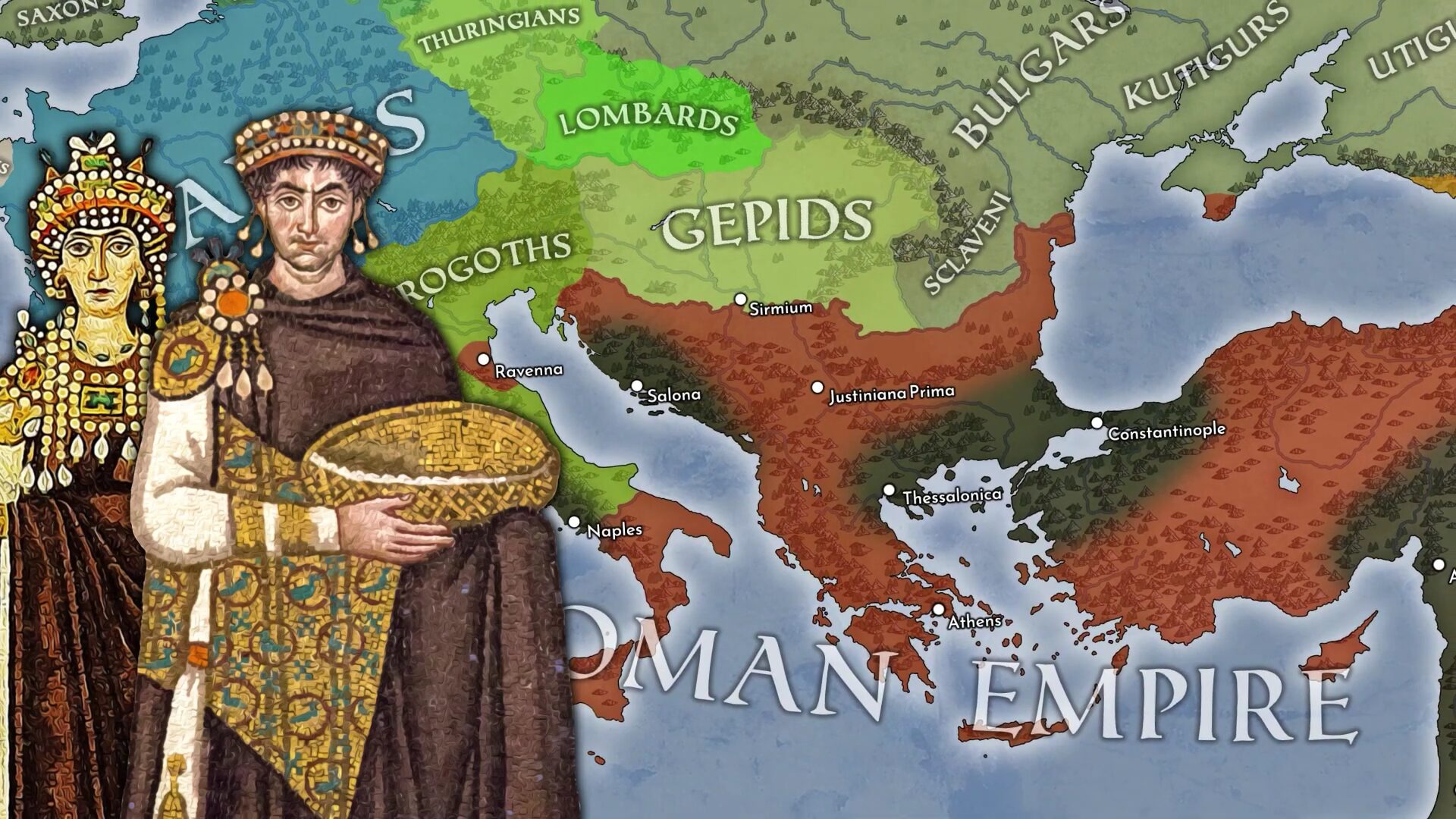
You establish Justiniana Prima as a new administrative capital. The city replaces Thessalonica as the seat of both the Diocese of Dacia and the Praetorian Prefecture of Illyricum.
| Change | Result |
|---|---|
| New capital founded | Faster control of the Balkans |
| Armies moved north | Stronger Danube defense |
| Administration relocated | Tighter imperial oversight |
This shift places troops closer to the frontier and shortens response time.
Campaigns Along the Adriatic Coast
You send forces under Mundus into Dalmatia to seize Salona from Gothic control. The advance strengthens your position on the eastern Adriatic.
After Mundus falls in battle, you adjust strategy. You encourage the Gepids to strike the Goths, which leads to the capture of Sirmium.
Soon after, a new commander resumes efforts in Dalmatia as Gothic forces withdraw to focus on Italy.
Renewed Persian Pressure and Strains on the Eastern Border
Kosrow’s Campaigns
You face renewed tension as the Persian front stretches from Arabia to the Caucasus. You split the eastern army, placing Belisarius in Mesopotamia and Sittas in Armenia to manage constant pressure.
Belisarius suffers a setback at Thannuris and pulls back to Dara. Persian-backed Arab forces keep striking into Syria while fighting continues along the border.
Threats to Antioch and Syria
You watch Syrian lands endure repeated raids by Lakhmid allies of Persia. These attacks disrupt security and force you to divert troops while the wider war remains unresolved.
Even after success at Dara, defeat at Callinicum weakens your position. You recall Belisarius, and command changes follow as the front remains unstable.
Shifts in Diplomacy
You turn toward negotiation after years of costly conflict. With Kosrow newly crowned, both sides agree to leave borders unchanged.
You secure peace by sending 11,000 pounds of gold, creating what many call an “Endless Peace.” This agreement eases pressure in the east and frees your resources for campaigns elsewhere.
Environmental Crises and Deadly Disease
Crop Failure and Strange Weather
In 536, you saw an odd change in the sky. The sun looked dim, like it sat behind a veil.
Cold weather followed. Crops failed across many regions, food ran short, and hunger spread. You also heard reports of snow in strange seasons and dry lands where rain once fell.
| Reported Effects | Examples |
|---|---|
| Climate shift | Reduced sunlight |
| Food loss | Failed harvests |
| Hardship | Famine and shortages |
Spread of Illness After the Shortages
As food became scarce, people grew weaker. You faced growing fears of sickness in crowded cities and camps.
These conditions strained daily life. Poor nutrition and stress made recovery harder for many communities.
Strain on Imperial Rule
Natural hardship forced you to shift attention from war and expansion. Local unrest increased as people struggled to survive.
Officials had to respond to hunger, rebellion, and disorder at the same time. These pressures tested the empire’s ability to govern during crisis.
Civil Disorder and Border Rebellions
Army Revolts in Roman Africa
You faced open mutiny in Africa after the new administration took control. The revolt forced Governor Solomon to flee, putting Carthage at risk.
You sent Belisarius to respond, and he beat the rebels in battle. Your cousin Germanus then arrived and broke the remaining resistance, restoring order to the province.
Turmoil Along the Caucasus Frontier
You dealt with rebellion in Armenia while the eastern frontier remained tense. Fighting there led to the death of the general Sittas during efforts to regain control.
You continued to manage pressure across the Caucasus zone as war and unrest strained local defenses. These troubles limited your ability to shift forces elsewhere.
Raids from the Northern Steppe
You faced repeated attacks in the Balkans from northern raiding groups. These incursions threatened border towns and supply routes.
You relied on commanders like Mundus to push the raiders back. His forces stopped their advance and kept the Danube line intact for the moment.
Legacy and the Midpoint Crisis
Erosion of Central Control
You take charge with strong authority, yet pressure tests it from all sides. Riots in the capital force you to choose between retreat and force, and you order troops to end the unrest at great cost. You later restore dismissed officials, showing how fragile control becomes even after decisive action.
Key signs you face
- Public unrest in the Hippodrome
- Fires that destroy major buildings
- Reliance on generals to restore order
Wars Without Clear Endings
You fight across wide fronts, and wins often follow losses. Victories at places like Dara bring confidence, but defeats like Callinicum slow momentum. Peace with Persia pauses the strain, yet new campaigns in Africa and Italy reopen it.
| Front | Result |
|---|---|
| Eastern border | Mixed battles, then paid peace |
| Africa | Fast success, later rebellions |
| Italy | Early gains, long resistance |
Pressure on Society and Resources
You push legal reform, faith policy, and building projects while war drains men and funds. Crop failures and cold weather add hunger and fear. Religious disputes persist despite talks, and unity remains out of reach.
You respond by:
- Expanding and revising Roman law
- Closing pagan schools and limiting rights
- Rebuilding the great church after destruction
