
In July 64 CE, Rome suffered one of the most destructive urban fires in its history. The blaze consumed large sections of the imperial capital, displaced thousands of residents, destroyed temples and public buildings, and transformed the political relationship between Emperor Nero and the Roman population.
Nearly two millennia later, one question continues to dominate the story: Did Nero deliberately burn Rome?
The evidence does not provide a definitive answer. Ancient writers disagreed sharply about the emperor’s conduct, while modern historians have had to reconstruct events from literary accounts written at different times, by authors with different political agendas. What can be established with greater confidence is that Rome’s urban environment made catastrophic fire exceptionally likely—and that the actions taken to contain the flames could easily have appeared destructive to people caught in the disaster.
The Great Fire of Rome therefore deserves to be understood less as a simple story of an emperor watching his city burn and more as a case study in the vulnerabilities of an ancient metropolis, the limitations of Roman firefighting, and the difficulty of separating historical evidence from political memory.
How the Fire Spread
Tacitus places the outbreak near the Circus Maximus, in an area crowded with shops and buildings containing combustible materials. Rome’s dense urban construction made the city exceptionally vulnerable to fire.
Much of the population lived in multi-story insulae, often constructed with timber components and packed tightly along narrow streets. Commercial premises contained food, textiles, wood and other flammable goods. Once the fire escaped its original location, flames could spread rapidly between buildings.
Tacitus describes residents attempting to escape while fire appeared ahead of them and around their escape routes. The fire continued for six days and seven nights before being brought under control, then broke out again.
Tacitus divides the fourteen districts of Rome according to the extent of the damage. Three were completely destroyed, seven suffered severe damage, and only four escaped serious destruction.
The disaster therefore affected a substantial portion of the city, but it did not destroy Rome entirely.
The Vigiles and the Destruction of Buildings
Rome maintained a professional fire and night-watch organization known as the vigiles. Created under Augustus, the force was responsible for responding to fires and maintaining security at night.
Fighting a major urban fire required more than extinguishing flames. Buildings could be demolished to prevent fire from spreading into adjacent districts.
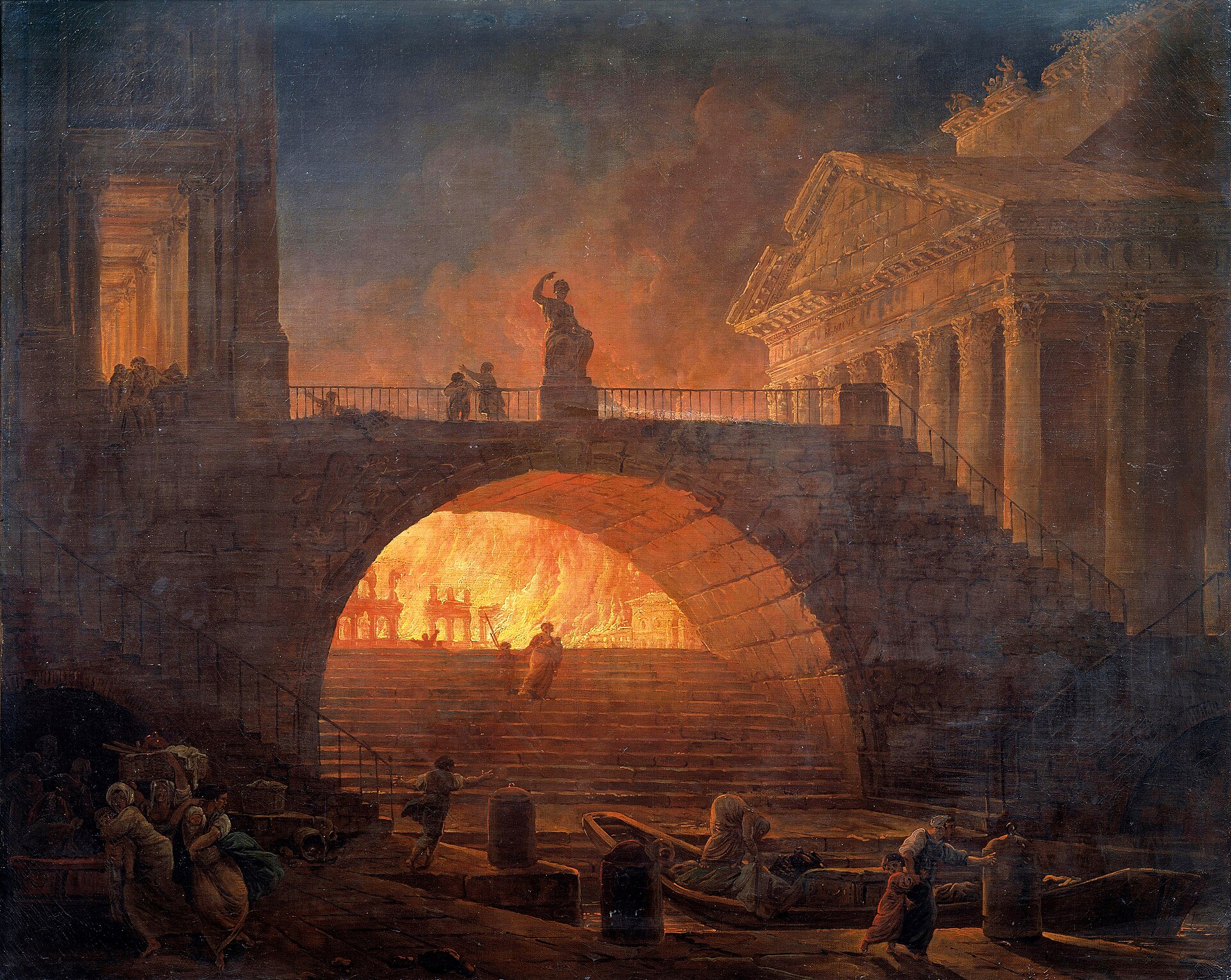
This appears to explain at least some of the destruction reported during the Great Fire.
Tacitus records that men were knocking down buildings while the fire spread. He also reports that some individuals claimed to be acting under official orders. However, he questions whether these men were actually members of the vigiles, suggesting that some may have been using the chaos to loot abandoned properties.
The distinction is important. Demolishing buildings ahead of a fire could be an effective firebreak strategy. The same activity could appear to residents as deliberate destruction.
Suetonius and the Nero Conspiracy
Suetonius presents a much more damaging account of Nero.
Writing decades after the fire, he claims that Nero’s men deliberately demolished buildings, including structures that had not yet been reached by the flames. Suetonius connects this activity with Nero’s supposed desire to rebuild Rome according to his own plans.
He also preserves the allegation that Nero intended to rename the city Neropolis.
These claims became central to the later tradition that Nero ordered the fire so he could rebuild Rome.
The problem is the lack of corroborating evidence.
Suetonius’s biographies frequently emphasize scandalous anecdotes and rumors surrounding imperial behavior. His account of Nero is particularly hostile and includes numerous allegations concerning the emperor’s personal conduct. His claim that Nero deliberately burned Rome therefore cannot be accepted without qualification.
Tacitus Provides the Stronger Account
Tacitus is generally the more useful source for reconstructing the fire.
He was not an eyewitness—the fire occurred when he was a child—but he lived close enough to the event chronologically to draw upon people and records from the preceding generation. His account also distinguishes between established events and circulating rumors.
Tacitus does not dismiss accusations against Nero. He records that suspicion fell on the emperor and that rumors claimed he had ordered the fire.
But he does not present the accusation as proven.
His account instead describes Nero’s response to the disaster, including efforts to provide shelter, food and financial assistance to displaced residents.
This does not prove Nero was innocent. A ruler responsible for a disaster could still organize relief afterward. It does, however, contradict the simplistic claim that Nero simply ignored the suffering of Rome.
The Firebreak Explanation
The destruction of buildings during the fire is one of the strongest pieces of evidence used by supporters of the Nero conspiracy. Yet it has another plausible explanation.
Ancient firefighters could not suppress a rapidly advancing urban conflagration using modern pumps and water systems. Creating open space by demolishing buildings was a practical way to deprive flames of fuel.
The vigiles therefore may have deliberately destroyed buildings outside the immediate fire zone to prevent the flames from advancing.
This interpretation does not prove that every demolition was authorized firefighting. Looting and opportunistic destruction undoubtedly became possible during the chaos.
It does, however, remove one of the central assumptions behind the Nero conspiracy: that the deliberate destruction of buildings necessarily indicates an imperial order to burn Rome.
Nero and the Rebuilding of Rome
After the fire, Nero initiated a major reconstruction program.
Tacitus describes regulations concerning new construction, including measures intended to reduce the vulnerability of rebuilt areas. Streets and building arrangements were modified, and efforts were made to improve the organization of the city.
Nero also began constructing the enormous Domus Aurea, or Golden House.
The palace became politically damaging because its scale appeared disproportionate after the destruction of large sections of Rome. Even if Nero had not caused the fire, his rebuilding program gave opponents a powerful argument: the emperor appeared to be using the catastrophe to transform the capital according to his personal ambitions.
This helped preserve the suspicion that he had benefited from the disaster.
The “Fiddling While Rome Burned” Myth
The familiar story that Nero played a fiddle while Rome burned is historically impossible in its literal form. The violin did not exist in first-century Rome.
The story derives from ancient allegations that Nero sang or performed while observing the fire, reportedly comparing the destruction of Rome with the fall of Troy.
Tacitus treats such claims as part of the rumors surrounding Nero rather than established fact.
The later image of Nero playing a fiddle is therefore a literary development rather than a historical description.
The Christians and the Fire
The Great Fire also produced one of the earliest surviving Roman accounts of the persecution of Christians.
Tacitus states that rumors blaming Nero became widespread. To divert suspicion, Nero accused Christians of responsibility for the catastrophe.
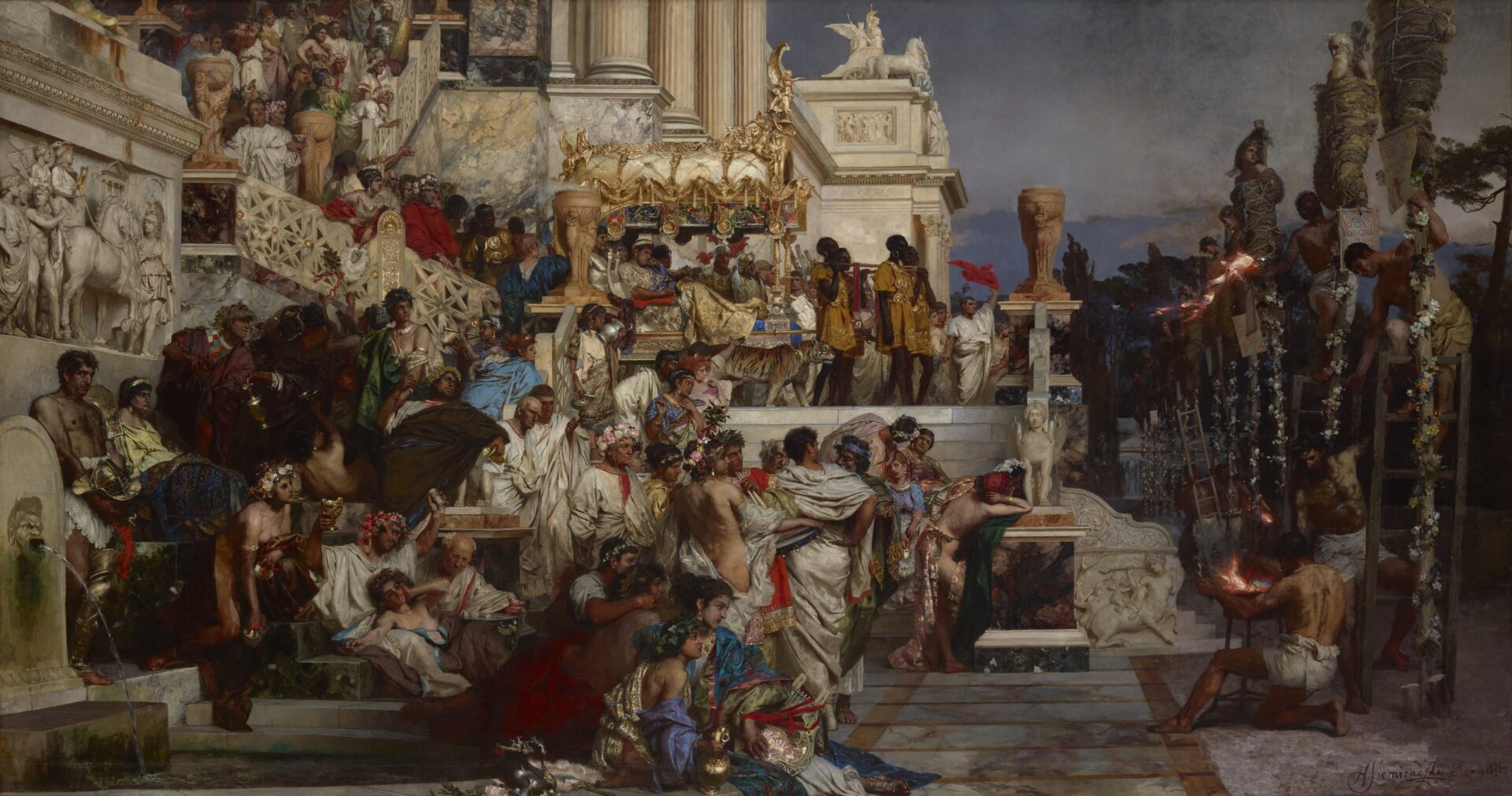
Christians were arrested and subjected to executions and public punishments.
Tacitus records that Nero’s persecution generated sympathy because the punishments were viewed as excessive.
The episode demonstrates the political consequences of the fire. Nero faced public suspicion after a disaster that had destroyed large parts of the capital, and the Christian community became a convenient target.
What Can Be Established?
The evidence supports several conclusions with reasonable confidence:
- The fire began near the Circus Maximus in July 64 CE.
- Rome’s dense construction and combustible materials allowed it to spread rapidly.
- The fire continued for approximately six days and seven nights before being brought under control and later reigniting.
- Fourteen districts were affected, with three completely destroyed and seven heavily damaged according to Tacitus.
- The vigiles and other authorities attempted to contain the fire.
- Buildings were deliberately demolished during firefighting operations.
- Nero provided relief and subsequently directed major reconstruction.
- Rumors accused Nero of causing the fire.
- Nero subsequently blamed Christians and persecuted them.
- No surviving evidence proves that Nero ordered the fire deliberately.
The final point is critical.
There is no surviving physical evidence demonstrating arson ordered by Nero, nor is there a contemporary document recording such an order.
Why the Nero Story Survived
Nero already possessed a damaging reputation when the fire occurred. His conflicts with the Senate, extravagant lifestyle, family killings and theatrical interests provided material for later hostile accounts.
The fire reinforced that reputation.
The combination of widespread destruction, suspicious-looking demolitions, Nero’s ambitious rebuilding program and the construction of the Domus Aurea created a narrative that was easy to preserve: Nero wanted a new Rome, burned the old one, and rebuilt it for himself.
The surviving evidence is less conclusive.
The Great Fire was likely the product of a highly combustible urban environment combined with conditions that allowed a relatively localized fire to become a city-wide catastrophe. The actions of the vigiles, including the destruction of buildings, are plausibly explained as attempts to create firebreaks rather than evidence of an imperial demolition campaign.
Nero cannot be conclusively absolved, but neither can he responsibly be identified as the arsonist.
The historical significance of the Great Fire lies not only in its destruction but in the uncertainty surrounding it. Tacitus, Suetonius and later writers preserved competing interpretations of the same catastrophe. Their accounts demonstrate how quickly a disaster can become a political weapon—and how an event can acquire a reputation that survives long after the evidence needed to resolve it has disappeared.
