
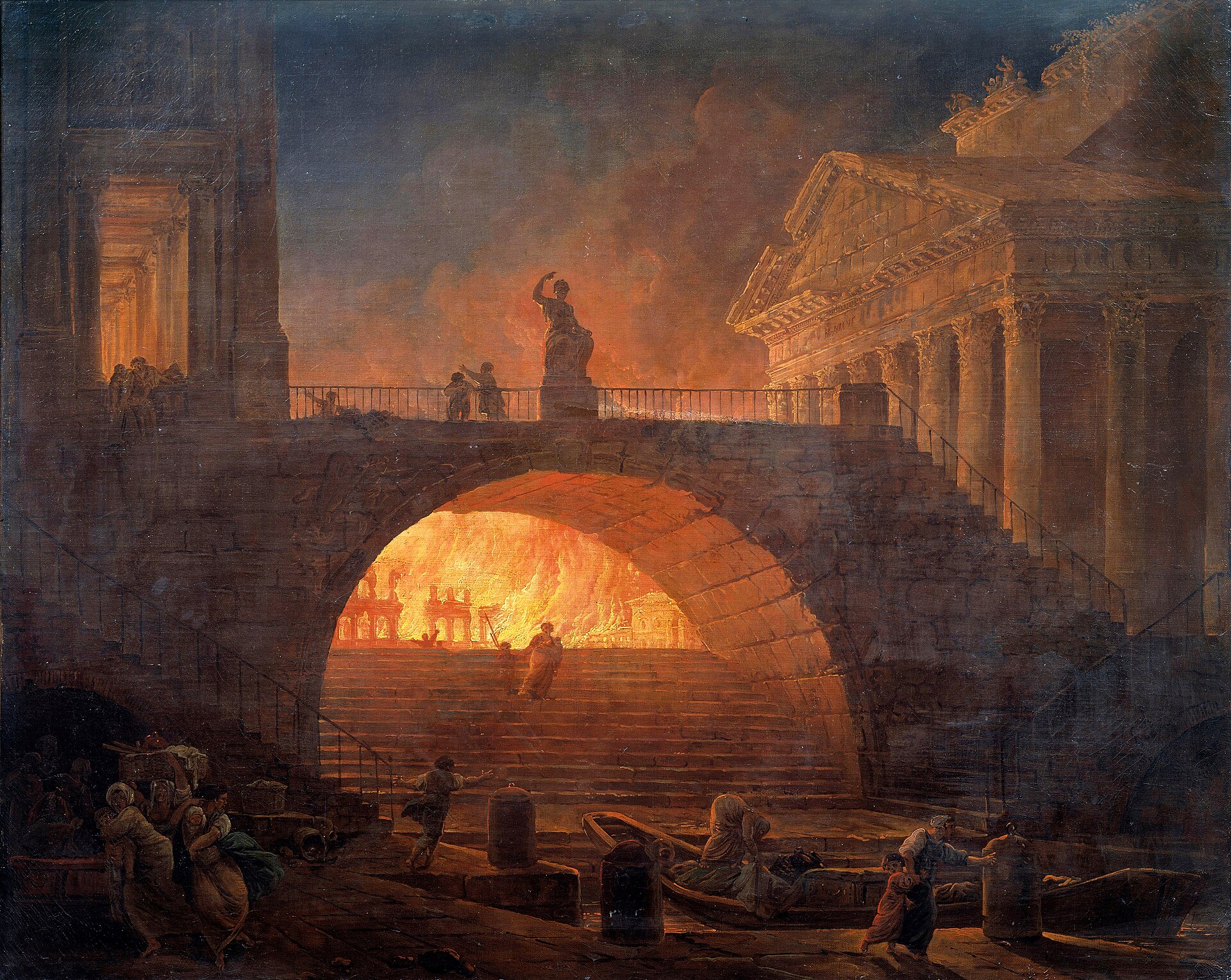
The Great Fire of Rome in AD 64 remains one of the most infamous disasters in Roman history. It destroyed large sections of the imperial capital during the reign of Emperor Nero and was followed by a reported wave of brutal executions targeting Christians. Among the most disturbing details recorded by ancient historians is the alleged use of condemned prisoners as human torches, their burning bodies illuminating nighttime spectacles in the emperor’s gardens.
This practice is sometimes called the Roman Candle in modern retellings, but the name is not an established ancient Roman term for an execution method. The better-known Roman candle firework originated from a different historical tradition. The ancient account instead describes a form of public punishment in which condemned people were crucified and burned to provide illumination.
The story is horrifying, but it also raises important historical questions. What do ancient sources actually say about Nero’s persecution of Christians? Were the executions connected to the Great Fire, and how much can historians establish about the methods used? Separating surviving evidence from later legend reveals a disturbing episode in Roman history without confusing documented events with sensationalized reconstructions.
The Great Fire of Rome in AD 64
Why Were Christians Targeted?
Tacitus describes Nero’s response in Annals 15.44. According to the historian, the emperor sought to suppress rumors about his responsibility for the fire by directing blame toward a group known as Christians.
The passage is particularly significant because Tacitus was not a Christian apologist. He belonged to the Roman political elite and viewed the movement with hostility. Nevertheless, his account portrays the punishments as excessive and suggests that the spectacle ultimately generated sympathy for the victims rather than restoring public confidence in Nero.
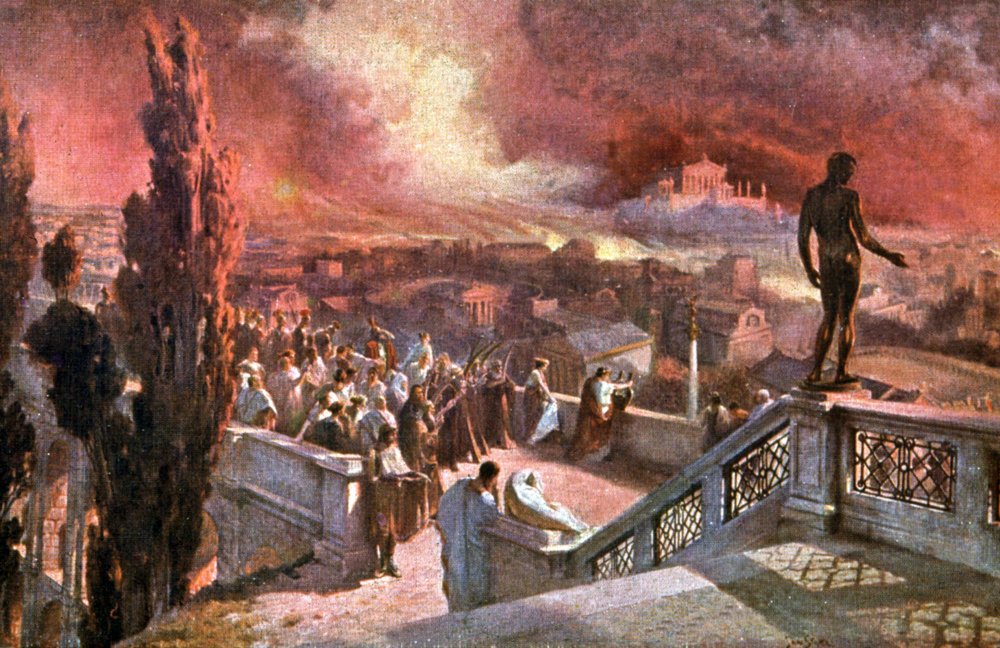
Tacitus describes the proceedings as beginning with the arrest of people who confessed, followed by further arrests based on information they supplied. He says a large number were convicted, although he does not provide a precise figure.
Importantly, Tacitus distinguishes between the accusation of arson and the grounds on which the prisoners were condemned. In his account, they were punished not so much for proven responsibility for the fire as for their perceived hostility toward humanity.
This distinction matters. The surviving evidence does not establish that the Christians executed by Nero had started the fire. Nor does it show that every person punished was formally convicted of arson.
There is also scholarly debate over the scale and character of the episode. Tacitus’s account, written decades after AD 64, is the principal surviving evidence for the alleged mass execution. Historian Brent D. Shaw has challenged the conventional interpretation of the passage as proof of a coordinated, empire-wide persecution, while other scholars consider Tacitus’s description credible evidence of punitive action against Christians in Rome.
The most defensible conclusion is that Tacitus records a specific episode of violence associated with Nero’s response to the fire, but the full circumstances cannot be reconstructed with certainty.
Crucifixion, Animal Attacks and Execution by Fire
Roman punishment varied according to an individual’s legal status, the alleged crime and the political circumstances. Crucifixion was a particularly degrading execution commonly associated with slaves, rebels and other people of lower legal standing. It was intended not merely to kill but also to humiliate the condemned and communicate the consequences of defying Roman authority.
Executions involving animals also formed part of Roman public entertainment. Condemned individuals could be exposed to wild beasts in arena spectacles, a practice often associated with damnatio ad bestias, or condemnation to the beasts.
Tacitus describes three forms of punishment inflicted on the Christians in Nero’s gardens:
-
Some were covered with animal skins and torn apart by dogs.
-
Others were nailed to crosses.
-
Still others were burned to serve as nighttime illumination.
These descriptions are the historical foundation for the modern story of Nero’s so-called human torches.
The executions were not simply a matter of choosing a method of killing. Public punishment in Rome could combine physical suffering, degradation and spectacle. By transforming condemned people into objects of entertainment, authorities could demonstrate their power while reinforcing social boundaries between those protected by Roman law and those vulnerable to its harshest penalties.
Nero’s Torches: The Historical Basis of the Roman Candle
This account supports the central claim that condemned Christians were reportedly burned as part of a nighttime display. It does not, however, provide a complete technical description of how their bodies were prepared or how the fires were maintained.
Modern retellings sometimes describe victims being coated in a flammable substance, tied to stakes and ignited at the feet to prolong their suffering. Such details should not be presented as established facts on the strength of Tacitus’s passage alone. The ancient historian describes the outcome and purpose of the executions, but does not specify this sequence of procedures.
The distinction is important because the historical evidence is already disturbing without embellishment. The reported practice involved the deliberate use of human beings as sources of light, combining execution with a spectacle designed to entertain the emperor and his guests.
Tacitus’s account also makes a striking point about the public response. Even people who considered the condemned deserving of punishment reportedly felt compassion because the executions appeared motivated by the cruelty of one man rather than the public interest.
That observation gives the episode its broader historical significance. The spectacle was intended to display imperial power, yet, according to Tacitus, it exposed the brutality of the ruler instead.
Were Saint Peter and Saint Paul Executed by Nero?
Christian tradition associates Nero’s reign with the deaths of the apostles Peter and Paul. Peter is traditionally said to have been crucified in Rome, while Paul is traditionally believed to have been beheaded.
However, their deaths cannot be securely reconstructed from Tacitus’s account of the Great Fire. He does not identify either apostle among the victims he describes, and his passage does not establish that they died during the same executions.
Later Christian traditions preserve important evidence about how early believers remembered their martyrs, but they must be distinguished from contemporary documentation. The precise dates, circumstances and relationship between the apostles’ deaths and Nero’s actions remain subjects of historical discussion.
The same caution applies to later stories about miraculous events surrounding Paul’s death. Such accounts belong to the history of Christian tradition rather than to the firmly established details of Nero’s response to the fire.
Nero’s Torches: The Painting That Immortalized the Story
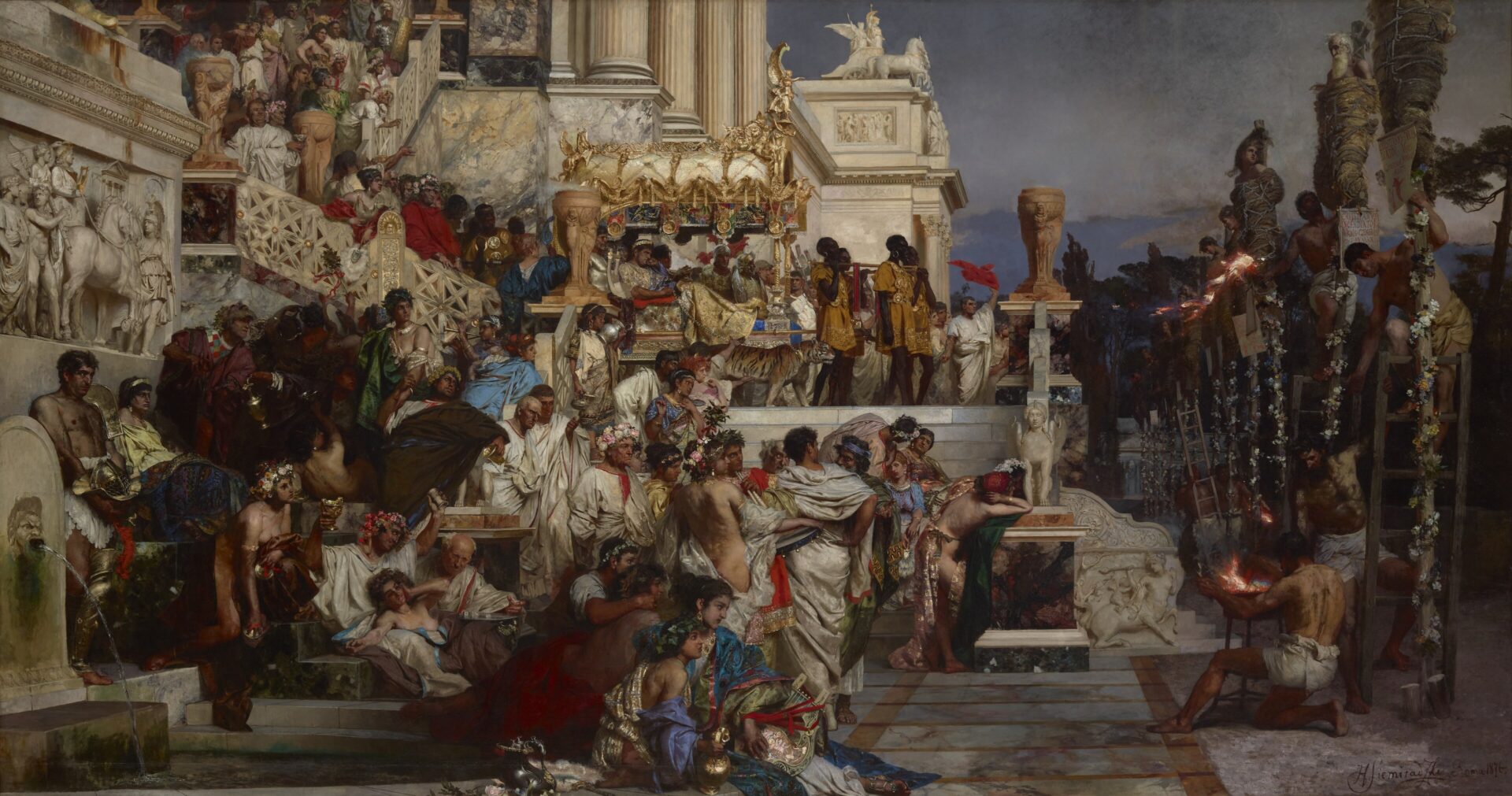
The nineteenth-century painting Nero’s Torches, completed by Polish academic painter Henryk Siemiradzki in 1876, helped cement the image of Christians being burned in Nero’s gardens in the popular imagination.
The painting depicts a dramatic scene of condemned Christians awaiting execution amid the opulence of the imperial court. Its grand architectural setting, theatrical lighting and contrast between the victims and their spectators reflect the artistic interests of the nineteenth century.
It is an artistic interpretation, not a contemporary visual record of the events of AD 64. Siemiradzki painted the scene more than 1,800 years after Nero’s reign, drawing on the literary tradition surrounding the emperor and the persecution of Christians.
Nevertheless, the painting illustrates why the story has endured. It presents the execution not simply as a method of killing, but as a collision between imperial luxury, public entertainment and extreme human suffering.
Was the Roman Candle One of History’s Worst Punishments?
The alleged burning of Christians as nighttime illumination stands among the most disturbing punishments described in ancient Roman literature. Its horror lies not only in the physical suffering involved but also in the apparent intention to turn executions into entertainment.
Yet ranking historical punishments from worst to least severe is inherently subjective. Crucifixion, exposure to wild animals, execution by fire and other forms of public killing inflicted suffering in different ways. The surviving evidence rarely allows historians to reconstruct the experience of individual victims with precision.
What can be established is that Tacitus presents Nero’s executions as exceptionally cruel and records that the spectacle provoked sympathy for the condemned. His account remains the central evidence for the story of Christians burned to illuminate the emperor’s gardens.
The historical distinction is essential: the so-called Roman Candle was not an ancient fireworks invention or a clearly documented execution technique with a standardized procedure. It is a modern name associated with Tacitus’s account of condemned Christians burned as nighttime torches.
The most disturbing aspect of the story is therefore not the nickname, but the historical report behind it: that human suffering was allegedly transformed into imperial entertainment in the aftermath of one of Rome’s greatest disasters.
