
Long before modern aircraft, satellites, and unidentified aerial phenomena (UAP) became subjects of scientific investigation, ancient Romans were recording extraordinary events in the skies above their cities. Historical accounts describe phantom fleets glowing above Italy, mysterious shields streaking across the heavens, armed armies fighting among the clouds, and strange human-like figures dressed in white appearing in distant fields.
These reports were not simply stories circulating among ordinary citizens. Some were recorded by prominent Roman historians, presented to the Senate, and incorporated into official religious proceedings. In a society where political stability and military success were closely connected to divine favor, unusual celestial events could have consequences far beyond curiosity.
Today, these accounts have attracted renewed attention from researchers interested in the possibility of unidentified flying objects in classical antiquity. Although there is no historical or scientific evidence that extraterrestrial visitors reached the Roman world, the surviving descriptions raise fascinating questions about ancient astronomy, religious beliefs, psychological phenomena, and how people interpreted unusual observations.
Hannibal’s Invasion and the First Strange Sightings
One of the earliest collections of unusual aerial reports emerged during the Second Punic War, when Rome faced its greatest military challenge against Carthage.
In 218 BC, Hannibal Barca crossed the Alps with his army and war elephants, bringing the conflict directly into Italy. Following his victory over Roman forces at the Trebia River, the Carthaginian general became a terrifying presence throughout the Italian countryside.
According to the Roman historian Livy, the winter of 218 BC brought a remarkable collection of reported prodigies, or extraordinary events interpreted as divine warnings.

Among the more unusual accounts were reports of a six-month-old infant uttering a declaration of victory in Rome’s vegetable market, an ox climbing to the upper floor of a building before jumping to its death, stones supposedly falling from the sky in Picenum, and a wolf stealing a sword from a Roman soldier in Gaul.
However, two particular reports stand out.
Livy records that a phantom fleet was seen shining in the sky. Elsewhere, in the territory of Amiternum, witnesses reportedly observed distant human-shaped figures dressed in white who never approached anyone.
These descriptions are particularly intriguing because they resemble some elements of modern unidentified aerial phenomena reports. Nevertheless, Livy does not connect the two incidents or suggest that they involved spacecraft or visitors from another world.
For the Romans, their significance was primarily religious.
Roman Prodigies and the Peace of the Gods
Understanding these sightings requires understanding the Roman concept of prodigia.
A prodigy was not necessarily something physically impossible. Lightning striking a temple, an unusual animal birth, a plague, or an unexpected celestial event could all be interpreted as signs that the established relationship between Rome and its gods had been disturbed.
This relationship was known as the pax deorum, or peace of the gods.
Roman religious practice operated on the principle that maintaining the correct rituals, sacrifices, and ceremonies helped preserve divine favor and protect the community. An extraordinary event could therefore indicate that this relationship was threatened.
The response was institutional rather than simply spontaneous superstition.
Reports could be presented to the Senate, witnesses questioned, and religious authorities consulted before appropriate ceremonies were prescribed.
During the crisis of 218 BC, Rome consulted the Sibylline Books, a collection of prophetic texts traditionally associated with the Sibyl of Cumae.
According to the traditional account, an elderly woman offered nine prophetic books to Rome’s last king, Tarquinius Superbus. After he refused her initial price, she burned three books and offered the remaining six for the same amount. When he refused again, she destroyed another three, leaving the king to purchase the final three at the original price.
These texts subsequently became an important religious authority in Rome.
Following consultation during the crisis of 218 BC, the Romans organized purification ceremonies, religious observances, and offerings. Livy records that 40 pounds of gold were dedicated to Juno at Lanuvium, while married Roman women dedicated a bronze statue to the goddess on the Aventine Hill. A nine-day religious observance was also prescribed in response to the reported showers of stones at Picenum.
The ceremonies addressed the collection of prodigies as a whole rather than the mysterious aerial sightings alone.
Flying Shields, Phantom Moons, and the Battle of Lake Trasimene
The reports continued into 217 BC, when Hannibal remained a serious threat to the Roman Republic.
According to Livy, witnesses at Arpi reported seeing shields in the sky. Other accounts described the sun appearing to fight the moon, two moons visible during daylight, and the heavens seemingly opening with blazing light pouring through the gap.
Rome responded with additional religious ceremonies and offerings. These included silver dedicated to Juno and Minerva and a golden thunderbolt weighing 50 pounds offered to Jupiter.
However, not everyone accepted the religious interpretations.
One of Rome’s consuls, Gaius Flaminius, was particularly associated with political opposition to the traditional senatorial establishment. Livy portrays him as dismissive of certain religious warnings, including reports of unusual omens and difficulties involving military standards.
The following June, Hannibal ambushed the Roman army near Lake Trasimene. Using the surrounding hills and morning fog to conceal his forces, the Carthaginian commander trapped the advancing Romans along the narrow lakeside route.
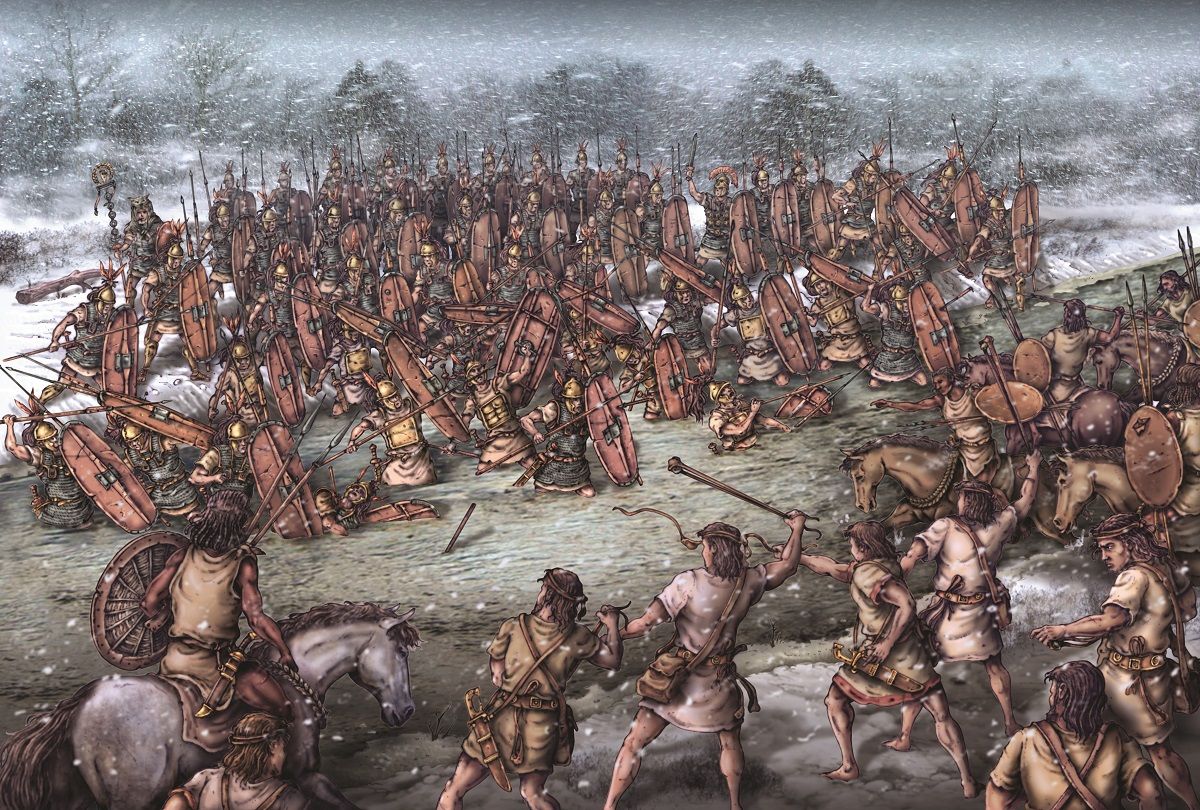
The resulting battle was disastrous. Approximately 15,000 Roman soldiers were killed, and Flaminius died during the engagement.
Livy’s narrative connects the consul’s disregard for religious warnings with the subsequent catastrophe. This should be understood as part of the historian’s moral and religious interpretation rather than evidence that the reported phenomena predicted the military defeat.
Nevertheless, the episode illustrates how seriously Roman society could treat unusual events in the heavens during periods of national insecurity.
An Altar in the Clouds and Armies Fighting in the Sky
In 214 BC, another extraordinary report emerged from Hadria on Italy’s Adriatic coast.
According to Livy, witnesses described an altar appearing in the sky, surrounded by figures dressed in white.
The description is particularly interesting because it combines an identifiable religious structure with apparently human figures. Modern interpretations sometimes compare it to an aerial platform carrying occupants, but the surviving account does not describe a vehicle, its movements, or any interaction with the observers.
Livy also records another revealing incident from the same period.
An alarm spread through Rome after reports claimed that armed soldiers had appeared on the Janiculum Hill, across the Tiber. However, people actually present on the hill reportedly saw no invading army, only ordinary workers tending gardens.
Livy’s inclusion of contradictory testimony is important. It demonstrates that ancient writers could recognize how fear, rumor, and collective expectation influenced reports of extraordinary events.
Other sightings continued during the following decades. In 173 BC, a great fleet was reportedly observed in the sky above Lanuvium. In 154 BC, weapons were said to have appeared flying through the air at Compsa.
By 104 BC, during the period of Roman anxiety following the invasion of the Cimbri and Teutones, another remarkable account emerged.
The writer Julius Obsequens records an apparition of two armies fighting in the heavens. One reportedly approached from the east and the other from the west, with the western army ultimately defeated.
The Roman response included offerings to Ceres and Proserpina, accompanied by a procession involving 27 young women.
For a population already fearful of invasion, an apparent celestial battle could easily acquire enormous religious and political significance.
How Reliable Are the Ancient Roman UFO Accounts?
Despite their fascinating descriptions, these reports present considerable historical difficulties.
Livy, the principal source for many of the incidents during the Second Punic War, was not an eyewitness. Writing during the reign of Augustus, approximately two centuries after the events, he relied on earlier historical accounts and records that have largely disappeared.
His enormous history of Rome originally comprised 142 books, but only a portion survives.
The accounts of the aerial phenomena around 104 BC present an even greater challenge. The relevant portion of Livy’s history is lost, and much of the information survives through Julius Obsequens, who compiled a chronological collection of Roman prodigies centuries later.
Consequently, historians must distinguish between the date of an alleged sighting and the date of the surviving written account.
There are also inconsistencies between similar descriptions. Pliny the Elder, for example, describes a burning shield crossing the sky around sunset in 86 BC, traveling from west to east and scattering sparks. Obsequens records a similar shield-shaped object under 100 BC, but with its direction reversed.
Whether these were separate events or the result of chronological confusion cannot be established confidently.
Pliny provides another particularly unusual account involving a Roman governor named Silanus. A luminous object reportedly descended from the heavens, increased in apparent size until it resembled the moon, and eventually returned upward in the shape of a torch.
Although the description is striking, the absence of information about distance, actual dimensions, and atmospheric conditions makes a scientific identification impossible.
Julius Caesar’s Comet: When a Celestial Event Became Political Power
One of the most consequential celestial events in Roman history occurred in 44 BC, following the assassination of Julius Caesar.
During public games organized in Caesar’s honor by his adopted heir Octavian, a brilliant comet reportedly appeared and remained visible for approximately seven days.
The Romans called it Sidus Iulium, or the Julian Star.
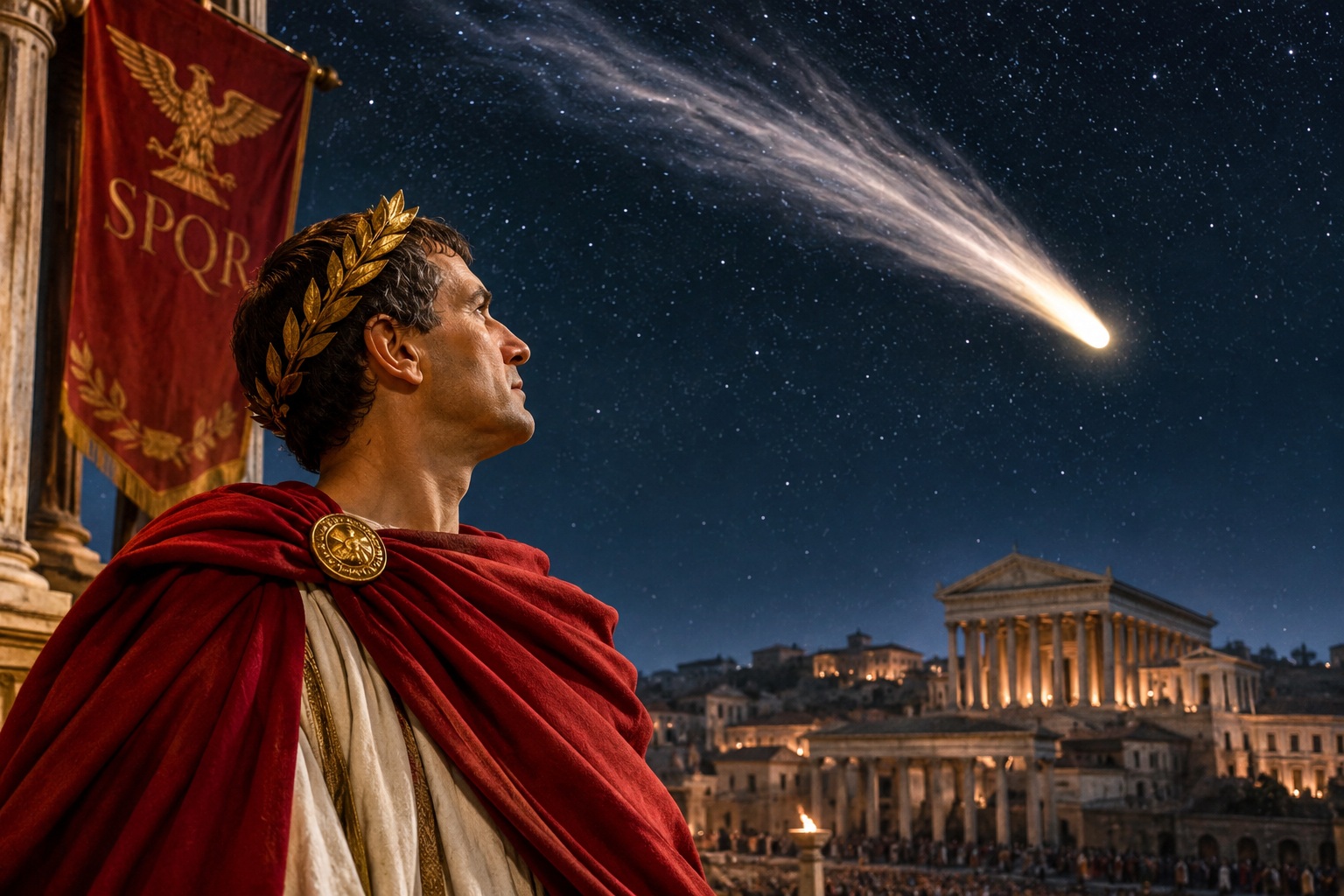
Many interpreted the phenomenon as evidence that Caesar’s soul had ascended into the heavens and joined the gods. Octavian recognized the political significance of this interpretation and incorporated the celestial symbol into the emerging cult of the deified Julius Caesar.
A star appeared on Caesar’s statues, while coins celebrated his divine status.
The event was more than an astronomical curiosity. It helped establish the religious legitimacy of Caesar’s deification and strengthened Octavian’s political position.
Ancient Chinese astronomical records also describe a comet in 44 BC, providing independent evidence that a celestial phenomenon occurred during that year.
Under Augustus, the interpretation and administration of religious signs became increasingly connected to imperial authority.
After becoming Pontifex Maximus in 12 BC, Augustus reportedly ordered more than 2,000 prophetic texts collected and examined, with many destroyed. The approved Sibylline verses were preserved under official supervision in the Temple of Apollo on the Palatine Hill.
Although traditional religious institutions continued to function, the imperial government increasingly controlled the interpretation of religious authority.
The sky had become an important instrument of political communication.
The Destruction of Jerusalem and Josephus’s Celestial Omens
The most dramatic collection of unusual aerial reports appears in the writings of Flavius Josephus, particularly his account of the Jewish revolt against Rome.
The conflict began in 66 AD and culminated in the Roman destruction of Jerusalem in 70 AD under the command of Titus.
Josephus, who had initially commanded Jewish forces before surrendering to the Romans, later became an eyewitness to the campaign from the Roman side.
In The Jewish War, he describes several extraordinary signs that allegedly preceded the catastrophe.
These included a star resembling a sword appearing over the city, a comet reportedly visible for an entire year, and a massive bronze temple gate opening by itself during the night.
Perhaps the most extraordinary description concerns a celestial procession.
Josephus reports that, before sunset on the twenty-first day of the month Artemisius, chariots and armed troops were seen racing through the clouds surrounding the cities.
He acknowledges that the account might sound unbelievable, but argues that it had been reported by witnesses and should not simply be dismissed.
Importantly, Josephus does not claim to have personally witnessed the phenomenon.
He also explains that people interpreted these events differently. Some considered them favorable signs, while others believed they foretold disaster.
Josephus connected an ancient oracle promising that someone from the region would eventually rule the world with the rise of Vespasian, who became emperor in 69 AD.
The same reported celestial events could therefore support entirely different political and religious interpretations.
Richard Stothers and the Scientific Examination of Ancient UFO Reports
Modern interest in these historical accounts received renewed attention in 2007, when astrophysicist Richard Stothers of NASA’s Goddard Institute for Space Studies published a research paper titled Unidentified Flying Objects in Classical Antiquity.
The study examined unusual aerial observations recorded in ancient Greek and Roman literature.
Stothers approached the accounts by considering whether conventional explanations could account for the reported phenomena. Meteors, comets, atmospheric effects, and other recognizable astronomical events offered possible explanations for numerous descriptions.
However, some reports remained difficult to classify.
His work considered whether a small number of surviving accounts could be categorized as unidentified flying objects in the broad observational sense.
This distinction is essential.
Stothers did not establish that ancient Rome was visited by extraterrestrial spacecraft, nor did his research represent an official NASA conclusion that aliens had visited Earth.
Rather, his study examined historical descriptions that lacked sufficiently convincing explanations.
The terminology also presents a significant problem. A Roman witness describing a shield-shaped object was using a familiar visual comparison. Translating that description into a modern flying saucer introduces an interpretation that the original source does not necessarily support.
Likewise, figures dressed in white are not automatically extraterrestrial occupants, and armies fighting in the clouds do not necessarily represent aerial combat between advanced civilizations.
The surviving texts describe what ancient observers believed they saw, not the physical nature of the objects themselves.
Ancient Rome’s Sky-Watching Culture and the Psychology of Unusual Sightings
Another important consideration is the relationship between ancient society and the natural environment.
Unlike modern urban populations surrounded by artificial lighting, aircraft, and electronic distractions, ancient Romans experienced much darker night skies.
Celestial observation was closely connected to agriculture, navigation, religious ceremonies, and the organization of time.
The appearance of comets, meteors, unusual atmospheric lights, and other astronomical phenomena could therefore attract considerable attention.
However, greater familiarity with the night sky did not necessarily guarantee accurate identification.
Religious expectations, military anxiety, rumors, and collective fear could influence how unusual events were understood and reported.
Livy’s account of the supposed armed forces on the Janiculum is particularly revealing because it preserves both the initial alarm and the contradictory testimony of people who claimed that no soldiers were present.
This illustrates an important historical distinction: a report can be genuine evidence of what people believed they witnessed without necessarily proving that the described event occurred exactly as recorded.
The same principle applies to modern unidentified aerial phenomena investigations.
Governments can collect witness statements, investigate unusual observations, and examine unexplained evidence without establishing an extraterrestrial explanation.
Did Ancient Rome Really Experience UFO Sightings?
The Roman accounts of mysterious objects in the sky remain fascinating precisely because they occupy the uncertain territory between historical documentation, religious interpretation, and unexplained observation.
The phantom fleets of 218 BC, the aerial altar of 214 BC, the celestial armies of 104 BC, and Josephus’s description of armed chariots moving through the clouds demonstrate how frequently unusual celestial events appeared in ancient historical literature.
Yet the surviving evidence has significant limitations. Many reports were written down long after the alleged events, some survive only through later compilations, and the descriptions rarely contain the observational details required for modern scientific investigation.
Richard Stothers’s research provides a useful framework for examining these accounts, but it does not establish an extraterrestrial explanation.
Perhaps the most important historical insight is that the Romans did not simply look upward and wonder what they were seeing. They attempted to understand what unusual events meant for their society, their gods, their political leadership, and their survival.
Under the Republic, celestial prodigies could trigger Senate investigations and elaborate religious ceremonies. Under Augustus, celestial phenomena became increasingly useful in communicating imperial legitimacy. During the Jewish revolt, Josephus interpreted extraordinary signs through the lens of political and religious catastrophe.
Whether these ancient observers witnessed unusual atmospheric phenomena, astronomical events, misidentified objects, or something that remains impossible to determine, their accounts have survived for nearly two millennia.
They offer a remarkable reminder that humanity’s fascination with unexplained objects in the sky is far older than modern aviation, space exploration, or the UFO phenomenon.
Ancient Rome may never surrender the secrets behind its mysterious celestial sightings, but its historical records preserve one enduring question: when people look toward the heavens and see something they cannot explain, how much of what they report belongs to the sky, and how much belongs to the world below?
Source: Camp Gagnon
