
The Roman army of the late Republic produced commanders whose names became inseparable from its greatest campaigns, but its battlefield success depended just as heavily on men whose careers rarely survived in the historical record. Among them was Cassius Scaeva, a centurion who served under Julius Caesar and became famous for an extraordinary stand during the civil war against Pompey.
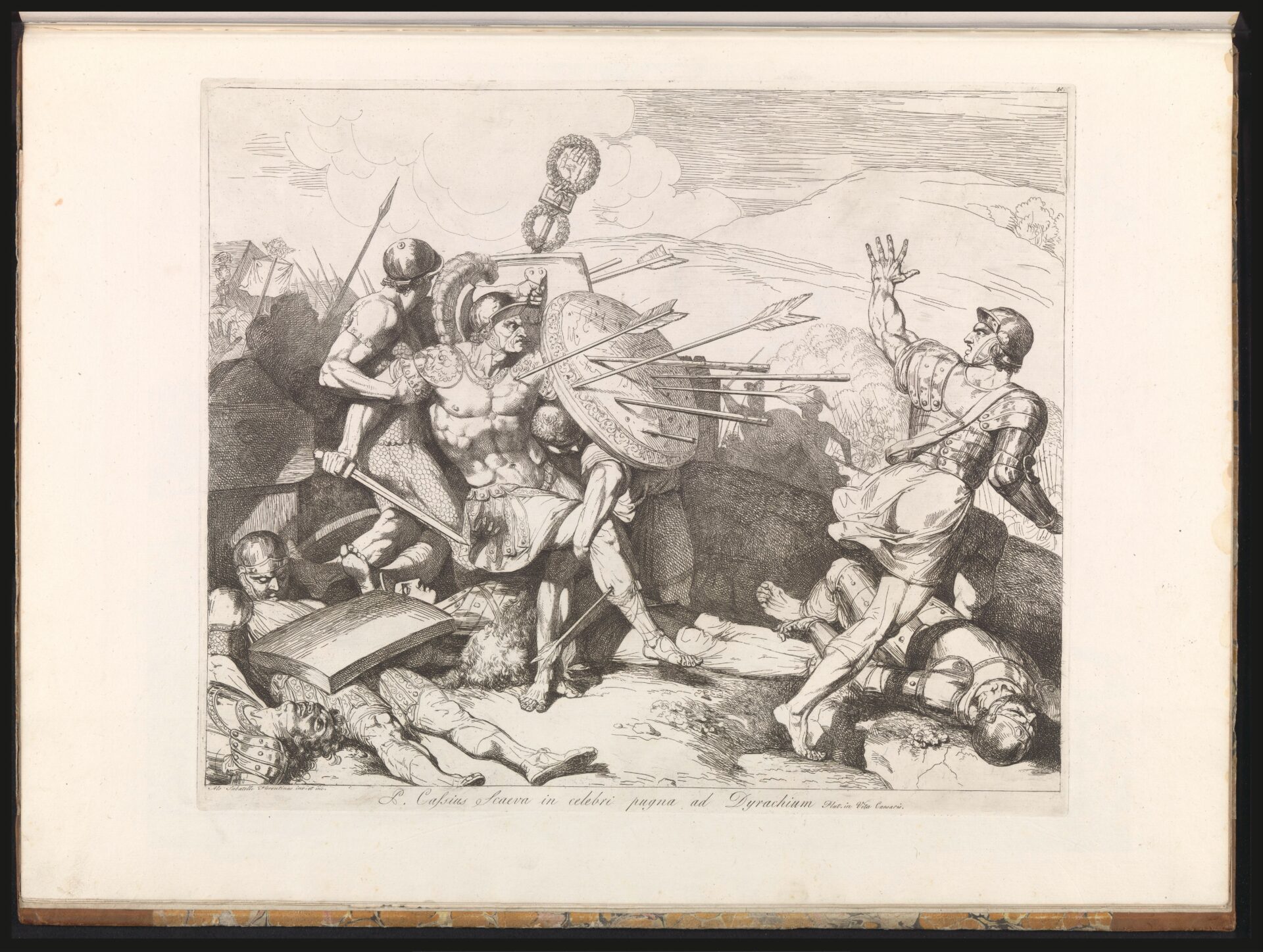
Scaeva’s story is preserved primarily in Caesar’s Civil War, with additional details supplied by Plutarch and other ancient authors. Some later retellings have embellished or conflated episodes in his career, but the core event is exceptionally well documented: at Dyrrachium in 48 BC, Scaeva helped hold a fortified position under an intense Pompeian assault despite suffering catastrophic wounds. Caesar subsequently rewarded him with a substantial monetary prize and promotion to primus pilus, the senior centurion of a legion.
The Centurions of Caesar’s Army
Centurions occupied a critical position within the Roman military hierarchy. They were professional soldiers responsible for discipline, training and battlefield leadership, commanding units of roughly a century of legionaries, although the actual strength of a centuria varied considerably.
Their importance went beyond administration. A centurion was expected to fight where the pressure was greatest and maintain cohesion when formations began to break down. Caesar’s armies operated over enormous distances and under conditions that demanded precisely this kind of leadership. The centurion was therefore an essential link between the senior commanders and the ordinary legionary.
Scaeva’s career is particularly revealing because his fame did not originate from a grand command or political position. It came from personal conduct under extreme battlefield pressure.
The Gallic Wars and the British Campaign
The precise chronology of Scaeva’s early career is uncertain. Later sources associate him with Caesar’s campaigns and describe an episode in Britain in which an ordinary Roman soldier fought to rescue Roman officers who had become trapped in difficult terrain.
Plutarch recounts that during Caesar’s British campaign, a private soldier entered the fighting to protect endangered officers. He drove back the Britons and helped save them, but lost his shield while withdrawing through mud and water. Caesar reportedly embraced him rather than punishing him for abandoning his equipment.
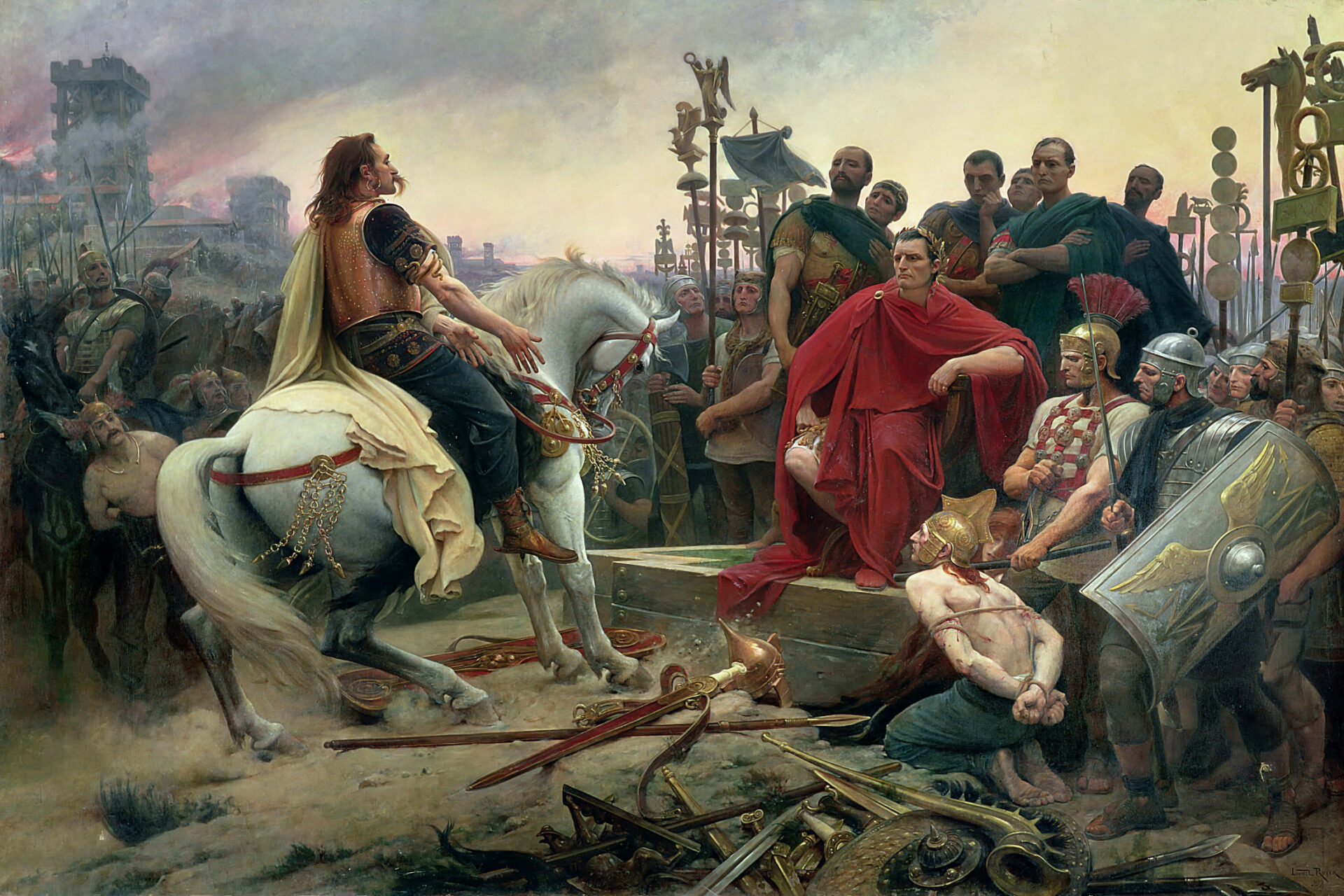
This episode is sometimes identified specifically with Scaeva, but the identification is not secure. Plutarch does not name the soldier in that passage. Consequently, it is historically safer to treat the British incident as evidence for the type of battlefield courage Caesar celebrated among his soldiers rather than as a firmly established episode in Scaeva’s personal biography.
That distinction matters. Scaeva’s documented reputation rests primarily on the events at Dyrrachium.
The Civil War Against Pompey
By 48 BC, Caesar and Pompey had become the principal military leaders of opposing factions in the Roman civil war. After Caesar crossed into Greece, the two armies eventually confronted one another around Dyrrachium on the Adriatic coast.
The campaign was dominated by fortified positions rather than a single conventional pitched battle. Caesar constructed an extensive system of fortifications designed to contain Pompey’s army and restrict its access to supplies, while Pompey constructed counterworks to isolate Caesar’s troops.
This created a brutal war of attrition. Forts, trenches, walls and redoubts became the decisive points of combat.
Pompey eventually launched coordinated attacks against Caesar’s defensive line. One of the positions came under particularly severe pressure. Caesar records that the defenders endured a sustained assault in which approximately 30,000 arrows were fired into the fortification. Every man in the position was wounded, while four centurions from one cohort lost an eye.
Among those defenders was Scaeva.
Scaeva at the Redoubt
The surviving accounts differ in some numerical details, but they agree on the essential sequence.
Plutarch describes Scaeva being struck in the eye by an arrow, pierced in the shoulder by a javelin and wounded in the thigh by another projectile. His shield absorbed an extraordinary number of missile strikes. Plutarch gives 130, while Caesar’s own account records 120 holes in the shield presented to him afterward.
The discrepancy is a reminder that ancient battle narratives should not be treated as modern after-action reports. The exact number cannot be established with certainty. What is beyond dispute is that Caesar considered the damage to Scaeva’s shield sufficiently remarkable to record it in his own account.
Scaeva’s wounds were severe enough to make continued resistance appear impossible. Yet the centurion did not simply abandon the position.
According to Plutarch, he called to the opposing soldiers and appeared prepared to surrender. Two Pompeian soldiers approached him, apparently believing that the wounded centurion was about to give himself up. Instead, Scaeva attacked them. He struck one severely and wounded the other before being assisted by his comrades.
The episode illustrates an important feature of Roman close combat. Individual physical courage mattered, but its military value came from its effect on collective morale. A centurion who refused to yield under circumstances that should have made resistance impossible could reinforce the determination of the soldiers around him.
Caesar’s Own Account
The most important testimony comes from Julius Caesar himself.
Writing about the fighting at Dyrrachium, Caesar states that approximately 30,000 arrows had been fired into the fort. He specifically identifies Scaeva’s shield, noting that it contained 120 holes. He then explains that Caesar rewarded Scaeva with 200,000 sesterces and promoted him from the centurionate of the eighth cohort to primus pilus, the chief centurion of the legion. Caesar explicitly attributes much of the fort’s survival to Scaeva’s efforts.
This is substantially different from the popular claim that Scaeva received 50,000 denarii. The surviving text of Caesar gives 200,000 sesterces, and that is the figure that should be used in a historically rigorous account.
Caesar also rewarded the surviving cohort with enhanced compensation, including double pay, grain, clothing and military decorations. The distinction is significant: Scaeva’s conduct was not treated merely as an act of individual heroism. Caesar used the event to recognize the collective performance of the unit.
Primus Pilus: The Summit of the Centurion’s Career
Scaeva’s promotion was particularly significant because primus pilus was the senior centurionate within a legion.
The primus pilus, literally the “first spear,” occupied the first position among the legion’s centurions and was a highly prestigious post. For a career soldier who had risen through the centurionate, reaching this rank represented the pinnacle of advancement within the ordinary legionary command structure.
Caesar’s wording makes the reason for Scaeva’s promotion clear: his actions were regarded as instrumental in preserving the fort.
This also demonstrates how the Roman military hierarchy could reward battlefield performance. Although social background and patronage remained important throughout the Roman Republic, demonstrated military ability could elevate a soldier into positions of considerable authority and status.
Heroism and Historical Memory
Scaeva’s story became increasingly elaborate as later authors retold it.
Plutarch preserved the dramatic image of the wounded centurion pretending to surrender before attacking the men who approached him. Caesar’s account is more restrained, concentrating on the measurable evidence of the battle: the thousands of missiles fired into the fort and the extraordinary damage inflicted on Scaeva’s shield.
Other ancient writers added further details, contributing to a tradition in which Scaeva became almost a literary archetype of Roman military courage. This development should be recognized when reconstructing his career. The basic event is historical, but not every detail repeated in later retellings has equal evidentiary value.
The strongest evidence remains Caesar’s own account of Dyrrachium.
What Happened to Scaeva?
Scaeva apparently continued his military career after Dyrrachium. Evidence from later sources and inscriptions has encouraged historians to identify him with a primus pilus of Legio XII and possibly with the individual associated with an auxiliary cavalry unit known as the ala Scaevae. An inscription from Minturnae, dated approximately to the late Republic or early Augustan period, attests the existence of this unit.
However, the identification should be presented cautiously. The inscription does not independently establish that the unit was named for Caesar’s famous centurion. Some scholars have accepted the connection, while others have emphasized that the identification ultimately rests on the common name Scaeva and the chronology.
There is nevertheless evidence pointing toward a continuing military career and a rise in status after Dyrrachium. If the identification is correct, Scaeva’s trajectory illustrates the extraordinary mobility that exceptional military service could sometimes produce during the turbulent transition from Republic to Empire.
The Significance of Cassius Scaeva
Scaeva’s importance lies not simply in the violence of his wounds or the dramatic image of a shield pierced by dozens of missiles. His career illustrates how Caesar’s military system functioned at its most effective level.
Roman victories were not produced solely by brilliant generals. They depended on thousands of soldiers maintaining formation, obeying orders and continuing to fight after plans had collapsed into confusion. Centurions were critical to that process. They embodied the discipline expected from the rank and file while simultaneously exercising authority over them.
At Dyrrachium, Scaeva became an extreme example of that principle.
The position he defended was only one component of a much larger fortified battlefront. Yet the survival of individual positions mattered because Caesar’s defensive system depended on maintaining cohesion across its length. A local collapse could expose adjacent positions and allow an enemy breakthrough.
Scaeva therefore represented something larger than personal bravery. His resistance helped preserve a military position at a moment when Caesar’s army was under intense pressure.
His reward reflects how Caesar understood this. Scaeva received money, public recognition and promotion to primus pilus. His cohort received additional pay, supplies and honors. Caesar transformed one episode of battlefield endurance into a demonstration of the standards expected from his army.
Marcus Cassius Scaeva was not a Caesar, Pompey or Hannibal. He left no political legacy and commanded no great army. His historical significance is precisely that he was a professional soldier whose reputation was earned at the lowest tactical level of warfare—behind a shield, inside a fortification and under a storm of enemy missiles.
At Dyrrachium, that was enough to make his name endure.
