
In the final decades of the first century AD, few figures in Rome could command the attention of a crowd like Scorpus. Born around AD 68 and dead by about AD 95, he spent barely three decades alive, yet his name became permanently associated with the spectacular and dangerous world of Roman chariot racing. According to the surviving tradition, Scorpus accumulated 2,048 victories, an extraordinary record that made him one of the most celebrated charioteers of the imperial age.
His story was remarkable for another reason. Scorpus was reportedly born in Hispania and entered the profession as a slave. Through exceptional success on the track, he accumulated wealth, fame and eventually purchased his freedom. He became a libertus, a freedman, but his social status remained complicated: Roman society could adore a successful performer while still treating professional entertainers as socially inferior.
His career and sudden death were memorialized by the poet Martial, who wrote two poignant epigrams about him in Book X of the Epigrams. Those poems provide the most important literary evidence for Scorpus and preserve the memory of a sports celebrity whose fame survived long after his death.
Rome’s Most Dangerous Sport
Chariot racing occupied a unique position in Roman popular culture. Unlike gladiatorial contests, which were usually staged on particular festival days, races could be presented frequently and attracted enormous audiences. The Circus Maximus was the principal venue in Rome, and its immense seating capacity made it one of the greatest public gathering places of the ancient world.
The races were organized around four principal factions, identified by colors: the Greens, Blues, Reds and Whites. These were not simply sporting teams in the modern sense. The factions were large commercial organizations responsible for horses, drivers, training, equipment and the practical business of staging races.
Scorpus became associated with the Green faction, one of the most powerful and successful racing organizations of the imperial period. His success transformed him from an anonymous driver into a celebrity whose name could be recognized by spectators throughout Rome.
The attraction was not simply speed. A typical major race involved multiple teams competing over several laps around the circus. Drivers had to control teams of horses while negotiating the metae, the turning posts at either end of the central barrier, or spina. These turns were among the most dangerous moments of a race.
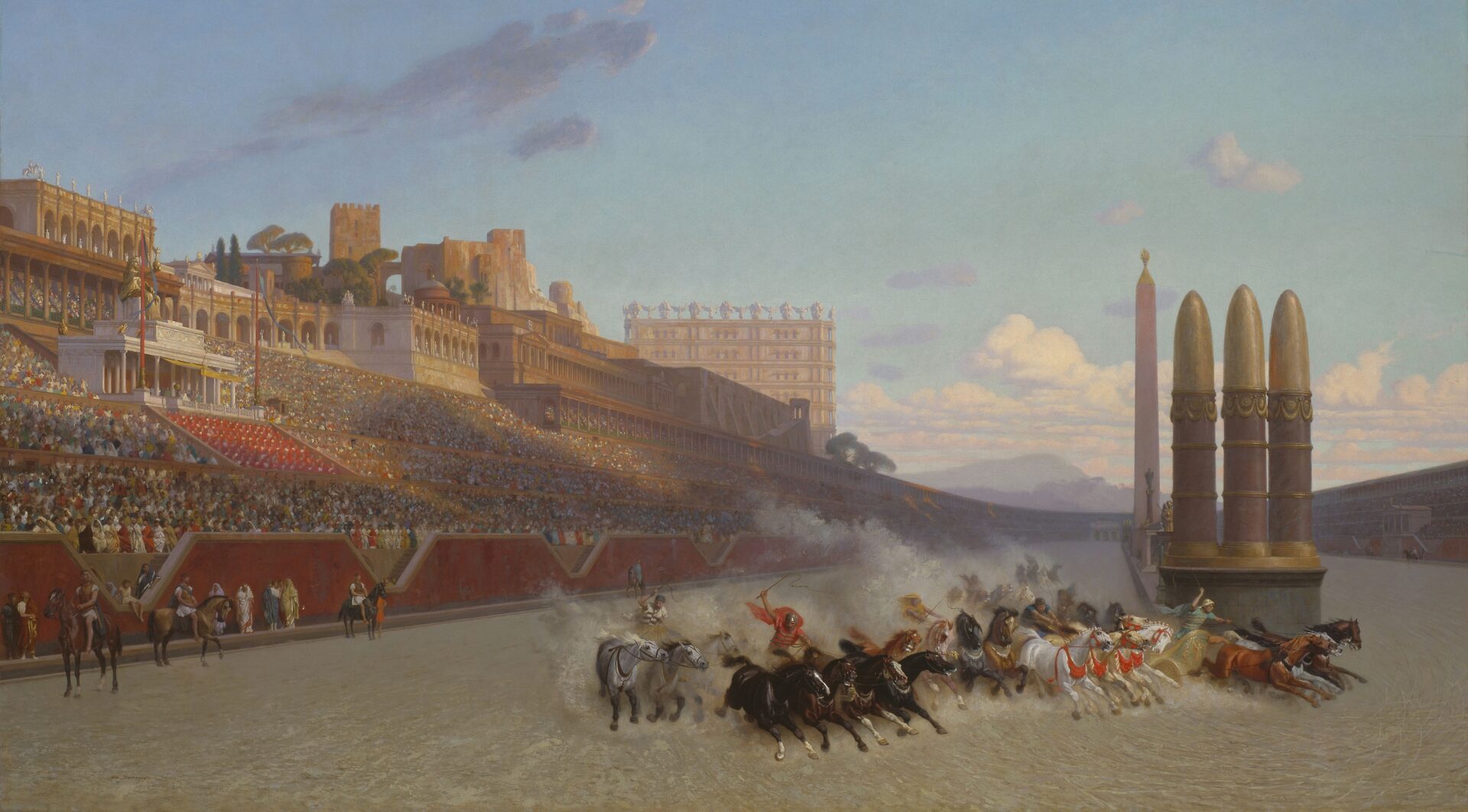
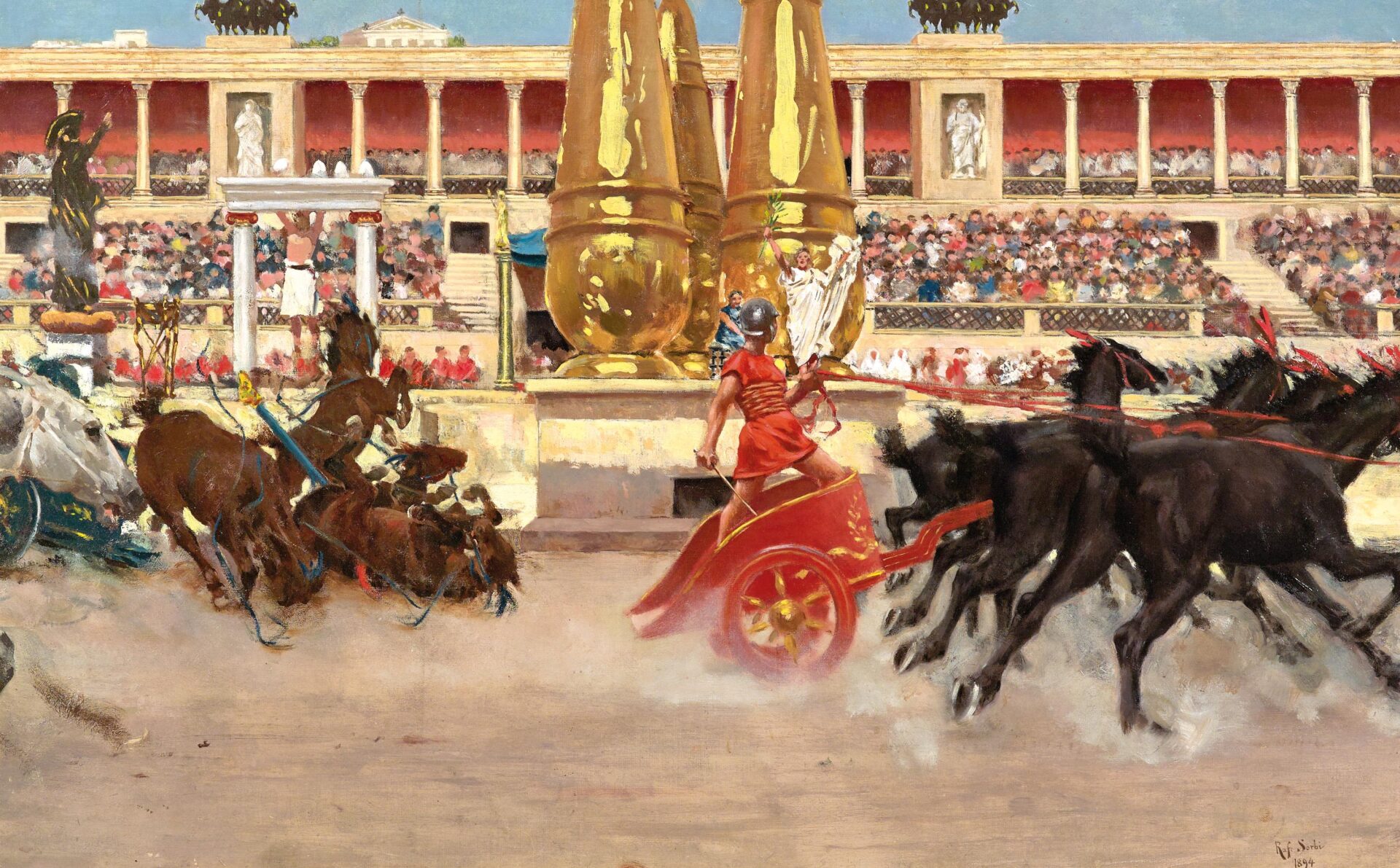
Roman charioteers commonly drove four-horse teams, known as quadrigae. The arrangement created tremendous demands on the driver. The reins had to be managed while the charioteer maintained control of the horses at speed, particularly through the tight turns. Ancient depictions and literary evidence make clear that crashes were an integral danger of the sport.
The Romans themselves called major wrecks naufragia—literally, “shipwrecks.” The metaphor was appropriate. A failed turn could send a chariot overturning into the track, potentially bringing horses, drivers and following competitors into the wreckage.
From Slave to Celebrity
Scorpus’ rise was especially significant because he began at the bottom of Roman society.
Slavery was deeply integrated into the Roman economy, and chariot racing offered some enslaved people an unusual route toward wealth and eventual freedom. A successful driver could generate enormous revenues for his owner and racing faction, giving the owner a powerful financial incentive to cultivate his talent.
Scorpus appears to have been one of those exceptional performers.
His victories brought prizes and gifts, while his popularity gave him an earning power far beyond that of an ordinary laborer. Martial had already identified him as a figure of extraordinary financial value. In Epigrams 5.67, the poet complains about the enormous sums associated with Scorpus and another charioteer, Thallus, illustrating how financially significant star drivers could become.
Eventually, Scorpus secured his freedom. In Roman society, manumission transformed a slave into a freed person, or libertus, although it did not erase every distinction between freedmen and freeborn citizens.
For Scorpus, however, freedom represented a remarkable transformation. A man who had begun his life as property had become one of Rome’s most recognizable sporting personalities.
2,048 Victories
The figure traditionally associated with Scorpus is 2,048 victories. That number is extraordinary even when placed beside the careers of other documented Roman charioteers.
A useful comparison comes from the second-century driver Gaius Appuleius Diocles, whose surviving inscription records 4,257 starts and 1,462 victories during a career lasting 24 years.
Scorpus supposedly accumulated his 2,048 victories by only about the age of 27.
That achievement explains the central joke in Martial’s most famous tribute to him: even Fate supposedly mistook Scorpus for an old man because of the number of victories he had accumulated.
His success also demonstrates how frequently elite charioteers could compete. Racing was not an occasional pursuit for professionals such as Scorpus. A successful driver could spend much of his life repeatedly entering races, each one carrying the possibility of both enormous financial reward and catastrophic injury.
Martial’s Tribute to Scorpus
The most authoritative surviving portrait of Scorpus comes from Martial, who was writing in Rome during the period immediately following the charioteer’s death.
In Epigrams 10.50, Martial turns Scorpus’ racing career into a metaphor for the brevity of human life. He contrasts the driver’s ability to reach the finish of a race with the shocking speed with which Scorpus himself reached the end of life.
The poem then invokes Lachesis, one of the three Fates responsible for determining the course of human life. Martial’s conceit is that Lachesis counted Scorpus’ victories rather than his years and therefore assumed that he was an old man.
The Latin original identifies his death through the phrase trieteride nona, literally referring to a ninth period of three years. This has traditionally been understood as indicating that Scorpus died at approximately 27. Some English translations render the expression as his “twenty-sixth year,” reflecting differences in Roman age-counting and translation, but the conventional modern dating places his death around age 27.
The Final Race
The precise circumstances of Scorpus’ death remain unknown.
There is no surviving ancient account that explicitly states that he died in a particular crash. It is therefore more accurate to say that a racing accident is a plausible possibility rather than an established fact.
The danger was unquestionably real. Charioteers could be thrown from their vehicles, trampled by horses or dragged along the track. Because drivers sometimes wrapped or secured the reins around their bodies to improve control, a wreck could become especially lethal if the driver could not free himself quickly.
The turning posts were particularly hazardous. A driver attempting to take the shortest possible line could gain a decisive advantage, but a mistake could result in a catastrophic collision.
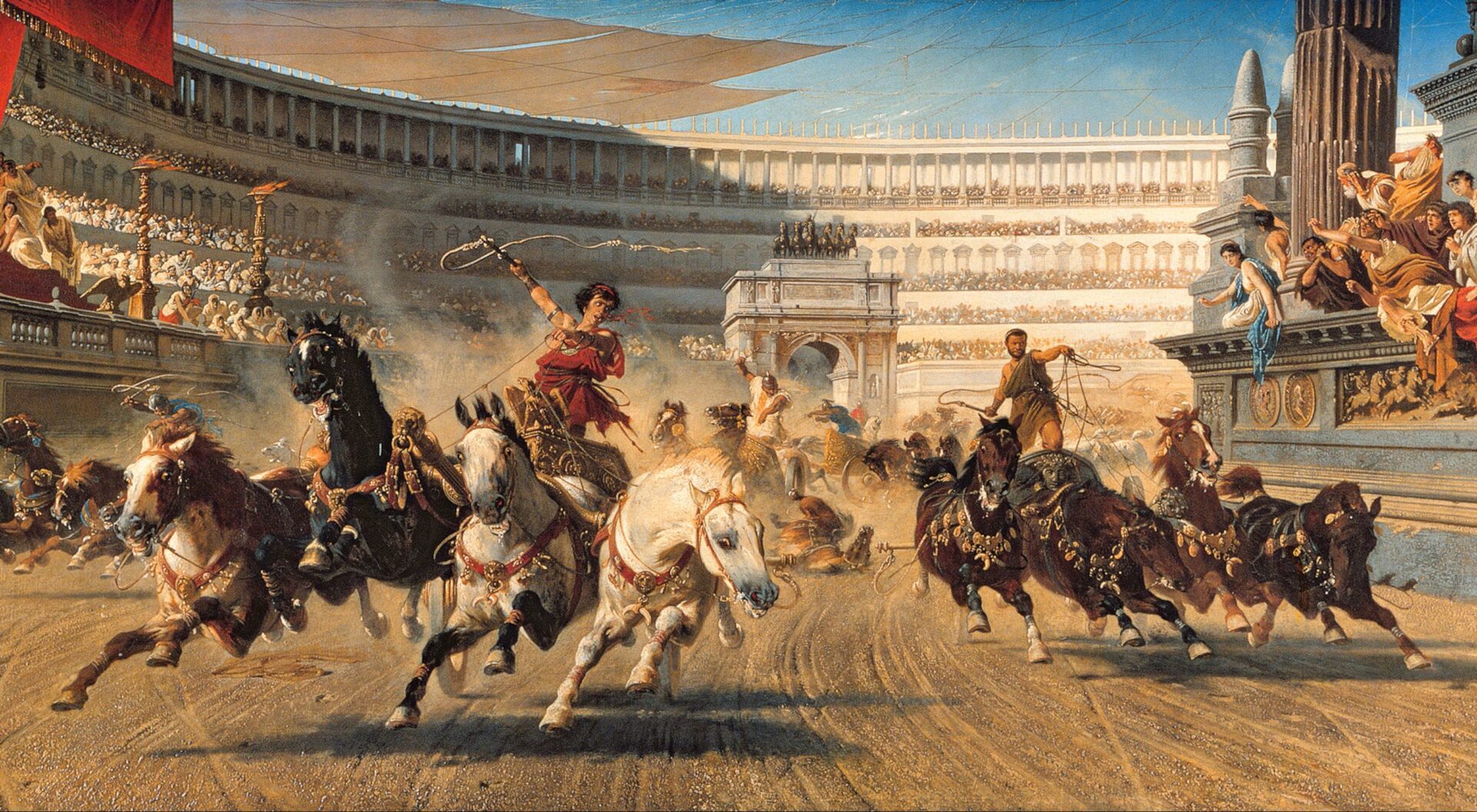
Martial’s language strongly emphasizes the tragedy of Scorpus’ premature death, but it does not identify the mechanism. Consequently, later reconstructions that depict Scorpus dying in a specific naufragium should be treated as historical interpretation rather than documented fact.
A Star Who Transcended Slavery
Scorpus’ importance extends beyond his victory total.
His career illustrates the contradictory nature of Roman entertainment. Charioteers could become extraordinarily wealthy and famous while remaining socially stigmatized. The Roman public could idolize a driver, shout his name and celebrate his victories, yet elite society did not necessarily regard professional performers as social equals.
That contradiction makes Scorpus particularly revealing. He crossed boundaries that were otherwise difficult to overcome. He moved from slavery to freedom, from obscurity to celebrity, and from dependence on an owner to enormous personal wealth.
Yet his fame ultimately rested on a profession in which death was an ever-present possibility.
Martial understood that contradiction. His two poems do not simply commemorate a sporting champion; they transform Scorpus into a symbol of the fragility of fame. Thousands of victories could make a young man seem ancient, but they could not protect him from mortality.
Scorpus’ life was extraordinarily short, but his reputation was not. Through Martial’s poetry and the surviving evidence for Roman circus culture, he remains one of antiquity’s clearest examples of a professional athlete becoming a genuine celebrity.
At only about 27 years old, he had already accumulated thousands of victories, amassed considerable wealth and achieved the freedom that many enslaved Romans could only hope for. Then his life ended abruptly.
For Rome’s spectators, Scorpus had been the man who seemed capable of winning forever. Martial’s elegy preserves the irony: the faster Scorpus reached the finish line of every race, the more astonishing it was that his own finish came so soon.
