
When we imagine the Roman army in the military camp, we usually imagine order. Straight roads. Rectangular military camps. Soldiers marching in formation. Everything is measured, planned, and organized with the kind of military precision that helped Rome conquer much of the known world. But a newly discovered Roman camp in Slovakia tells a very different story.
Here, archaeologists have found soldiers buried in shallow graves, dumped into defensive ditches, and even thrown into wells. Weapons and pieces of armor remained beside them. Valuable equipment was apparently left behind. Something happened here. And judging by the evidence, the Romans may have left in a hurry.
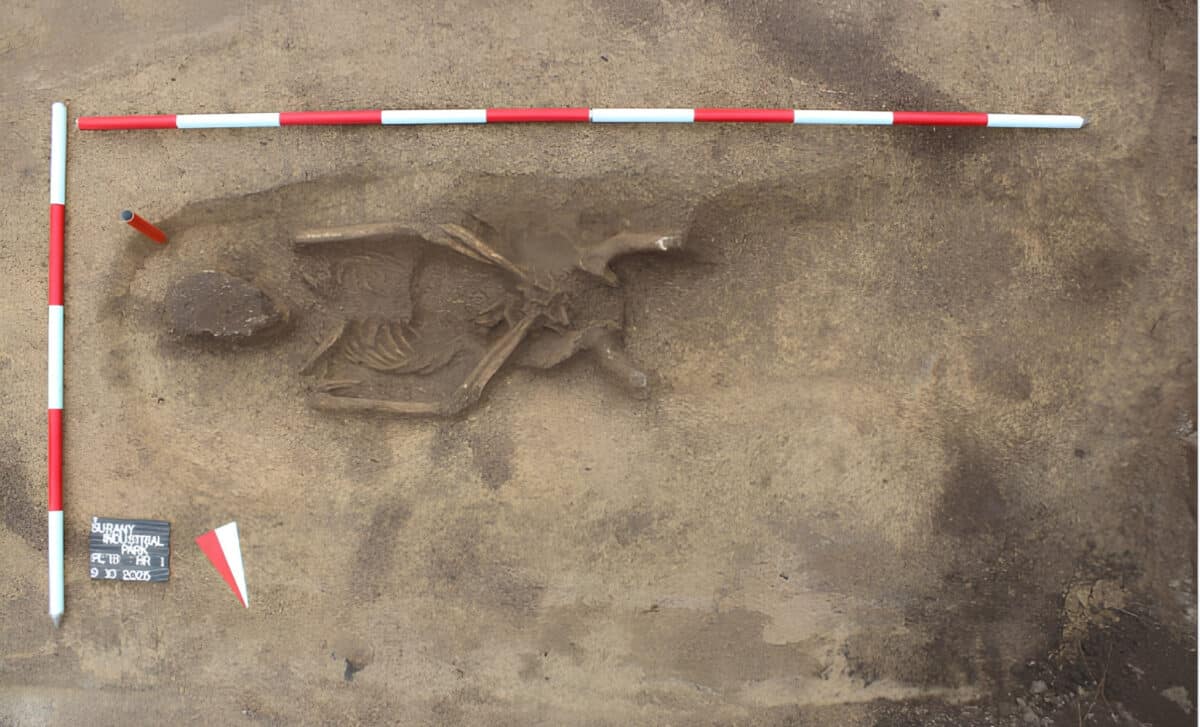
Image credit: ArÚ SAS – M. Ruttkay, M. Vojteček, M. Cheben, MH Invest
A Roman Military Camp North of the Danube
The discovery was made near the town of Šurany in southwestern Slovakia, during archaeological investigations connected with the construction of the Šurany Industrial Park. It was not a small excavation. Archaeologists from the Institute of Archaeology of the Slovak Academy of Sciences have investigated more than 150 hectares in the area.
Among the discoveries was something exceptional: a Roman military marching camp covering approximately 7.4 hectares, or around 18 acres. The camp probably dates from the second half of the 2nd century AD, most likely during the Marcomannic Wars of AD 166–180. This matters because the Danube was one of Rome’s great frontiers. South of the river were Roman provinces and military bases. North of it was the world of Germanic peoples, including the Quadi and Marcomanni.
The camp at Šurany was therefore not comfortably inside the Roman Empire. The soldiers who built it were operating beyond the frontier.
Marcus Aurelius Goes to War
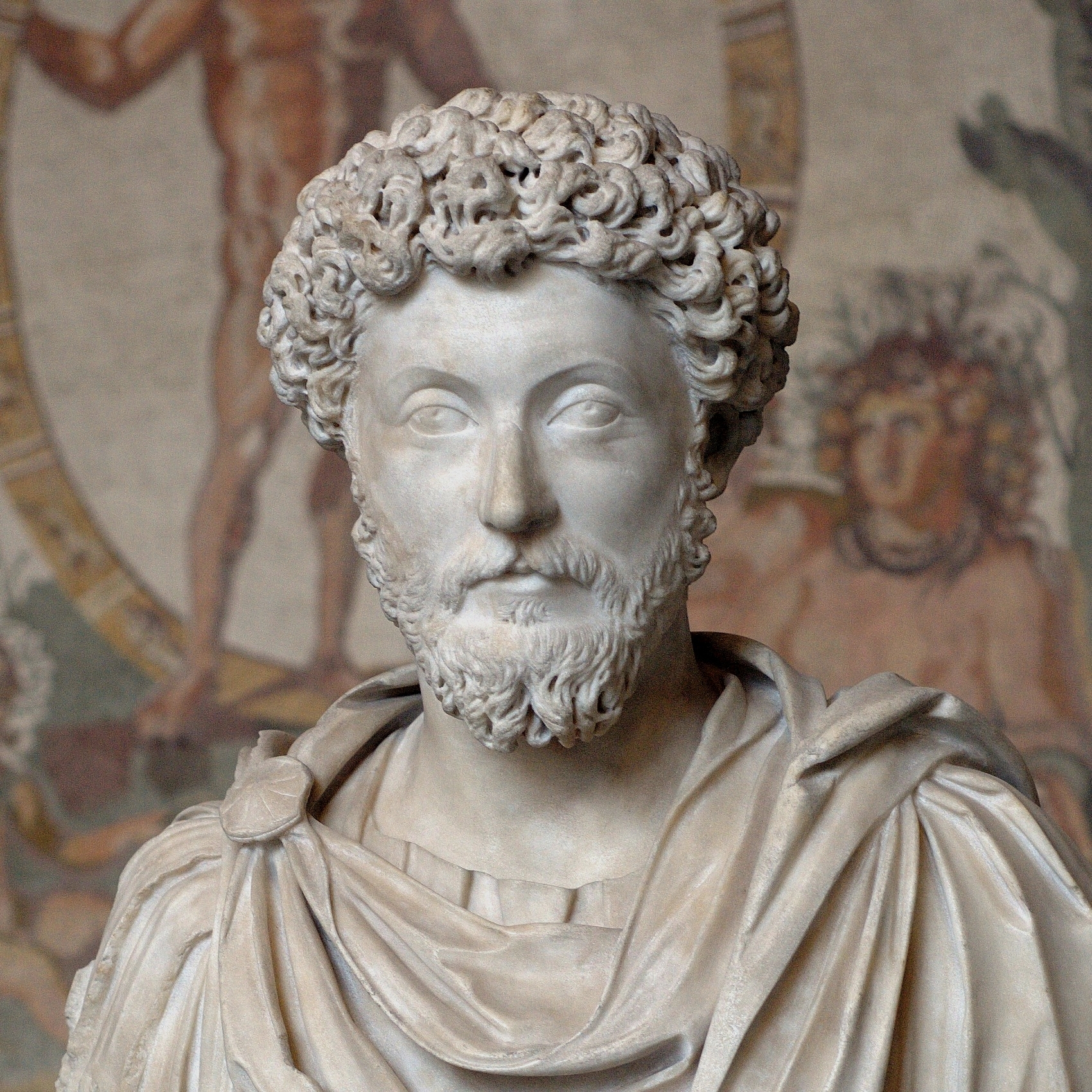
Emperor Marcus Aurelius, associated with this period, is better remembered today as a philosopher. Marcus Aurelius wrote the Meditations, reflected on duty and mortality, and eventually became one of history’s most famous Stoic thinkers. Unfortunately for Marcus Aurelius, he spent a considerable part of his reign doing something rather less peaceful, fighting Germans.
Beginning in the 160s, Germanic and other peoples placed enormous pressure on Rome’s Danubian frontier. In AD 170, raiders even crossed into Italy and threatened Aquileia. Rome responded with major military campaigns. Marcus Aurelius spent years near the Danube, personally directing operations against the Marcomanni, Quadi and other groups. Roman armies did not simply defend the river. They crossed it.
Temporary marching military camps allowed thousands of soldiers to operate deep inside hostile territory. Archaeologists have identified a number of such Roman military camps north of the Danube, showing just how extensive these campaigns became. The new discovery at Šurany adds another important piece to that map.
A Strange Roman Military Camp
Although far from main roads, Roman marching military camps are famous for their organization. Even when an army stopped only temporarily, soldiers could construct ditches, ramparts, and protected entrances. The layout was usually highly regular. Šurany is different.
The camp does not have the typical rectangular ground plan seen at many Roman military sites. But there is little doubt about what it was. Archaeologists identified defensive ditches, fortifications and five entrances. One of these used a defensive feature known as a clavicula.
The idea was simple. Instead of providing an attacker with a straight path through the gate, the fortification curved inward, forcing anyone entering to turn and exposing them to defenders. It is a very Roman solution to a very old problem.
According to the Slovak Academy of Sciences, this is the first clavicula-type entrance ever identified at a Roman camp in Slovakia. But the fortifications are not the strangest part of the discovery. The dead are.
Soldiers in Ditches and Wells
Archaeologists discovered numerous human remains throughout the site. Some were complete skeletons, while others were only parts of bodies. They appeared in defensive ditches, pits, and hastily excavated shallow graves. Some bodies had apparently been thrown into deep storage pits and wells.
This is not what archaeologists would normally expect from an orderly Roman military burial. And there is another strange detail. The bodies were found together with Roman military equipment.
Researchers recovered spearheads, arrowheads, fragments of helmets, legionary brooches, coins, and pieces of both segmented and scale armor. There were also remains of Roman military footwear.
The famous caligae worn by Roman soldiers were reinforced with iron hobnails underneath their soles. Leather normally disappears after almost two thousand years, but the arrangement of the nails can survive. In some cases, X-rays of blocks of soil have allowed archaeologists to see the original arrangement of the footwear so clearly that they may even be able to determine the soldier’s shoe size. A surprisingly personal detail from an otherwise grim discovery.
There were also ordinary objects. An axe, a cutting tool and even a gaming die. For a moment, the people in the military camp stopped being anonymous skeletons. They were soldiers who marched, worked, ate, gambled and waited for whatever came next. Then something went wrong.
What Happened at Šurany Roman Military Camp?
This is where the story becomes frustrating. We don’t know. Not yet. The archaeological team believes that most of the dead were probably Roman soldiers, but this remains a preliminary interpretation. And researchers are asking some very obvious questions. Were these men killed in battle? Did disease spread through the camp? Was the camp attacked? Why were bodies disposed of so quickly? And perhaps most strangely, why was so much valuable military equipment left behind?
Armor, weapons, and metal objects were valuable. Ancient battlefields and abandoned camps were often stripped of anything useful. Yet many objects at Šurany remained beside the dead. That suggests that whoever disposed of the bodies either could not, or did not have time to, recover everything.
Too many questions and no answers.
It is tempting to imagine a catastrophic Roman defeat. But archaeology requires more patience than imagination. For now, the evidence tells us that the camp seems to have disappeared shortly after a military conflict between Romans and Germanic forces. Exactly what happened during that conflict remains unknown.
Rome Deep Inside Slovakia
Šurany also fits into a much larger archaeological story. Roman soldiers were operating surprisingly far north of the Danube during the Marcomannic Wars. One of the most famous pieces of evidence survives at Trenčín in Slovakia. There, an inscription carved into the castle rock records Roman soldiers stationed at ancient Laugaricio in AD 179. It mentions 855 soldiers of Legio II Adiutrix and remains one of the most remarkable surviving Roman inscriptions north of the Danube.

There is even a fascinating connection with Marcus Aurelius himself. A Roman military camp discovered at Želiezovce has been suggested as one possible location where the emperor wrote part of his Meditations. Marcus tells us that portions of the work were written: “among the Quadi at the Granua.” The Granua is generally identified with the modern Hron River.
The War That Marcus Aurelius Never Finished
The Marcomannic Wars dominated the final years of Marcus Aurelius’ life. By the late 170s, Rome had carried the war deep into enemy territory. Some ancient evidence has even encouraged the idea that Marcus considered creating new provinces beyond the Danube. Then, in AD 180, Marcus Aurelius died.
His son Commodus became emperor and chose another path. Instead of continuing his father’s campaigns, Commodus negotiated peace and withdrew Roman forces. Rome’s great push north of the Danube ended. The military camps were abandoned, and the legions went home. With that movement, places like Šurany slowly disappeared beneath the soil.
The Roman Soldiers Who Never Came Home
Almost 1,850 years later, archaeologists are uncovering that forgotten campaign one skeleton at a time. For now, we cannot say exactly what happened at the Roman camp near Šurany. Genetic analysis, isotope studies, radiocarbon dating and examination of the human remains may eventually tell us where these men came from and how they died. That work could take years. But the discovery already changes the picture.
Marcus Aurelius’ wars were not distant skirmishes fought neatly along Rome’s frontier. Roman armies marched deep into Central Europe, built camps in enemy territory, and fought a long, difficult war that consumed the final years of one of Rome’s most famous emperors. At Šurany, something brought one of those Roman camps to a sudden end. Most of the army eventually marched south again. Some soldiers never left. Their remains are still in the Roman military camp in Slovakia.

Hello, my name is Vladimir, and I am a part of the Roman-empire writing team.
I am a historian, and history is an integral part of my life.
To be honest, while I was in school, I didn’t like history so how did I end up studying it? Well, for that, I have to thank history-based strategy PC games. Thank you so much, Europa Universalis IV, and thank you, Medieval Total War.
Since games made me fall in love with history, I completed bachelor studies at Filozofski Fakultet Niš, a part of the University of Niš. My bachelor’s thesis was about Julis Caesar. Soon, I completed my master’s studies at the same university.
For years now, I have been working as a teacher in a local elementary school, but my passion for writing isn’t fulfilled, so I decided to pursue that ambition online. There were a few gigs, but most of them were not history-related.
Then I stumbled upon roman-empire.com, and now I am a part of something bigger. No, I am not a part of the ancient Roman Empire but of a creative writing team where I have the freedom to write about whatever I want. Yes, even about Star Wars. Stay tuned for that.
Anyway, I am better at writing about Rome than writing about me. But if you would like to contact me for any reason, you can do it at contact@roman-empire.net. Except for negative reviews, of course. 😀
Kind regards,
Vladimir