
A Place Once Central to Rome’s Northern Frontier
At the confluence of the rivers Mlava and Danube, ancient Romans recognized more than a scenic landscape; they saw a place of strategic importance. On that spot in what is now eastern Serbia, they built Viminacium, a city that would stand for centuries as one of the most significant urban and military centers of the Roman Empire beyond Italy. Today, it remains in the form of an archaeological park near Kostolac, where visitors can walk the grounds where legionaries once lived, trained, fought, and administered an empire.
Viminacium wasn’t merely a fortification on a frontier. It was a city of up to 40,000 inhabitants at its peak, boasting temples, baths, streets, squares, an amphitheater, and even a hippodrome. The site represents the fusion of military purpose and urban life, reflecting Rome’s layered presence in the ancient world.

Strategic Beginnings: From Camp to City
Roman involvement in the region began in the 1st century AD, when a military camp was established as part of a wider system defending the empire’s Danube frontier. What began as a legionary garrison grew into a bustling settlement, attracting traders, artisans, families of soldiers, and administrators. Over time, it was elevated to the status of a Roman colony, granting it self-governance and marking it as a place of significant regional influence.
(Photo by Carles Lalueza-Fox)
The city’s placement was far from accidental. The intersection of rivers and roads made Viminacium a natural hub of commerce and movement, perfect for a society that depended on rapid deployment of troops and supplies, as well as cultural interaction between Rome and neighboring peoples.
Life in a Roman Frontier City
Viminacium was at once a military stronghold and a functioning urban center. It hosted at least two legions, Legio VII Claudia and later Legio IIII Flavia Felix, and served as a base for Roman operations along the Danube Limes, the empire’s northern defensive system.
But armies don’t exist in isolation, and neither did this community. Markets bustled, craftsmen practised their trades, families established homes, and public buildings like baths and amphitheaters echoed with the rhythms of daily life. Excavations have unearthed streets, temples, homes, sewer systems, and a complex water infrastructure, giving archaeologists and visitors alike a rich picture of how Romans lived far from the city of Rome.
In recent years, archaeologists have even uncovered the remains of ships buried in the old riverbed, relics of economic and possibly military activity, dating back to the 1st century BC and later periods. These watercraft remind us that rivers were vital arteries of trade and movement just as much as roads were.

Entertainment, Death, and Daily Rituals
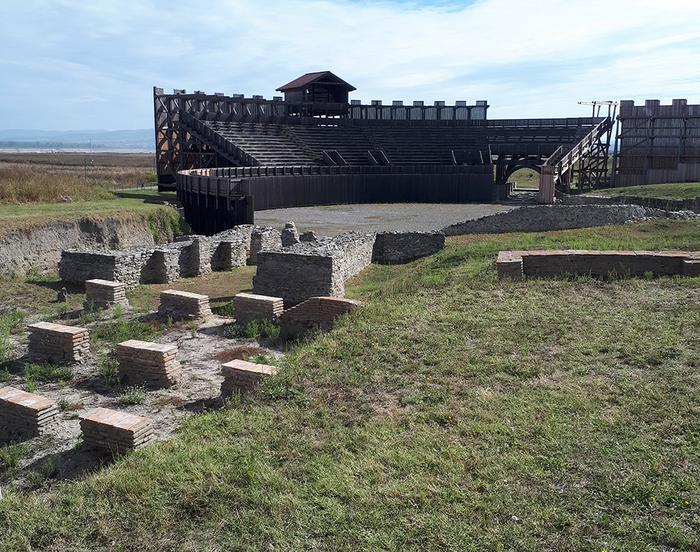
No Roman city was complete without spaces for entertainment and public ritual. Viminacium was no exception. The archaeological park includes the remains of an amphitheater capable of seating thousands, one of the largest known in the Balkans. Studies of animal bones and rare finds such as a bear skull discovered near the arena suggest that games, gladiatorial spectacles, and venationes (animal hunts) were part of the city’s cultural life.
Such discoveries do more than tell us that Romans enjoyed games. They nuance our understanding of the complex social dynamics on the frontier, a blend of military discipline and civilian leisure, of the brutal and the communal, all under the shadow of empire.
Religion, Power, and Burial Practices
Religion was deeply woven into Roman life, and Viminacium was a canvas for religious expression and ritual. Temples uncovered at the park hint at a pantheon familiar to Romans across the empire. What sets the site apart is the sheer number of burial sites. Viminacium is known for having one of the largest collections of graves ever found in a Roman archaeological context. Over 16,000 tombs have been excavated, offering an expansive view of life, status, and belief from all walks of ancient society.
Power Plays and Imperial Presence
Viminacium was not just a local center; it was woven into the larger political and military frameworks of Rome. In 196 AD, the future emperor Septimius Severus declared his son Caracalla as his successor there, an act that highlights the city’s importance as more than a backwater but a place where imperial decisions were made.
The city later weathered devastation and rebirth. It was destroyed by Huns in the 5th century but saw restoration under Byzantine authority before the eventual decline of Roman power in the region. By the time Slavic populations arrived in the 6th century, Viminacium had already been through generations of transformation.
Excavations and Modern Rediscovery
Systematic archaeological work at Viminacium began in earnest in the late 19th century and accelerated through the 20th century. By 2006, the site was officially opened as Viminacium Archaeological Park, allowing the public to explore and appreciate centuries of Roman history.
Ongoing digs continue to reveal more about the city’s structure and society. Guided tours, educational programs, and interactive exhibits bring ancient life to contemporary audiences, making Viminacium not just a place of ruins but a living classroom of history.
What You Can See Today
Visitors to the archaeological park can walk among the outlines of amphitheaters where citizens once gathered, stand before restored baths that once steamed with social rituals, and enter the reconstructed north gate of the legionary camp where soldiers marched out to defend the empire. Highlights include the mammoth park, a creative modern addition that contextualizes prehistoric life alongside Roman history, and the mausoleum where some scholars believe Emperor Hadrian might have been temporarily interred.
These layers of human history, prehistoric, Roman, medieval, and modern, make Viminacium unlike many other archaeological sites in Europe.
Why Viminacium Matters
Beyond its spectacular ruins, Viminacium tells a larger story about the Roman Empire’s complexity. It was a military installation, a provincial capital, a hub of commerce and culture, and a place where ordinary people lived and died amid the ambitions of emperors. The blend of urban sophistication and strategic importance shows how Rome didn’t just conquer lands, it built lasting communities.
Visiting Today: Practical Tips
The archaeological park is near Požarevac in eastern Serbia and offers year-round access with guided tours available. Whether you’re fascinated by ancient military history, urban life in antiquity, or the human stories hidden beneath fields and rivers, Viminacium provides a tangible connection to a world that shaped our own.

Hello, my name is Vladimir, and I am a part of the Roman-empire writing team.
I am a historian, and history is an integral part of my life.
To be honest, while I was in school, I didn’t like history so how did I end up studying it? Well, for that, I have to thank history-based strategy PC games. Thank you so much, Europa Universalis IV, and thank you, Medieval Total War.
Since games made me fall in love with history, I completed bachelor studies at Filozofski Fakultet Niš, a part of the University of Niš. My bachelor’s thesis was about Julis Caesar. Soon, I completed my master’s studies at the same university.
For years now, I have been working as a teacher in a local elementary school, but my passion for writing isn’t fulfilled, so I decided to pursue that ambition online. There were a few gigs, but most of them were not history-related.
Then I stumbled upon roman-empire.com, and now I am a part of something bigger. No, I am not a part of the ancient Roman Empire but of a creative writing team where I have the freedom to write about whatever I want. Yes, even about Star Wars. Stay tuned for that.
Anyway, I am better at writing about Rome than writing about me. But if you would like to contact me for any reason, you can do it at contact@roman-empire.net. Except for negative reviews, of course. 😀
Kind regards,
Vladimir