
Imagine standing on a windswept ridge in northern England, looking across green valleys and rolling hills. A long stone wall follows the contours of the landscape, disappearing over the next rise. Sheep graze nearby, the wind carries across the open countryside, and it is difficult to believe that nearly 1,900 years ago, this was one of the most important military frontiers of the Roman Empire.
Welcome to Hadrian’s Wall! This is the place where Roman history is not confined to museums but remains part of the landscape itself. Whether you are planning a long-distance hike or simply a day surrounded by ancient history, the Wall offers an experience unlike almost anywhere else in Britain.
Where the Roman world met the northern frontier
Construction of Hadrian’s Wall began around AD 122, following Emperor Hadrian’s visit to Britain. Stretching approximately 73 miles (117 kilometres) from the Solway coast to the River Tyne, it marked a major frontier of Roman Britain.

But the Wall was more than a barrier. Its forts, milecastles, watchtowers and gates helped regulate movement, support military patrols and project Roman authority across the northern landscape. Soldiers stationed here came from different parts of the Empire. Alongside them lived traders, craftspeople, families and people who supplied the frontier’s military communities.
Today, you can follow much of this ancient route on the Hadrian’s Wall Path, a National Trail that passes through some of England’s most striking countryside. And the best way to experience it? Take your time. The Wall is not a monument to rush through.
Housesteads: Walking through a Roman fort

For many visitors, Housesteads Roman Fort is the perfect place to begin. The remains of the fort stand on an exposed hillside, overlooking the surrounding countryside. Once inside, you can explore the outlines of barracks, headquarters buildings, granaries and the famous communal latrines. It is one thing to read that Roman soldiers lived on the frontier, and quite another to stand among the foundations of their barracks and imagine the daily routine: morning duties, equipment inspections and patrols during the long northern winters.
The fort also helps explain the scale of Roman military organisation. This was not an isolated outpost occupied by a handful of men, but part of a carefully structured frontier system. For visitors who enjoy walking, the route between Housesteads and Steel Rigg offers an especially memorable experience. The National Trust describes its circular walk as approximately eight miles (12.8 km), with steep climbs and descents.
Steel Rigg and the landscape of the Wall

If there is one place that captures the visual drama of Hadrian’s Wall, it is Steel Rigg. Here, the Wall follows a dramatic ridge, rising and falling with the natural contours of the land. The views across the surrounding countryside are magnificent, particularly on a clear day.
This is also where the ancient engineering becomes easier to appreciate. The Romans did not simply draw a straight line across Britain. They adapted their construction to the terrain, using hills and natural obstacles to strengthen the frontier. Walking here, you begin to understand why the landscape itself was such an important part of Roman military planning. The paths can be steep, muddy and exposed to changing weather, so proper footwear and suitable clothing are essential.
Vindolanda: The people behind the frontier

A short journey south of the Wall brings you to Vindolanda, one of the most fascinating archaeological sites in Roman Britain. Although the fort predates Hadrian’s Wall, its story is closely connected with the frontier and the soldiers who served there. Vindolanda is particularly famous for its collection of wooden writing tablets, which preserve everyday communications from the Roman military community. They include messages concerning supplies, duties, personal relationships, and ordinary concerns.
One famous letter, written by Claudia Severa to Sulpicia Lepidina, is often described as one of the earliest surviving examples of writing in Latin by a woman in Roman Britain. Instead of seeing only military buildings, you encounter the people who inhabited them. The site and its museum are an excellent addition to a visit to the Wall. The Vindolanda Trust provides current visitor and travel information on its official website.
The wider Roman frontier
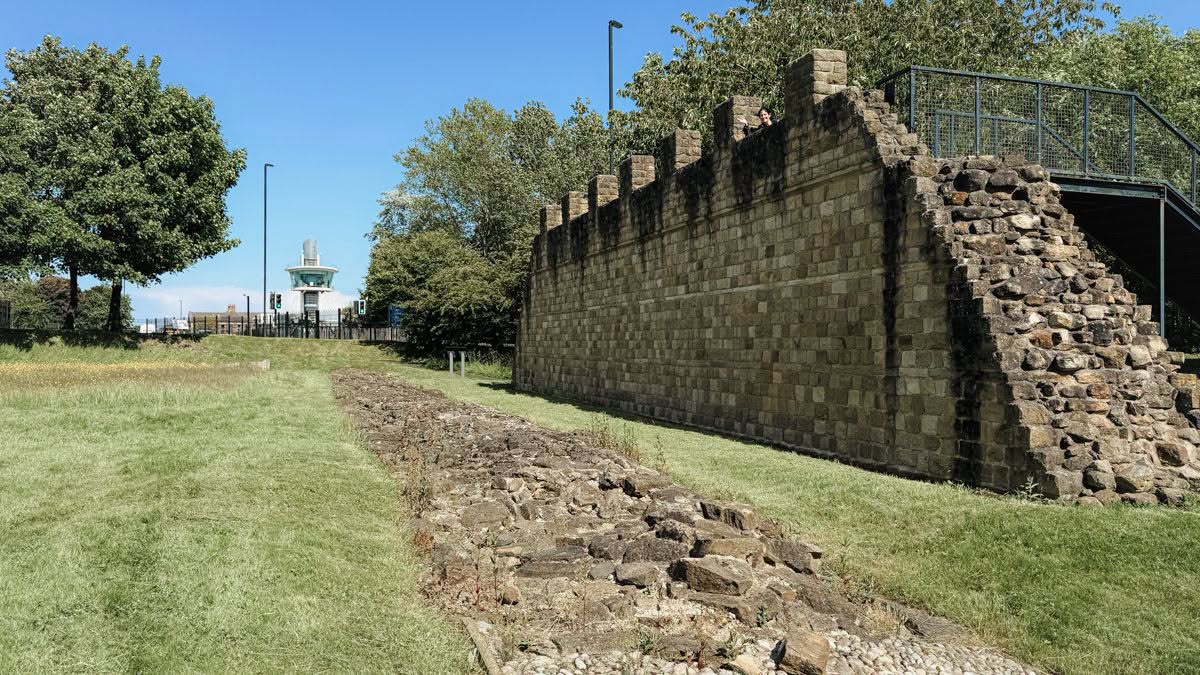
And, if you want to see what Hadrian’s Wall may have looked like nearly 1,900 years ago, Segedunum Roman Fort & Museum is well worth a visit. Located at the eastern end of the Wall, the site preserves the remains of a Roman fort, barracks, bathhouse and surrounding military settlement. Its reconstructed section of the Wall gives visitors a glimpse of the frontier’s original appearance, and you can even walk along its top, imagining Roman soldiers keeping watch over the northern frontier. It is one of the most important stops during the visit. If you don’t believe me, believe the two traveling Texans, as they are among the most helpful and well-informed walkers on this trail.
Walking Hadrian’s Wall: What should you know?
The full Hadrian’s Wall Path is approximately 84 miles (135 km) long and is generally walked from west to east, although visitors can choose individual sections.
A few practical considerations will make your visit easier:
-
Wear suitable footwear. Paths can be uneven, steep and muddy.
-
Prepare for changing weather. Conditions in the exposed countryside can change quickly.
-
Plan transport carefully. The AD122 bus connects several important visitor locations, but check current timetables before travelling.
-
Check opening arrangements. Forts and museums have different opening hours, admission arrangements and facilities.
-
Respect the monument. Do not climb on fragile sections of the Wall or remove archaeological material.
For visitors who want to walk longer sections, the National Trail’s official guidance provides route information, maps and accessibility details. The travel blog Two Traveling Texans also offers a useful personal perspective in its guide, Tips for Walking Hadrian’s Wall, particularly for those preparing for a longer walking adventure.

Hello, my name is Vladimir, and I am a part of the Roman-empire writing team.
I am a historian, and history is an integral part of my life.
To be honest, while I was in school, I didn’t like history so how did I end up studying it? Well, for that, I have to thank history-based strategy PC games. Thank you so much, Europa Universalis IV, and thank you, Medieval Total War.
Since games made me fall in love with history, I completed bachelor studies at Filozofski Fakultet Niš, a part of the University of Niš. My bachelor’s thesis was about Julis Caesar. Soon, I completed my master’s studies at the same university.
For years now, I have been working as a teacher in a local elementary school, but my passion for writing isn’t fulfilled, so I decided to pursue that ambition online. There were a few gigs, but most of them were not history-related.
Then I stumbled upon roman-empire.com, and now I am a part of something bigger. No, I am not a part of the ancient Roman Empire but of a creative writing team where I have the freedom to write about whatever I want. Yes, even about Star Wars. Stay tuned for that.
Anyway, I am better at writing about Rome than writing about me. But if you would like to contact me for any reason, you can do it at contact@roman-empire.net. Except for negative reviews, of course. 😀
Kind regards,
Vladimir