
Flamma, whose name means “the Flame,” is one of the most intriguing gladiators known from the Roman world. Unlike many famous gladiators whose careers are reconstructed from literary accounts, Flamma is known almost entirely from a single funerary inscription discovered in Sicily. That brief epitaph records an unusually long career, 34 fights, 21 victories, and four occasions on which he was spared.
It is also the source of the enduring claim that Flamma was offered freedom four times and rejected it. The historical evidence, however, requires an important correction: the inscription does not say that Flamma was awarded the rudis, the wooden sword symbolizing formal release from gladiatorial service. Instead, it says that he was missus four times—that is, granted mercy after defeat or surrender. The distinction fundamentally changes what can be established about his life.
A Syrian in the Roman Arena
The inscription identifies Flamma as natione Syrus, meaning “Syrian by birth.” Beyond that, virtually nothing certain is known about his origins, childhood, or how he became a gladiator.
Later accounts have attempted to connect him with the Jewish population of Roman Syria and the suppression of the Bar Kokhba revolt in Judaea, which ended in 135 AD. One theory proposes that Flamma may have been a young Syrian or Jewish auxiliary who fell into Roman captivity or punishment during this turbulent period before being sold into gladiatorial service.
There is no surviving ancient evidence, however, establishing that Flamma was Jewish, that he served in the Roman army, or that he was enslaved because of insubordination. These details remain speculation. The inscription itself provides only his Syrian origin and gladiatorial record.
That distinction matters because Flamma’s biography has often been expanded far beyond what the surviving evidence can support.
Flamma the Secutor
What the inscription does establish is that Flamma was a secutor, a heavily armed gladiator whose name means “pursuer.” The type developed as a specialized opponent of the retiarius, a lightly equipped gladiator who fought with a net, trident, and dagger.
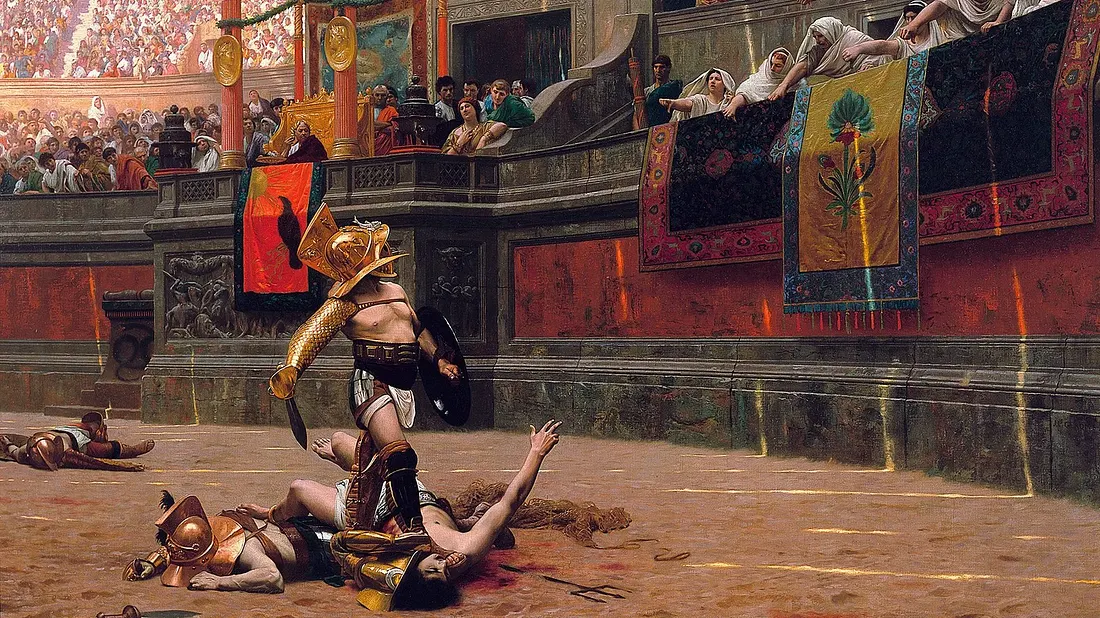
A secutor carried a sword and shield and wore substantial armor. His helmet was particularly distinctive, with a smooth, rounded design and minimal openings that protected the face while reducing the chance of becoming entangled in the retiarius‘s net.
Flamma’s career was therefore not that of an inexperienced prisoner simply thrown into the arena. By the time commemorated by his epitaph, he had become a professional gladiator capable of repeatedly surviving highly specialized combat.
His record was remarkable:
- 34 fights
- 21 victories
- 9 occasions of stans missus
- 4 occasions of missus
- 30 years old at death
The terminology requires care. Stans missus is generally understood as a bout ending without a decisive victory, with both combatants being released. Missus refers to a gladiator being spared after defeat or surrender.
Consequently, Flamma’s record indicates that he lost four contests but survived them.
The Myth of Four Rejected Freedoms
The most famous element of Flamma’s story is also the most frequently misunderstood.
The claim that Flamma was offered freedom four times and voluntarily rejected it comes from interpreting his four missus as four offers of the rudis. But the inscription does not mention the rudis.
The rudis was indeed associated with liberation from gladiatorial service. A gladiator who received it could leave the arena profession, although the precise circumstances and legal implications of gladiatorial manumission varied. Flamma’s epitaph simply records four instances in which he was spared.
That makes his story less certain—but arguably more interesting.
The inscription demonstrates that Flamma survived four defeats. It does not demonstrate that he rejected freedom four times.
A Remarkably Durable Career
Flamma’s 34 recorded fights reveal the extraordinary durability required of a successful gladiator. Gladiatorial combat was dangerous, but the popular image that every contest automatically ended with one fighter’s death is inaccurate.
A defeated gladiator could sometimes receive missio, particularly when the circumstances of the fight, the rules of the games, and the judgment of the editor—the person staging the spectacle—allowed it. The crowd could influence the atmosphere surrounding a decision, but the final authority belonged to the person responsible for the games.
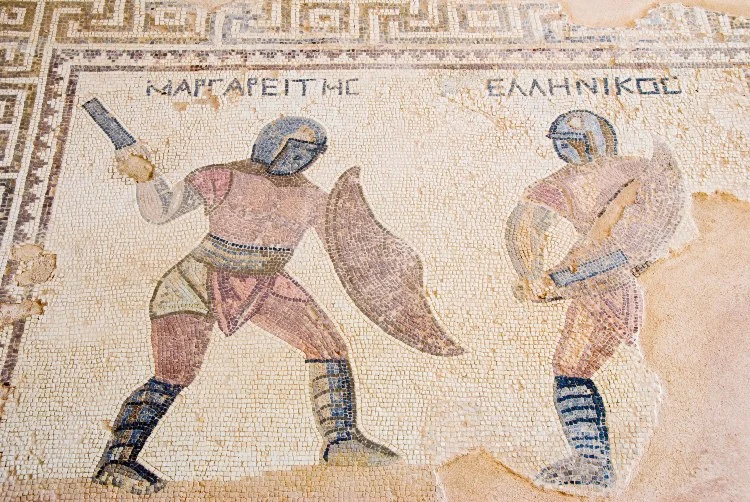
Gladiators who accumulated victories could gain prestige, better treatment, and financial rewards. Some ultimately obtained formal freedom and could continue their association with the gladiatorial world as trainers, managers, or instructors.
Flamma evidently remained in the profession for a considerable period. His 34 fights place him among the more extensively documented gladiatorial careers, particularly because most ordinary gladiators left little surviving evidence.
Death and the Tombstone of Flamma
Flamma eventually died at only 30 years of age. Whether he died during his 34th recorded contest is not completely explicit from the inscription, although the wording of his epitaph is naturally associated with the end of his career.
His tombstone was erected by Delicatus, described as his coarmio—a fellow combatant or comrade-in-arms. That detail provides an unusually human glimpse into the social world surrounding gladiators.
The epitaph reads, in abbreviated Latin:
Flamma sec(utor) vix(it) ann(is) XXX / pugna(vit) XXXIIII vicit XXI / stans VIIII mis(sus) IIII nat(ione) Syrus / huic Delicatus coarmio merenti fecit.
In translation, it records that Flamma was a secutor, lived 30 years, fought 34 times, won 21 contests, was released from nine undecided contests and spared four times, and was Syrian by birth. Delicatus made the monument for his deserving fellow combatant.
That final dedication is significant. Flamma was not remembered merely as property or as an anonymous casualty of the arena. His fellow gladiator considered him worthy of a permanent memorial.
