
Long before modern fast-food chains, takeaway restaurants, and street-food markets, Roman cities had an extensive network of establishments selling ready-to-eat meals and drinks. Known as thermopolia (singular: thermopolium), these ancient food shops were a familiar feature of urban life, particularly in Pompeii and Herculaneum.
They offered something essential to ordinary Romans: affordable food without the need to prepare an entire meal at home. Their counters, built-in storage vessels, and archaeological remains provide a remarkable glimpse into how Romans ate, worked, and socialized nearly 2,000 years ago.
What Was a Roman Thermopolium?
The term thermopolium comes from Greek elements associated with heat and selling. These establishments served hot food and beverages, although the terminology used for Roman food shops was not always consistent.
Unlike modern restaurants, many thermopolia were compact commercial premises opening directly onto busy streets. Their most recognizable feature was a masonry serving counter, sometimes decorated with marble or painted plaster.
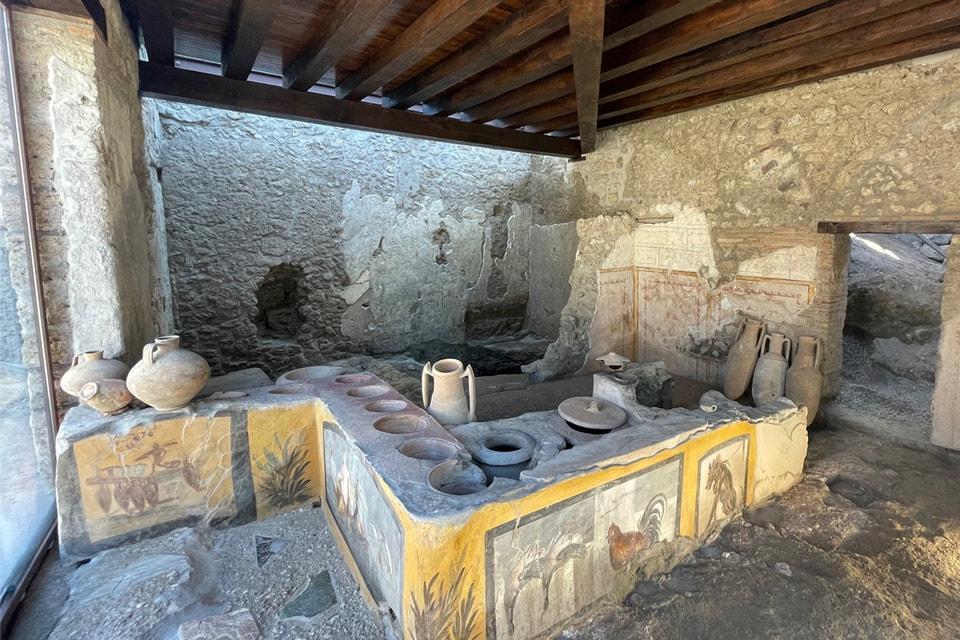
Large ceramic storage vessels called dolia were frequently embedded into the counters. These containers held food, ingredients, or beverages, allowing shopkeepers to serve customers efficiently.
Not every establishment followed exactly the same design. Some had additional rooms behind the counter, and archaeological evidence suggests that certain businesses provided space for customers to eat inside.
Pompeii is particularly valuable for studying this food culture. Archaeologists have identified approximately 80 to 90 such establishments in the excavated parts of the city, demonstrating how widespread commercial food services had become.
Why So Many Romans Ate Outside Their Homes
The popularity of thermopolia was closely connected to Roman urban housing.
Many residents lived in insulae, multi-story apartment buildings that accommodated families, workers, and tenants. Unlike wealthy residences, these buildings often offered limited domestic space and few convenient cooking facilities.
It would be inaccurate, however, to claim that Romans generally never cooked at home or that cooking fires were universally prohibited on upper floors. Conditions varied considerably between buildings, neighborhoods, and social classes.
Nevertheless, limited space, the expense and inconvenience of preparing meals, and the demands of urban employment made purchasing prepared food a practical alternative.
For craftspeople, merchants, laborers, and people living in modest accommodation, street-side food shops were an important part of everyday life.
What Did Romans Eat at These Ancient Food Shops?
The menu was more varied than a simple selection of bread and wine.
Archaeological evidence from Pompeii’s food shops indicates that meat, fish, vegetables, legumes, and other ingredients were used in preparing meals. Some establishments probably specialized in particular products, while others offered a broader selection.
One of the most important discoveries came from the Thermopolium of Regio V, where excavators recovered food residues and animal bones from containers embedded in the counter.
Initial laboratory analyses identified remains of:
-
Duck
-
Pig
-
Goats and sheep
-
Fish
-
Land snails
-
Fava beans
These discoveries are particularly valuable because they provide direct evidence of ingredients handled by an actual Roman food business, rather than relying exclusively on ancient recipes or literary descriptions.
The fava beans are especially interesting. Researchers found crushed beans inside a container associated with wine. They may have been used to alter the drink’s taste and color, a practice also described by the Roman culinary writer Apicius in De Re Coquinaria (On the Subject of Cooking).
Wine was another important product sold at these establishments. Romans consumed different preparations of wine, including mixtures with water and heated wine-based beverages.
The Remarkable Thermopolium of Regio V
One of the most extraordinary examples of Roman street food culture emerged during excavations in Pompeii’s Regio V district.
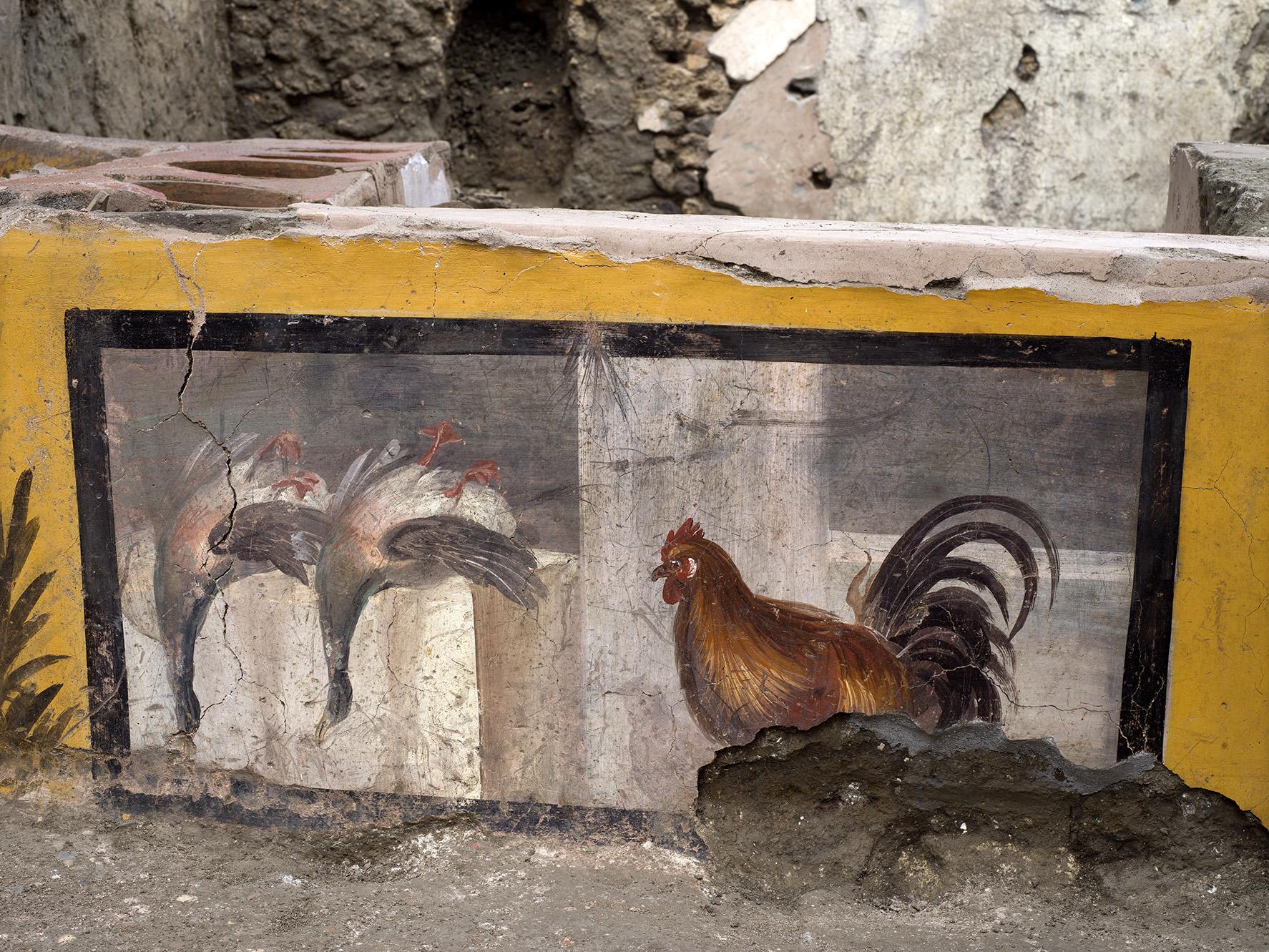
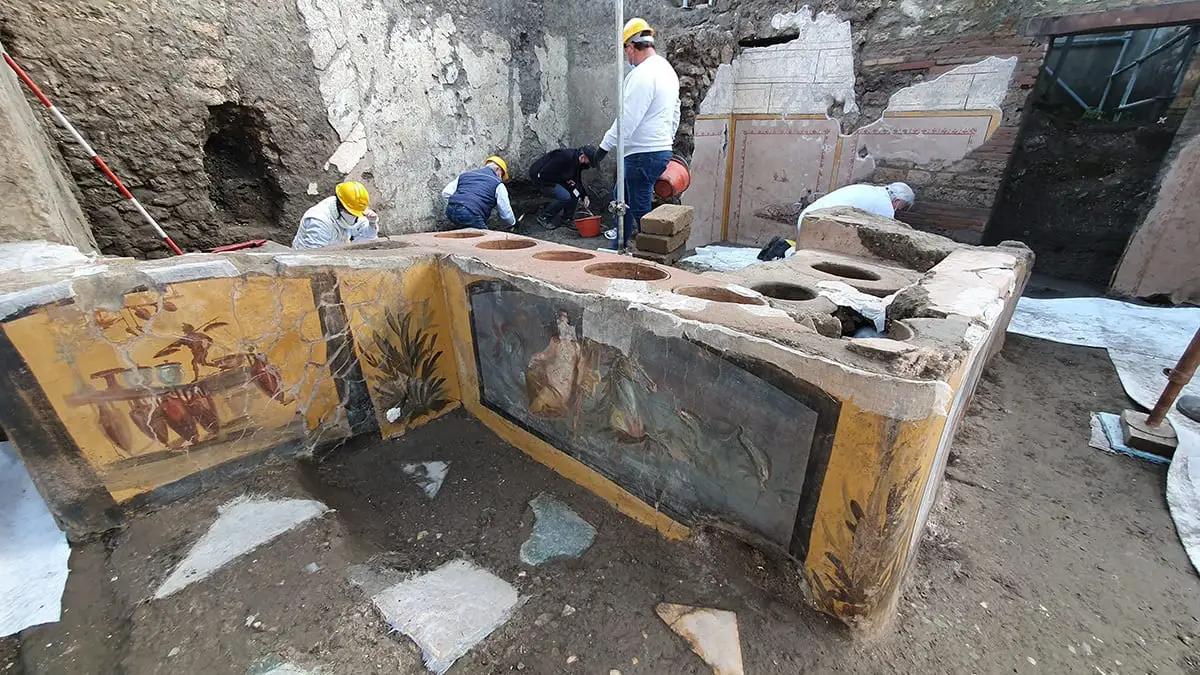
The establishment was partially investigated in 2019 and subsequently excavated in greater detail. Its exceptional preservation revealed a decorated counter featuring colorful paintings of animals and food-related scenes.
One of its most striking images depicts a Nereid, a mythological sea nymph, riding a seahorse. Other paintings include ducks and a rooster, apparently reflecting some of the products associated with the business.
The archaeological discoveries extended beyond the artwork. Researchers recovered animal bones, food residues, amphorae, and other objects connected with the establishment’s final period of operation.
The findings provided an unusually detailed picture of a Roman food business shortly before the eruption of Mount Vesuvius in AD 79.
The preservation was not simply the result of ash covering the building. Volcanic deposits and the wider eruption sequence buried and sealed much of Pompeii, preserving organic materials and everyday objects that would otherwise have disappeared.
The discovery is particularly important because it allows archaeologists to compare the painted representations of food with actual animal remains recovered from the premises.
Food, Religion, and Everyday Roman Life
Thermopolia were not exclusively commercial spaces. Some also reflected the religious traditions and household beliefs of their owners.
A particularly interesting example is the establishment associated with Lucius Vetutius Placidus on Pompeii’s Via dell’Abbondanza.
At the rear of the premises, archaeologists identified a painted lararium, a household shrine dedicated to protective deities.
Its decoration includes the Lares, guardian spirits associated with the household, alongside Mercury, the god associated with commerce, and Dionysus-Bacchus, associated with wine.
The arrangement offers an interesting glimpse into how Roman religious practices extended beyond private domestic spaces and into commercial life.
The establishment also contained a substantial collection of coins inside one of its storage vessels, providing further evidence of its commercial activity.
More Than Just Ancient Fast Food
Thermopolia were important features of Roman urban life because they connected food preparation, commerce, and everyday social interaction.
Customers could purchase prepared meals while going about their daily business. Workers, merchants, and residents without convenient cooking facilities all had reasons to use these establishments.
However, claims that thermopolia operated continuously from before dawn until midnight, or that every customer ate standing shoulder-to-shoulder using communal cups, cannot be established as general facts from the archaeological evidence.
Some premises included interior dining areas, while others were primarily street-facing businesses.
What is clear is that these establishments formed part of a wider commercial landscape that made Roman cities function.
The Lasting Legacy of Roman Street Food
The Roman thermopolium was not identical to a modern fast-food restaurant, but the similarities are difficult to overlook.
Both offered convenient prepared meals, relied on accessible commercial locations, and served customers who wanted food without preparing it themselves.
More importantly, Pompeii’s preserved establishments demonstrate that eating outside the home was not an unusual activity in the ancient world. It was an established part of urban life.
Nearly 2,000 years later, the counters, ceramic vessels, painted advertisements, and food remains of Pompeii continue to reveal how ordinary Romans lived.
The Colosseum and imperial monuments may represent Rome’s political and military power, but the thermopolium tells another important story: how an empire fed its people one meal at a time.
