
London’s history began long before its medieval streets, Victorian landmarks, and modern skyscrapers. Beneath the financial district and among the city’s historic markets lie the remains of Londinium, the Roman settlement established on the north bank of the River Thames during the first century AD. Although much of the ancient city disappeared, its roads, commercial center, defensive walls, and architectural legacy continue to influence London’s urban landscape.
The relationship between Roman Londinium and modern London is not simply a matter of archaeological remains. It is a story of urban continuity, economic geography, destruction, and reconstruction, in which successive generations built upon, adapted, or rediscovered the foundations of an earlier city.
The Roman Foundation of London
The Romans established Londinium around AD 47, shortly after their invasion of Britain began in AD 43. Its location was strategically advantageous. The Thames provided access to inland settlements and the North Sea, while the river’s navigable reaches and crossing opportunities made the area suitable for trade and transportation.
Londinium developed into a commercial and administrative center connecting Roman Britain with the wider empire. Merchants moved goods through its river port, while roads linked the settlement with other towns and military centers across the province.
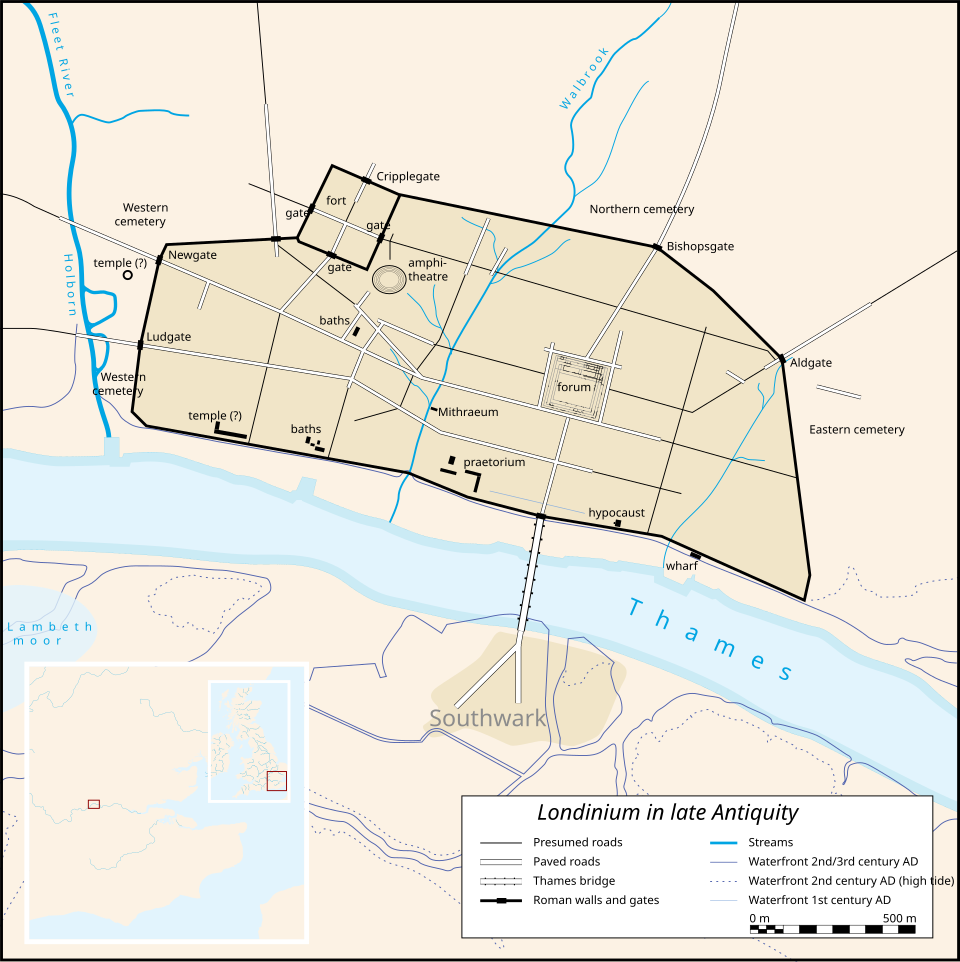
The Roman city did not survive unchanged. During the revolt led by Boudica, usually dated to AD 60 or 61, Londinium was destroyed by fire. The Romans subsequently rebuilt it, and the settlement expanded into an important center of provincial commerce and government.
Modern London inherited its name from this Roman predecessor, although the precise linguistic origins of Londinium remain uncertain. More importantly, the city’s location near the Thames continued to favor settlement and trade long after Roman political authority in Britain ended.
The Roman Forum and the Origins of London’s Street Plan
The surviving foundations and walls demonstrate the scale of the original structure. Built around the late first century AD, the basilica served as a center for administrative, judicial, commercial, and civic activities. Its location helps archaeologists reconstruct the layout of Londinium’s earliest public buildings.
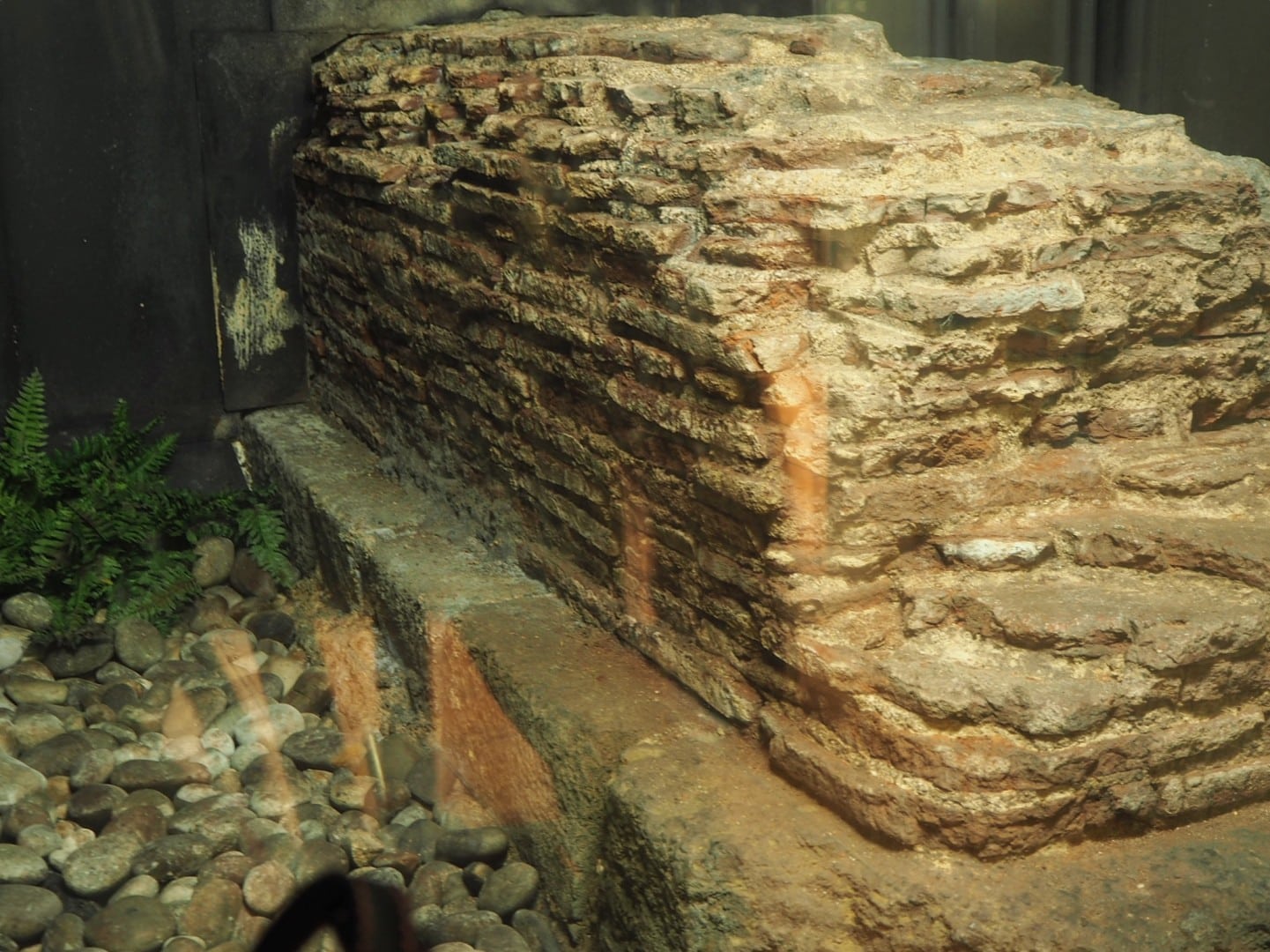
A Roman basilica was not originally a church. It was a multipurpose civic building, often characterized by a large central hall and adjoining spaces. Early Christian architects later adapted this architectural form for churches, helping establish the basilica as one of the most influential building types in European history.
Leadenhall Market, whose present Victorian structure was designed by Horace Jones in the nineteenth century, illustrates how commercial architecture continued to shape the same historic district. However, the modern market and the Roman basilica belong to distinct architectural periods; their relationship is one of urban continuity rather than evidence of an uninterrupted building tradition.
The 2025 discovery is especially important because it revealed how much of Londinium’s monumental architecture survived beneath later construction, despite centuries of redevelopment. Plans for the site’s redevelopment have included preserving and displaying the archaeological remains.
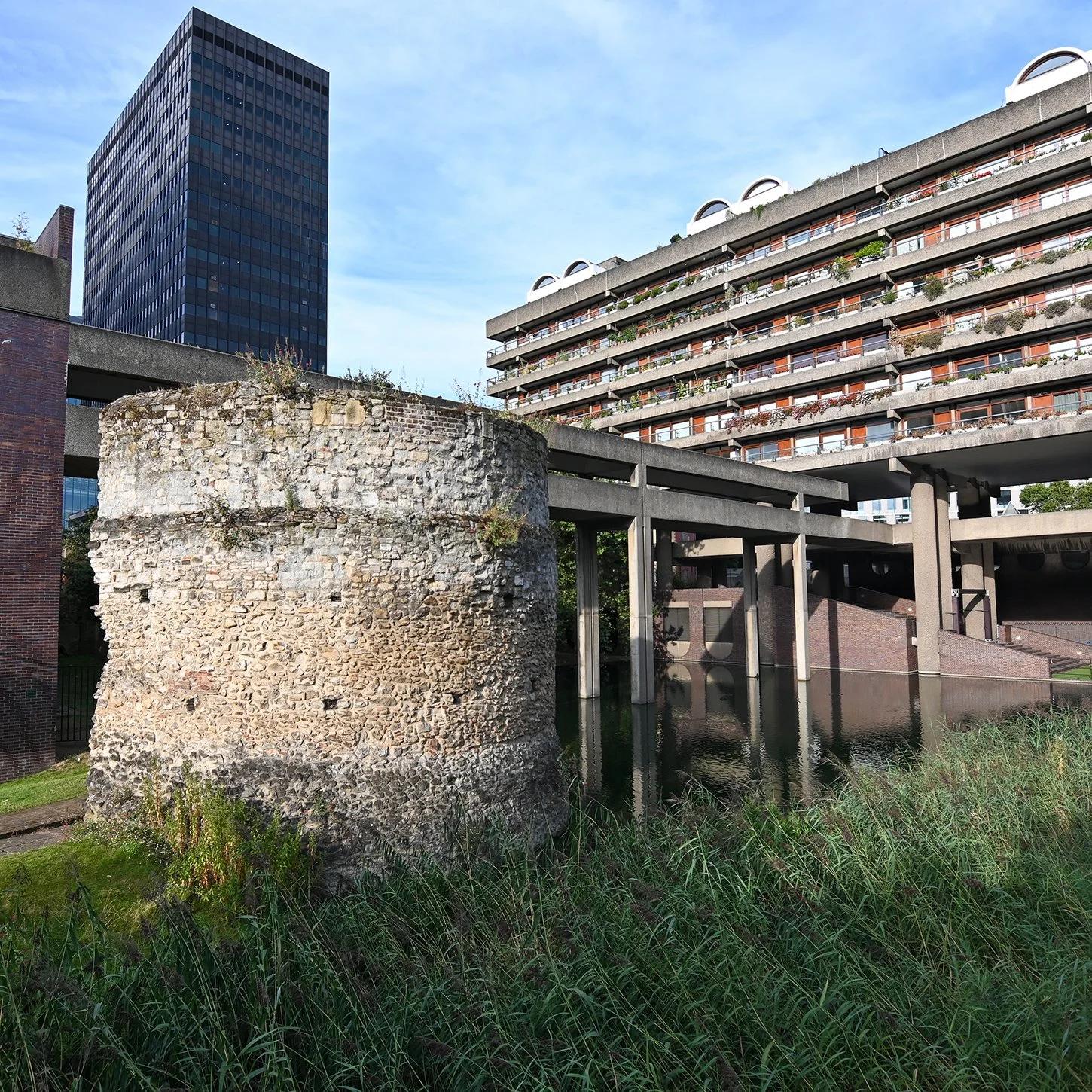
The Barbican presents another example of London’s layered architectural history. Today, the area is associated with monumental Brutalist architecture, elevated walkways, housing, cultural venues, and public spaces. Yet its history reaches back to Roman Londinium, when a fort occupied part of the northern settlement.
During the third century, Londinium acquired substantial defensive walls, some of which survive in fragments throughout the City of London. The walls were subsequently modified and incorporated into later structures, making them physical records of successive periods of urban development.
The Barbican’s architects, Chamberlin, Powell and Bon, developed a modernist complex that treated the historic environment as part of the wider urban landscape. Its architecture does not attempt to reproduce Roman buildings. Instead, it reflects a twentieth-century approach to reconstruction in which new structures coexist with fragments of the past.
This contrast illustrates a defining feature of London: its architectural history is not a sequence of completely separate cities but an accumulation of structures, street patterns, and surviving materials from different eras.
Roman London’s Wall and the Temple of Mithras
Other discoveries reinforce the scale and diversity of Londinium. Sections of the Roman wall remain visible in the historic core, sometimes alongside medieval masonry or later buildings. Their survival reflects the practical reuse of existing stonework as well as the preservation of selected ruins.
The Temple of Mithras offers a different perspective on Roman life. Dedicated to Mithras, a deity associated with a mystery cult practiced in parts of the Roman Empire, the temple provides evidence of religious practices within the city. Its remains were discovered during postwar redevelopment and are now presented at Bloomberg’s London headquarters as the London Mithraeum.
Together, the wall, basilica foundations, temple, and surviving road alignments reveal a city whose physical history extends well beyond its visible medieval and Victorian landmarks. Archaeology has become essential to understanding that history because modern construction continues to expose remains concealed beneath the contemporary street level.
How Londinium Shaped Modern London
Roman London did not survive as an unchanged urban settlement. Roman authority in Britain ended in the early fifth century, and Londinium was largely abandoned before settlement later returned to the area. The medieval city developed under different political, economic, and architectural conditions. Nevertheless, the Roman settlement established important geographical foundations for what followed.
Its position on the Thames, its historic river crossing, the alignment of major roads, and the location of its civic center helped shape the development of later London. Subsequent generations modified these features, but they did not erase every trace of the original city.
The discoveries beneath Gracechurch Street and elsewhere demonstrate why London’s Roman history remains an active field of research. Each excavation adds evidence to the reconstruction of Londinium, revealing how its inhabitants organized commerce, exercised government, practiced religion, and built a functioning urban community.
Modern London is not simply Roman Londinium preserved beneath a modern surface. It is a city repeatedly rebuilt around inherited geographical and architectural features. Its Roman origins remain visible not only in surviving ruins, but also in the enduring relationship between its streets, river, and historic center.
