
Near Tarragona, in northeastern Spain, the remains of the ancient Roman settlement of Tarraco, stands one of the most enigmatic monuments of late Roman Hispania: the complex of Centcelles. Distinguished by its remarkably preserved domed structure and elaborate fourth-century mosaics, Centcelles has generated longstanding debate over its original purpose. It may have served as a Christian mausoleum, an aristocratic burial monument, a religious building, or part of a larger imperial estate.
What makes Centcelles particularly significant is the survival of its monumental architecture and portions of a mosaic program that combines hunting scenes, biblical narratives, and enthroned figures. Together, these elements offer a rare glimpse into the religious beliefs, social ambitions, and artistic traditions of the Roman world during the fourth century AD, when Christianity was becoming increasingly influential across the empire.
From Roman Villa to Monumental Complex
Centcelles began as a Roman villa during the early Imperial period, when the surrounding territory formed part of the prosperous hinterland of Tarraco. As the capital of Hispania Citerior, Tarraco was an important administrative, commercial, and political center. Its surrounding countryside supported agricultural estates, residential villas, and settlements connected to the regional economy.
The site underwent a major transformation during late antiquity. In the fourth century, the earlier villa was replaced or substantially reorganized into a monumental complex whose defining feature was an enormous domed hall. The precise circumstances behind this redevelopment remain uncertain, and the identity of the person who commissioned it has never been conclusively established.
The surviving remains reveal an architectural arrangement that combined residential and functional spaces with a building of exceptional scale. At the western end of the complex stood two bath facilities, constructed during different phases of the site’s occupation. Both preserve evidence of a hypocaust, the underfloor heating system widely used in Roman baths and other buildings requiring controlled interior temperatures.
In a hypocaust, a furnace heated the air beneath a raised floor, allowing hot gases to circulate through the space below. In some installations, heat also traveled through cavities in the walls. This technology required careful construction and a reliable fuel supply, reflecting the engineering expertise and resources available to the estate’s occupants.
The baths formed part of a broader architectural ensemble whose principal rooms extended along a landscaped courtyard. The arrangement suggests that the complex was designed to accommodate more than ordinary domestic activities. Its monumental centerpiece, however, was the great domed chamber.
The Great Dome and Its Mosaic Decoration
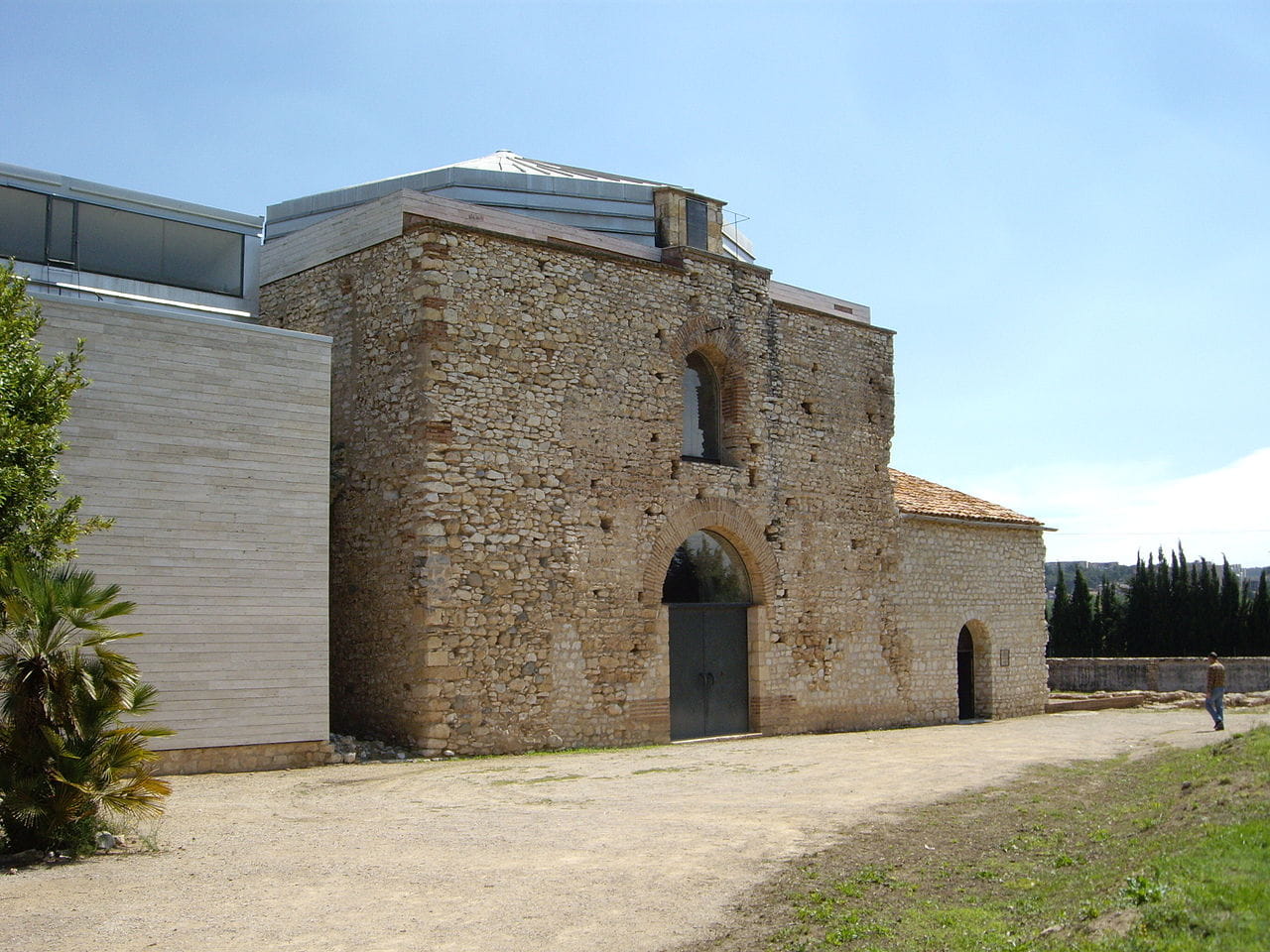
The central domed chamber is the defining feature of Centcelles. Its thick walls and circular form were constructed using brick and lime mortar, creating a robust structure capable of supporting a substantial roof. Despite centuries of alteration, the building retains much of its original architectural mass, making it an exceptional survival from late Roman Spain.
Its later history helped preserve the structure while obscuring its original function. During the Middle Ages, the domed building served as a church. In the nineteenth century, a three-story farmhouse was constructed within it. The later occupation eventually brought attention to the extraordinary mosaics that had survived inside the dome.
The original decorative program is estimated to have contained approximately one million individual tesserae, the small pieces of stone, glass, and other materials assembled to create mosaic images. Although substantial sections have disappeared, enough remains to reveal a carefully planned composition divided into three concentric registers. The arrangement progresses from scenes of earthly activity at the bottom to biblical imagery in the middle and more enigmatic, elevated figures above.
The Lower Register: Hunting and Aristocratic Power
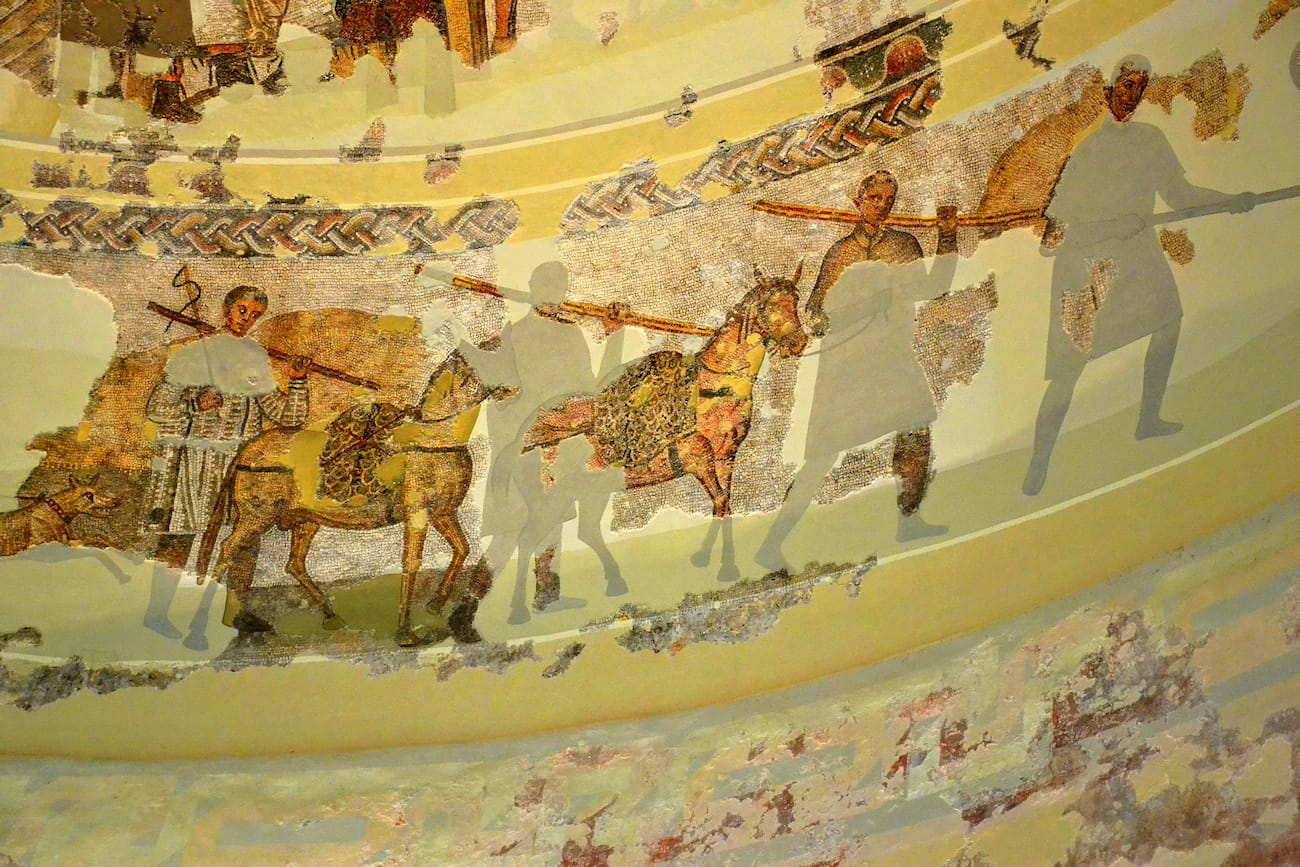
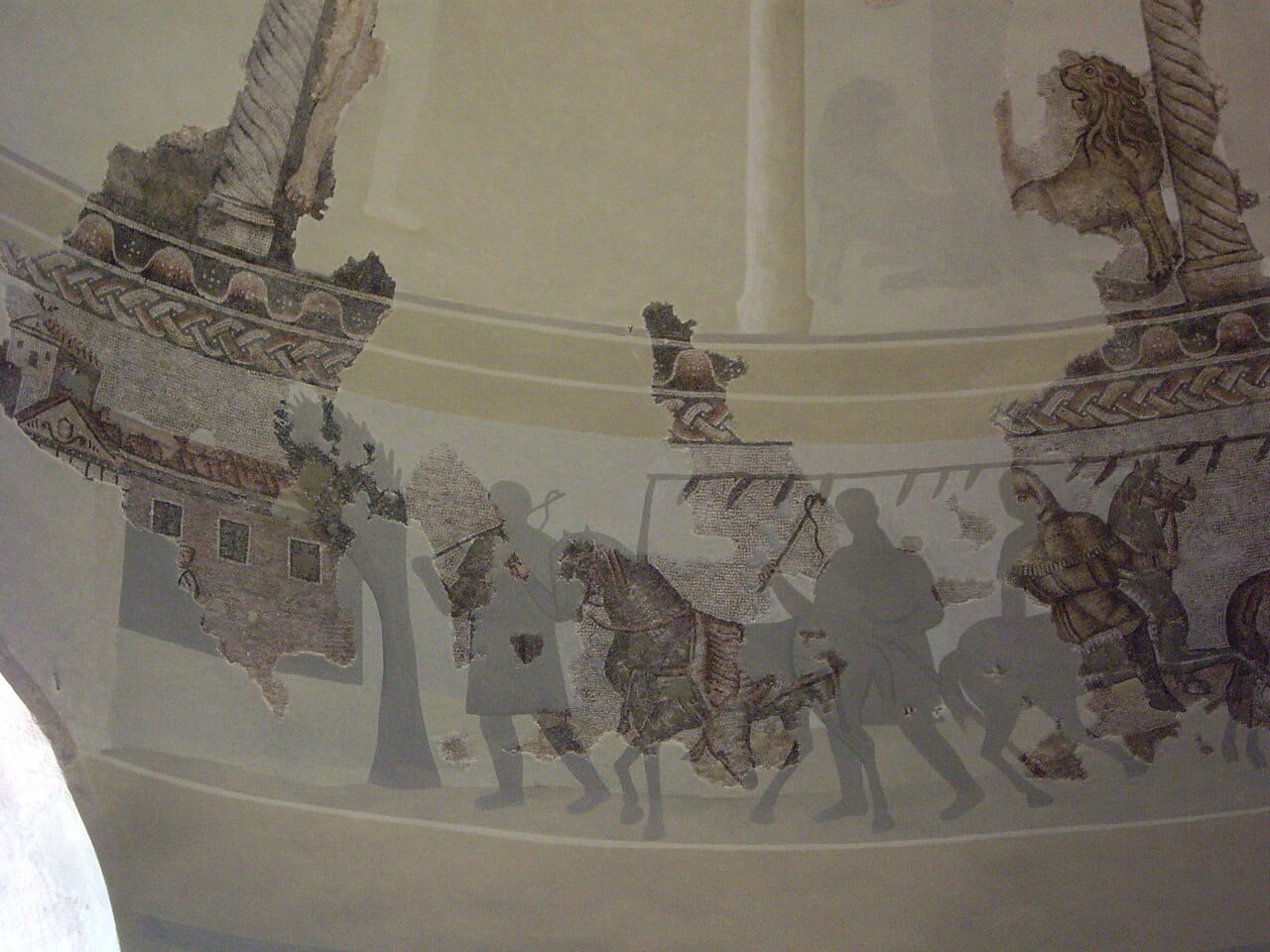
The lowest register is the best-preserved section of the dome’s decoration. It depicts a hunting expedition, a subject deeply associated with wealth, social rank, and elite identity in Roman art.
The scenes show hunters setting out from a villa, pursuing and capturing deer with nets, and returning from the hunt. The narrative presents hunting not simply as recreation but as a demonstration of organization, physical prowess, and command over the countryside.
Hunting imagery was a familiar feature of Roman elite residences. For wealthy landowners, the hunt was an opportunity to display status and reinforce their identity as members of the ruling class. Its inclusion at Centcelles therefore fits the visual language of aristocratic life in late antiquity.
One prominent figure in the hunting scenes may represent the estate’s owner. If this interpretation is correct, the mosaic connected the patron’s personal identity with the prosperity and prestige of the property. However, the figure has not been identified securely, and it cannot be assumed that the building’s commissioner was an emperor simply because the decoration is monumental.
The hunting scenes are particularly important because they place traditional Roman aristocratic culture alongside the explicitly Christian imagery higher in the dome. Rather than presenting a simple break with the past, Centcelles reflects a period when established elite customs and Christian beliefs could coexist within the same artistic program.
The Middle Register: Biblical Narratives and Christian Belief
Above the hunting scenes lies a register of biblical imagery drawn from both the Old and New Testaments. Despite losses to the mosaic surface, several episodes remain identifiable, including Jonah and the great fish, Noah’s Ark, Daniel in the lions’ den, and Christ depicted as the Good Shepherd.
These subjects carry associations with deliverance, protection, and salvation. Jonah’s survival after being swallowed by the great fish became an important Christian symbol of deliverance from death. Noah’s Ark represented preservation through catastrophe, while Daniel’s rescue from the lions illustrated divine protection in the face of mortal danger.
The Good Shepherd, one of early Christianity’s most recognizable images of Christ, emphasized care, guidance, and the salvation of the faithful. In late Roman funerary art, such imagery could express hope for life beyond death. Yet these themes were not exclusive to burial monuments; they also appeared in Christian settings associated with worship and elite patronage.
The combination of Old and New Testament scenes establishes the Christian character of the mosaic program. It demonstrates that the patron, or whoever commissioned the decoration, operated within a cultural environment in which biblical imagery had become an important means of communicating religious identity.
Nevertheless, Christian iconography alone does not prove that Centcelles was a mausoleum or a church. Christian owners could commission elaborate imagery for residences and ceremonial reception rooms as well as for religious and funerary buildings. The significance of the mosaics depends on their relationship to the architecture, archaeological context, and other evidence from the site.
The Upper Register: Seasons and Enigmatic Figures
The upper register is much more severely damaged, but its surviving fragments suggest a composition involving four enthroned figures separated by personifications of the seasons. At the very top of the dome, a central roundel has almost entirely disappeared.
The seasons were a longstanding motif in Roman art. They could symbolize the passage of time, agricultural abundance, the cyclical order of nature, and the continuity of prosperity. In a funerary setting, such imagery might also have suggested renewal and the hope of life beyond death.
The enthroned figures are harder to interpret. Various scholars have proposed that they represent emperors, members of a wealthy household, bishops, or other figures involved in formal ceremonies. Their identification is central to understanding the monument, because each interpretation points toward a different purpose for the building.
If the figures represent imperial rulers, the mosaic might express dynastic legitimacy and political authority. If they portray the estate’s owners, the scenes could have celebrated aristocratic status. An episcopal interpretation would instead place Centcelles within the institutional and religious life of the Christian community at Tarraco.
The damage prevents a definitive conclusion. Although the surviving imagery reveals the sophistication of the original composition, it does not provide an unambiguous identification of the figures or their relationship to the building’s patron.
Was Centcelles the Tomb of an Emperor?
The building’s original purpose remains the central archaeological question. One of the most influential interpretations identifies Centcelles as a mausoleum intended for Constans, the youngest surviving son of Constantine the Great and emperor of the western Roman Empire from 337 to 350.
Constans’s death provides a compelling historical context for the theory. In 350, he was overthrown by the usurper Magnentius. While attempting to escape, Constans was killed near Helena, generally identified with modern Elne in southern France, close to the eastern end of the Pyrenees.
Some scholars have proposed that his body was brought to Centcelles for burial. The building’s circular plan, monumental dome, and possible funerary function would be consistent with the broader tradition of imposing late Roman mausolea. A crypt beneath the domed chamber has also been cited as evidence supporting a burial-related interpretation.
Another important element of the argument concerns fragments of a porphyry sarcophagus reportedly removed from the structure during the Middle Ages. Porphyry, a distinctive purple stone associated with imperial authority, was used for important imperial monuments and burials. Fragments traditionally associated with Centcelles have been linked to a sarcophagus preserved at the Monastery of Santes Creus.
Taken together, these clues have encouraged the theory that Centcelles was intended to receive a member of the imperial family. Nevertheless, the identification of Constans as its intended occupant remains hypothetical. The sarcophagus fragments do not independently establish whose remains they once contained, and the building’s architecture cannot by itself prove an imperial commission.
More recent scholarship has challenged the certainty of this interpretation, questioning whether the upper mosaic figures depict emperors at all. Some researchers instead identify them as the owners of the estate or as members of the Christian ecclesiastical hierarchy.
Alternative Interpretations: Villa, Church, or Military Headquarters?
The imperial mausoleum theory is only one of several explanations proposed for Centcelles.
One alternative is that the building formed part of an exceptionally elaborate late Roman villa belonging to a wealthy aristocratic family. Under this interpretation, the domed room served as a ceremonial reception hall, where visitors encountered a carefully designed display of the owner’s wealth, religious identity, and social position.
The mosaic’s combination of hunting scenes, biblical narratives, and seasonal imagery would fit such a setting. The hunting scenes could celebrate aristocratic status, while the biblical episodes expressed Christian belief. The upper register might have portrayed the household itself, presenting the owners as prominent figures within the social and religious order of late Roman society.
Another interpretation associates Centcelles with the Christian Church. Its biblical imagery and monumental architecture have led scholars to consider whether the complex served a bishop or another high-ranking ecclesiastical figure. The building could have included a ceremonial or religious space without necessarily functioning as a dedicated church from the outset.
A further proposal places the monument in the context of the fifth-century military and political history of Tarraco. Researchers Josep Anton Remolà Vallverdú and Meritxell Pérez Martínez have argued that Centcelles may have formed the central area of a late Roman military encampment associated with the comes Hispaniarum, the senior imperial military commander responsible for operations in Hispania. Their interpretation connects the complex with the presence of the commander Asterius at Tarraco around 420 AD.
This proposal challenges the conventional fourth-century dating and suggests that the monumental complex may have played a role in the imperial government’s efforts to reassert authority over the Iberian Peninsula during a period of political instability. It remains a scholarly hypothesis rather than an established identification.
The competing interpretations demonstrate why Centcelles cannot be understood through its mosaics alone. Archaeological stratigraphy, construction phases, architectural analysis, and the historical context must all be considered together. The possibility that the building’s purpose changed during its lifetime further complicates the question.
Centcelles and the Transformation of the Roman World
Whatever its original function, Centcelles captures a significant moment in the transformation of Roman society during late antiquity.
The fourth century was a period of profound religious and political change. Christianity had moved from a persecuted religion to one increasingly supported by imperial power. Constantine’s reign helped establish this transition, while his successors continued to reshape the relationship between the Roman state and Christian institutions.
Yet traditional Roman cultural practices did not disappear. Hunting remained an important expression of elite status, monumental architecture continued to communicate authority, and classical artistic conventions persisted alongside Christian themes.
Centcelles brings these traditions together in a single decorative program. Its hunting scenes belong to the established visual language of Roman aristocratic life, while the biblical imagery reflects Christianity’s growing cultural prominence. The upper register, with its enthroned figures and seasonal symbolism, may have connected religious belief with social authority, although its precise meaning remains disputed.
The quality and scale of the mosaics also indicate access to considerable resources and specialized craftsmanship. Their execution required skilled mosaicists, carefully selected materials, and a patron capable of commissioning a complex decorative scheme on a monumental scale.
Today, Centcelles forms part of the UNESCO World Heritage listing associated with the archaeological ensemble of ancient Tarraco, recognized in 2000. It stands as one of the most important surviving examples of late Roman architecture and Christian-themed mosaic decoration in the region.
