
Silbannacus is one of the most obscure figures associated with the Roman Empire. No surviving ancient historian mentions him. No inscription records his name, and no statue preserves his image. His existence became known only through a single silver coin acquired by the British Museum in 1937.
For decades, that coin remained the only evidence for him. In 1996, however, a second coin was published. It carried the same name and portrait and was struck from the same obverse die as the British Museum specimen. Its reverse type was closely related to coinage of the emperor Aemilian, providing evidence that Silbannacus probably ruled briefly in Rome during the political crisis of AD 253.
Key Takeaways
- Silbannacus is known from only two surviving antoniniani.
- His coins identify him as IMP MAR SILBANNACVS AVG.
- The first specimen entered the British Museum in 1937 and was reportedly found in Lorraine.
- The second specimen was discovered near Paris and published in 1996.
- Both coins share the same obverse die, strongly supporting their authenticity.
- The coins are now generally associated with Rome in AD 253.
- Silbannacus probably ruled for a very short period during the struggle between Aemilian and Valerian.
- His reign is absent from the surviving literary sources.
The First Coin
The British Museum’s coin is a silver antoninianus measuring approximately 23 millimeters and weighing 3.53 grams. It shows Silbannacus wearing a radiate crown and cuirass.
Its inscription identifies him as:
IMP MAR SILBANNACVS AVG
The reverse depicts Mercury holding Victory and a caduceus, accompanied by the legend VICTORIA AVG. The British Museum dates the coin to AD 253 and identifies Rome as its mint.
The coin was acquired in 1937 after reportedly being found in Lorraine.
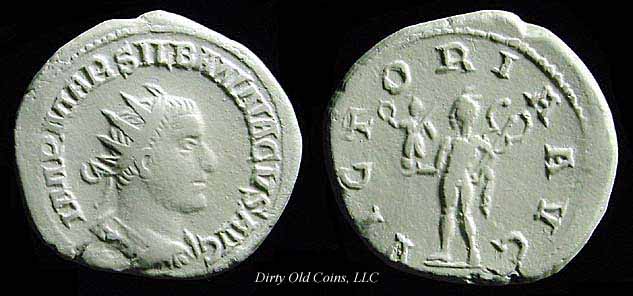
Because no written source mentions Silbannacus, the uniqueness of the coin initially created doubts about whether the emperor and his coinage were genuine.
The Second Coin
The decisive evidence appeared in 1996.
A second antoninianus bearing Silbannacus’ name was published by numismatist Sylviane Estiot. It had reportedly been discovered near Paris.
Its obverse was struck from the same die used for the British Museum specimen. This was important because it demonstrated that the two coins belonged to the same genuine issue rather than representing two unrelated modern objects.
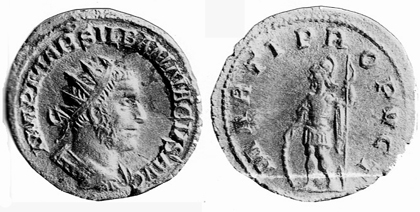
The reverse was different. It showed Mars with the legend MARTI PROPVGT, meaning Mars the Defender.
More importantly, the type and style closely resembled coinage produced for Aemilian at Rome. Estiot concluded that Silbannacus’ coinage was produced at the Roman mint and dated his brief usurpation to the autumn of AD 253.
Who Was Silbannacus?
Almost nothing is known about his background.
The name Silbannacus is unusual and has sometimes been interpreted as having a Celtic or provincial character. The abbreviation MAR on the coins may represent part of his Roman name, but its precise expansion is uncertain.
The name cannot establish his birthplace.
His coins provide stronger evidence. They show that he claimed the title Augustus and issued money using the standard imagery and conventions of Roman imperial coinage.
That indicates an attempt to exercise legitimate imperial authority rather than simply leading a local rebellion.
Silbannacus and the Crisis of 253
AD 253 was one of the most unstable years of the third century.
The emperor Trebonianus Gallus was overthrown by Aemilian, who had been proclaimed emperor by his troops. Aemilian moved rapidly into Italy and seized Rome.
His reign lasted only a few months.
The army commander Valerian, who was operating with forces in the north, was then proclaimed emperor against Aemilian. Aemilian marched to confront him, but his own soldiers assassinated him before the two armies fought.
Valerian subsequently became emperor.
This rapid succession created a narrow period in which control of Rome could have been contested.
Silbannacus may belong to this interval.
Political Situation in AD 253
| Emperor | Reign | Position |
|---|---|---|
| Trebonianus Gallus | 251–253 | Overthrown by Aemilian |
| Aemilian | 253 | Overthrew Gallus; later assassinated |
| Silbannacus | c. 253 | Extremely brief and poorly documented |
| Valerian | 253–260 | Defeated the remaining opposition |
The exact position of Silbannacus within this sequence cannot be proven, but the coin evidence makes AD 253 the strongest proposed date.
The Roman Mint
The most important clue is the style of Silbannacus’ second coin.
Its portrait and reverse closely resemble issues associated with Aemilian’s coinage from Rome. The shared obverse die between the two Silbannacus specimens further demonstrates that the coins came from the same production sequence.
This makes a temporary occupation of Rome more likely than the older theory that Silbannacus was a Rhine-based commander.
The British Museum now states that his coinage was apparently produced at Rome and that his brief authority probably included control of the capital but little else.
The Gallic Connection
Both known Silbannacus coins were reportedly found in France.
The first came from Lorraine; the second was found near Paris.
This originally encouraged the theory that Silbannacus was a Gallic or Rhine military commander.
The evidence is not sufficient to support that conclusion.
Roman coins circulated throughout the empire, particularly with military units. A coin struck in Rome could easily reach Gaul through soldiers, merchants or administrative movement.
The French findspots therefore establish where the surviving coins were eventually deposited, not necessarily where Silbannacus ruled.
His unusual name may suggest a Gallic connection, but the numismatic evidence points more strongly toward Rome.
Mercury and Mars
Silbannacus used two different religious images on his known coins.
Mercury
The first coin depicts Mercury holding Victory and a caduceus, accompanied by VICTORIA AVG.
The imagery emphasizes victory and imperial success.
Mercury was particularly prominent in the religious traditions of Gaul, but his appearance does not prove that Silbannacus ruled there.
Mars
The second coin depicts Mars the Defender.
Mars was an obvious choice for a military ruler during a civil war. The type also provides the stronger chronological clue because of its relationship with Aemilian’s Roman coinage.
The End of Silbannacus
Silbannacus’ fate is unknown.
If he controlled Rome after Aemilian’s death, his position would have been threatened immediately by Valerian’s advancing forces.
There is no surviving account of a battle between them and no source describing Silbannacus’ death.
His extremely limited coinage suggests that his authority lasted only briefly.
The most likely explanation is that Valerian’s victory ended the regime before Silbannacus could establish wider support.
Whether he was killed, executed, or removed in another way cannot be determined.
Why Silbannacus Matters
Silbannacus demonstrates how incomplete the written record of Roman history can be.
A man could claim the imperial title, control a major imperial mint and issue official-looking currency without appearing in the surviving histories.
His existence was reconstructed almost entirely through numismatics.
The two coins provide evidence for:
- His imperial name and title
- His portrait
- His use of Roman imperial coinage
- His probable date
- His probable connection with the mint of Rome
- His association with the political crisis of AD 253
The second coin transformed Silbannacus from a questionable name on a unique object into a historically credible, though extremely obscure, Roman ruler.
The strongest interpretation is that Silbannacus briefly controlled Rome in AD 253 during the collapse of Aemilian’s regime and the rise of Valerian. His authority was short-lived, his political reach appears to have been limited, and his reign disappeared from the written record.
Two coins are all that remain.
