
Lucius Annaeus Seneca the Younger (c. 4 BC–AD 65) was one of the most influential intellectuals of Imperial Rome: a Stoic philosopher, statesman, dramatist, essayist, and political adviser who rose from exile to become one of the most powerful figures in the early reign of Emperor Nero. His career was defined by contradictions. He preached self-command while accumulating immense wealth, advocated clemency while serving an increasingly violent emperor, and sought philosophical withdrawal while remaining entangled in imperial politics.
Yet reducing Seneca to a hypocrite misses the historical complexity of his life. His writings represent one of the most substantial surviving bodies of Roman Stoic thought, while his tragedies profoundly influenced European drama. His life also provides an unusually revealing view of the moral and political compromises demanded of an elite Roman who attempted to practice philosophy within the imperial court.
Early Life and Education
Seneca was born in Colonia Patricia Corduba, modern Córdoba in southern Spain, in the Roman province of Baetica. His exact birth year is uncertain, with ancient evidence allowing dates around 8, 4, or 1 BC; modern scholarship commonly places it around 4 BC.
His father, Seneca the Elder, was a Roman equestrian and celebrated rhetorician who spent much of his career in Rome. Seneca was the second of three brothers. His elder brother, Lucius Annaeus Novatus, later adopted the name Junius Gallio and became a prominent provincial governor. His younger brother, Annaeus Mela, was the father of the poet Lucan.
Seneca was brought to Rome as a young child, probably around the age of five. There he received the conventional elite education in grammar, literature, rhetoric, and public speaking. Philosophy, however, became central to his intellectual development.
Among his teachers were the Stoic Attalus and the philosophers Sotion and Papirius Fabianus, associated with the School of the Sextii. Seneca was particularly attracted to Stoic discipline, although his philosophical interests remained broader than strict adherence to a single intellectual tradition. He also read Epicurus and drew upon Platonic and other philosophical ideas.
His youth was interrupted by serious illness. He suffered chronic respiratory problems and apparently endured a prolonged period of severe illness, possibly tuberculosis. He eventually went to Egypt to stay with his maternal aunt, whose husband, Gaius Galerius, served as prefect of Egypt. He spent several years there before returning to Rome around AD 31.
The experience appears to have strengthened his interest in philosophy, nature, mortality, and the relationship between physical adversity and mental resilience—subjects that would dominate his later writings.
Entry Into Roman Politics
Seneca’s return to Rome marked the beginning of his political career. Through family connections, particularly the influence of his aunt, he entered public life and eventually became a quaestor, giving him entry into the Senate.
He quickly acquired a reputation as an exceptionally effective speaker. His rhetorical talent, however, was potentially dangerous in an imperial system where political success could provoke the suspicion of the emperor.
The ancient historian Cassius Dio records a dramatic story that Caligula was so irritated by Seneca’s oratorical ability that he considered ordering his execution. According to the story, Seneca survived because Caligula was persuaded that his serious illness would soon kill him anyway. The reliability of this episode cannot be established with certainty, but it illustrates the precarious position of ambitious senators under the Julio-Claudian emperors.
Seneca’s relationship with imperial power became considerably more dangerous after Claudius became emperor in AD 41.
Exile Under Claudius
In AD 41, Seneca was accused of adultery with Julia Livilla, the sister of Caligula and Agrippina the Younger. The accusation came amid a political struggle surrounding Julia and her supporters. The precise truth of the alleged affair remains uncertain, and modern historians have generally treated the charge with caution.
The Senate condemned Seneca to death, but Claudius commuted the sentence to exile. Seneca was sent to Corsica, where he remained for approximately eight years.
Exile represented a profound reversal. A rising Roman senator had been removed from political life and isolated from the center of power. Seneca responded by turning his circumstances into philosophical material.
During this period he wrote the Consolation to Helvia, addressed to his mother, and the Consolation to Polybius. The former argued that exile could not deprive a person of the things that genuinely constituted happiness. Virtue, reason, and moral character remained within one’s control.
The Consolation to Polybius, however, reveals another side of Seneca. Written to Claudius’s powerful freedman after the death of his brother, it contains extravagant praise of the emperor and an implicit appeal for Seneca’s recall.
The work demonstrates the tension that would follow Seneca throughout his life: the philosopher advocating detachment from political fortune was also a Roman politician determined to regain his position.
Recall and the Education of Nero
Seneca’s opportunity came in AD 49, after Agrippina the Younger married her uncle, Emperor Claudius. Agrippina arranged for Seneca’s recall from Corsica and helped secure his appointment as praetor.
More importantly, she made him tutor to her son, Nero.
This appointment transformed Seneca’s prospects. Nero was being prepared for an imperial future, and Seneca became one of the intellectual forces responsible for shaping the young prince.
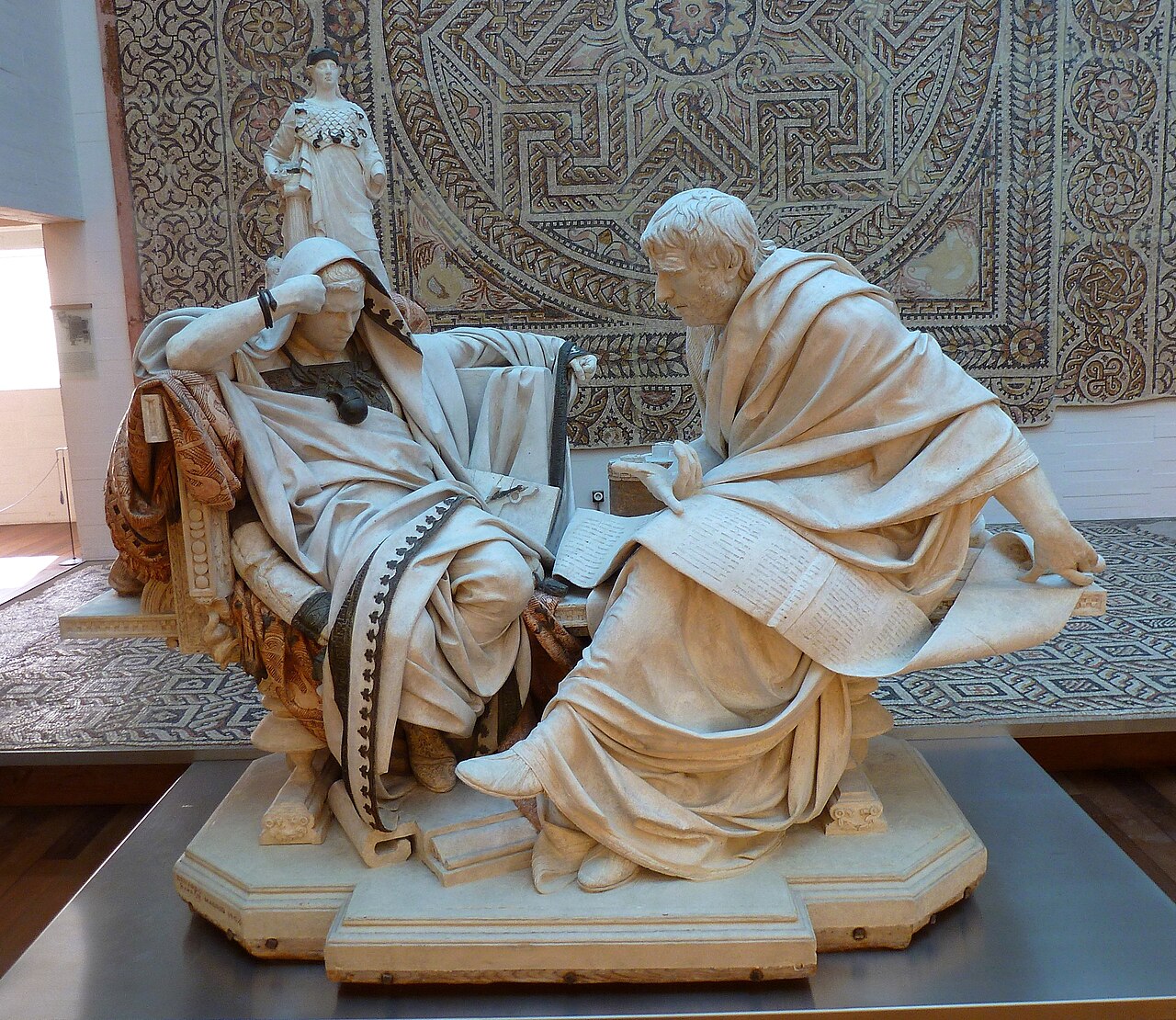
When Claudius died in AD 54, Nero became emperor at approximately 16 years of age. Seneca and the Praetorian Prefect Sextus Afranius Burrus emerged as the young emperor’s principal advisers.
For roughly the first five years of Nero’s reign, Seneca and Burrus exercised substantial influence over imperial administration. Ancient sources, particularly Tacitus and Cassius Dio, portray this early period as comparatively stable and orderly.
Seneca helped construct Nero’s public image and political program. He composed or helped formulate the emperor’s accession speech, which emphasized respect for the Senate and a restoration of proper legal procedure.
His position also required him to reconcile philosophical ideals with political necessity.
Seneca and the Murder of Britannicus
That compromise became increasingly difficult after Nero ordered the murder of his stepbrother Britannicus in AD 55.
Shortly afterward, Seneca composed De Clementia (On Clemency), addressed directly to Nero. The work presented clemency as one of the defining virtues of a ruler.
Its political purpose was significant. Seneca sought to establish the philosophical principle that imperial power should be restrained by reason rather than driven by fear, anger, vengeance, or arbitrary violence.
The work therefore functioned simultaneously as philosophy and political counsel. Seneca could not simply condemn imperial violence from outside the system; instead, he attempted to persuade the emperor that mercy and self-restraint were characteristics of a superior ruler.
That strategy had limited success.
Wealth, Power, and the Problem of Hypocrisy
Seneca’s growing political influence brought enormous financial rewards. By the late 50s, he had accumulated extensive property and wealth, including estates in Italy and holdings associated with Egypt.
In AD 58, the senator Publius Suillius Rufus publicly attacked Seneca. According to Tacitus and Cassius Dio, Suillius accused him of exploiting his position to accumulate approximately 300 million sestertii through loans and high interest rates. He also made accusations of sexual misconduct.
The reliability of Suillius’s allegations is questionable. Tacitus portrays him as a compromised figure with his own history of corruption and political opportunism. Nevertheless, the scale of Seneca’s wealth is not simply a hostile invention. He was undeniably extremely rich.
The criticism created a philosophical problem that Seneca confronted directly.
In De Vita Beata (On the Happy Life), he argued that wealth itself was neither good nor evil. A Stoic could possess money provided that he remained psychologically independent of it. Wealth could be used for virtuous purposes without becoming the source of happiness.
The distinction was fundamental to Seneca’s Stoicism: external possessions were indifferents. What mattered was how a person used them and whether attachment to them corrupted reason.
Yet the contradiction remained visible. Seneca was a wealthy imperial adviser writing about the dangers of material attachment while participating in the financial and political structures of Nero’s government.
The tension would become one of the defining features of his historical reputation.
The Murder of Agrippina
Seneca’s relationship with Nero became more morally complicated in AD 59.
Nero ordered the murder of his mother, Agrippina, after years of political tension between them. Seneca and Burrus appear to have been involved in managing the aftermath. Tacitus reports that Seneca subsequently drafted a letter to the Senate presenting Agrippina as a conspirator against her son.
For Seneca, this was a critical moment.
The philosopher who had written about clemency was now helping justify the killing of the emperor’s mother. Whatever his personal reservations may have been, his participation tied him directly to the machinery of imperial violence.
This episode also demonstrates the limitations of treating Seneca as either a secret opponent of Nero or a simple architect of Nero’s tyranny. The surviving evidence suggests a more complicated figure—someone who attempted to influence imperial behavior while repeatedly compromising himself by remaining within the imperial system.
Withdrawal From Nero’s Court
Burrus died in AD 62, and Seneca’s political position deteriorated rapidly. Tacitus explicitly connects Burrus’s death with the collapse of Seneca’s influence.
New advisers gained greater access to Nero, while Seneca increasingly withdrew from public life. He reportedly attempted to retire in AD 62 and again around AD 64. He offered to return his wealth to Nero, but the emperor refused.
Seneca nevertheless moved away from the center of government. His final years were increasingly devoted to philosophical writing and study.
This period produced two of his most important surviving works: the Naturales Quaestiones and the Epistulae Morales ad Lucilium, or Letters to Lucilius.
Seneca the Stoic Philosopher
Seneca’s philosophical achievement lies principally in adapting Stoicism to the realities of Roman life.
Earlier Greek Stoicism had developed an extensive system encompassing logic, physics, and ethics. Seneca concentrated heavily on ethics and practical moral psychology.
For him, philosophy was not an abstract academic exercise. It was training for life.
His writings examine anger, grief, fear, friendship, wealth, political power, adversity, aging, death, and the proper use of time. He repeatedly insists that people suffer not merely because events occur but because their judgments about those events can become irrational.
The Letters to Lucilius are particularly important because they present philosophy as an ongoing process of moral self-improvement. Seneca does not consistently portray himself as someone who has achieved perfect wisdom. Instead, he presents himself as a person attempting to improve through reflection and disciplined practice.
One of his central concerns is time. Human beings, he argues, often complain about the shortness of life while wasting large portions of it. The problem is therefore not simply how long one lives, but how deliberately one uses the time available.
He also repeatedly returns to death. Mortality, for Seneca, should not produce paralysis. Awareness of death should clarify priorities and diminish dependence upon temporary external circumstances.
Naturales Quaestiones and the Natural World
Seneca’s philosophical interests extended beyond ethics.
The Naturales Quaestiones investigates phenomena including comets, lightning, earthquakes, winds, water, and other aspects of the natural world. It reflects the Stoic belief that nature was governed by rational principles and that understanding the cosmos could contribute to moral development.
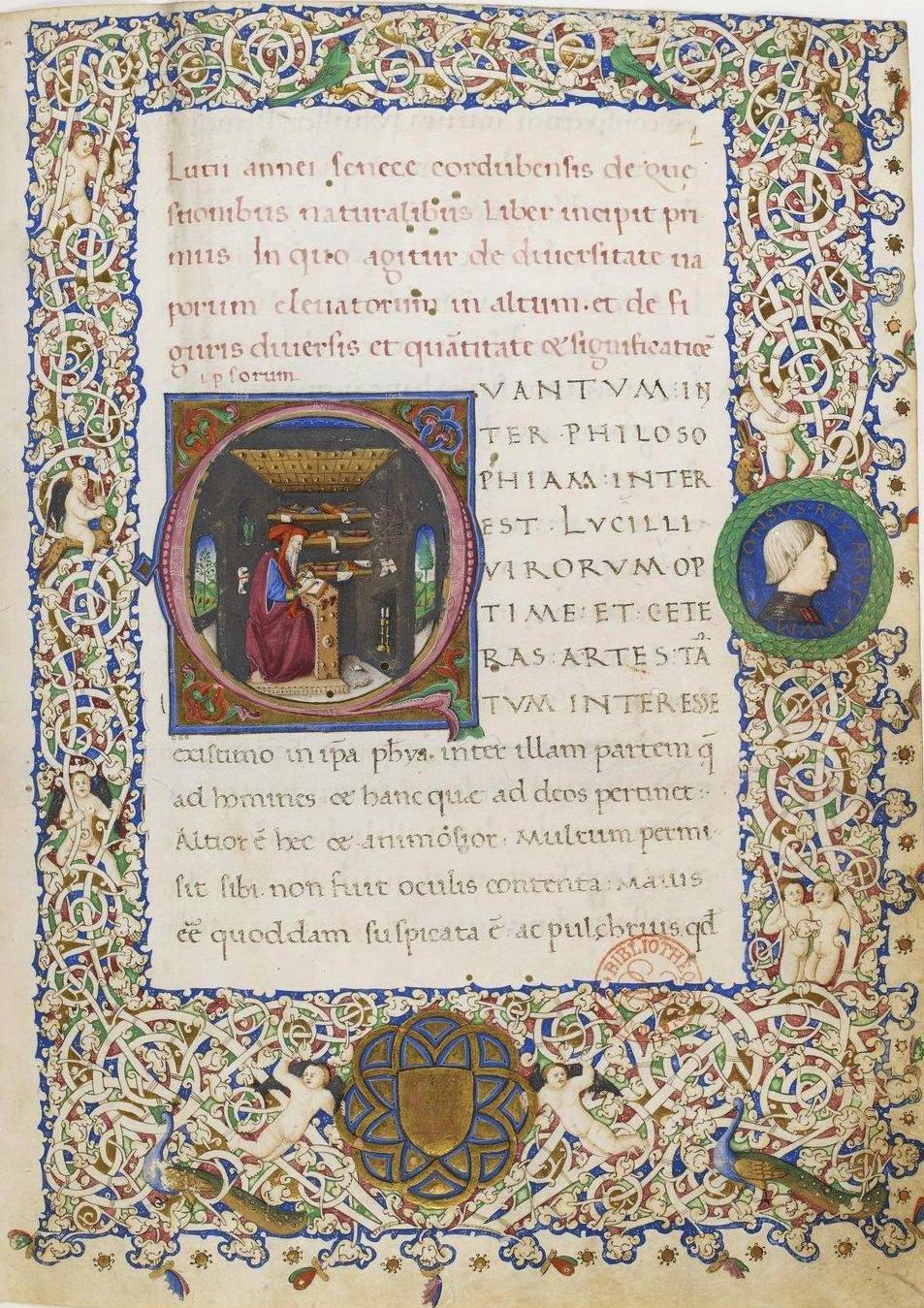
Seneca did not possess modern scientific knowledge, and many of his explanations are now obsolete. Nevertheless, the work demonstrates the breadth of Roman intellectual culture and Seneca’s conviction that studying nature had ethical significance.
Understanding the universe could teach human beings humility about their own position within it.
Seneca the Dramatist
Seneca’s literary legacy extends far beyond philosophy.
A group of Latin tragedies is traditionally attributed to him, including Medea, Phaedra, Thyestes, Agamemnon, Oedipus, Hercules Furens, Troades, and Phoenissae. The authorship and chronology of some works remain subjects of scholarly debate, but the Senecan dramatic tradition is firmly established.
His tragedies are characterized by extreme psychological tension, revenge, rage, political violence, incest, murder, and supernatural imagery.
At first glance, they seem radically different from the controlled rationality of his Stoic prose. Yet the contrast is significant. Seneca’s tragedies repeatedly dramatize what happens when passion overwhelms reason.
Medea, for example, presents vengeance consuming moral judgment. Thyestes explores the catastrophic consequences of dynastic hatred. Phaedra examines destructive desire and the inability of reason to control overwhelming passion.
Whether these plays were primarily intended for stage performance or literary recitation remains debated. Their influence, however, is beyond dispute. Renaissance writers rediscovered Senecan tragedy, and its structures, rhetoric, violence, ghosts, revenge, and psychological intensity helped shape European drama.
The Pisonian Conspiracy and Death
Seneca’s final confrontation with Nero came in AD 65.
The Pisonian conspiracy was an extensive plot involving senators, equestrians, soldiers, and other figures who planned to kill Nero. The surviving evidence does not establish convincingly that Seneca was an active participant.
Nevertheless, Seneca’s connections with some conspirators were enough to make him vulnerable after the conspiracy was uncovered.
Nero ordered him to commit suicide.
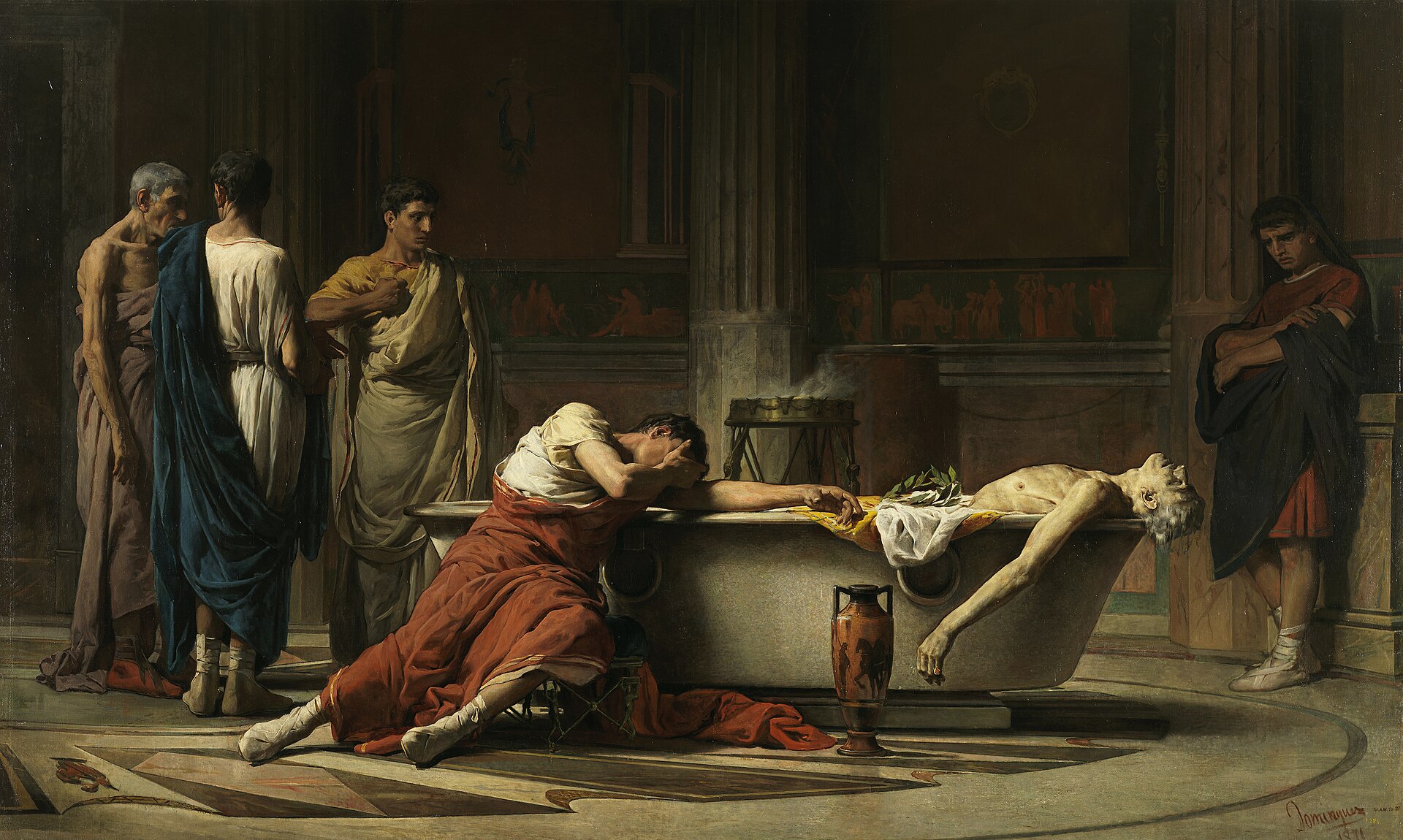
Seneca obeyed.
According to Tacitus, Seneca opened his veins while surrounded by friends. His wife, Pompeia Paulina, attempted to die alongside him, but Nero ordered that her life be saved.
Seneca’s own death was apparently prolonged. Because the bleeding was insufficient, he also took poison, but this too failed to kill him quickly. Eventually he entered a warm bath in the hope that the heat would accelerate the loss of blood.
Tacitus states that Seneca ultimately died from the combination of blood loss and the effects of the bath’s steam. His body was cremated without elaborate funeral ceremonies, reportedly in accordance with instructions he had made earlier.
The account has become one of the most famous death scenes in Roman history, although Tacitus’s presentation is literary as well as historical. His depiction of Seneca’s final hours emphasizes philosophical composure, but it also leaves room for ambiguity about how much of that composure was genuine behavior and how much was a carefully constructed final image.
Legacy
Seneca’s influence survived the collapse of the Julio-Claudian dynasty.
His Latin prose became one of the principal vehicles through which Stoic ethics reached medieval and Renaissance Europe. Early Christian writers were attracted to his emphasis on moral discipline, self-control, charity, humility, and the proper attitude toward wealth and death.
A fabricated correspondence between Seneca and the Apostle Paul further strengthened the medieval perception of Seneca as a philosopher unusually compatible with Christianity.
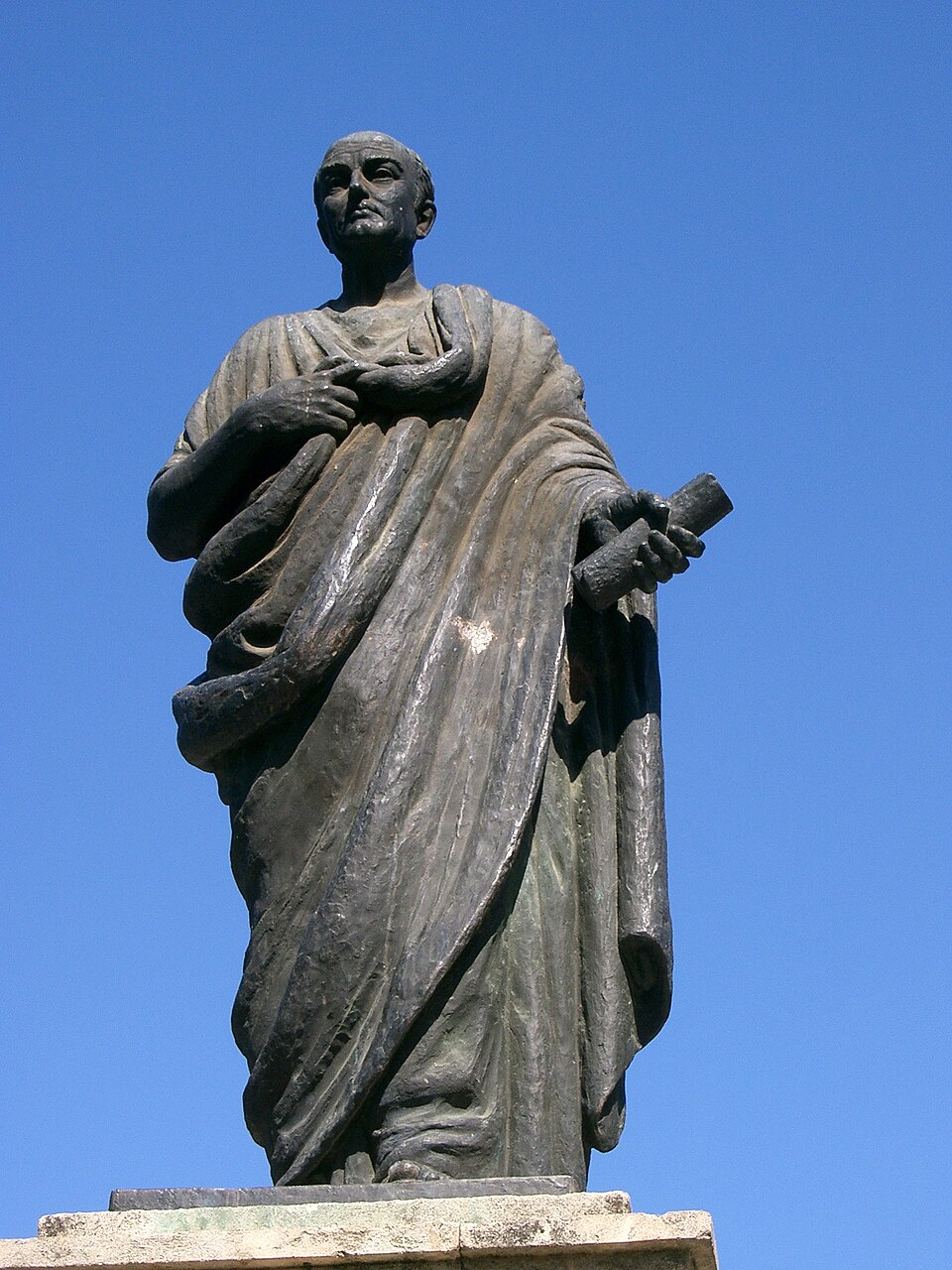
During the Renaissance, his reputation expanded dramatically. Writers including Michel de Montaigne admired his moral essays and letters, while Senecan tragedy became a major influence on European theatrical traditions.
His philosophical legacy has proved particularly durable because he addressed problems that do not depend upon Roman political institutions: how to respond to anger, how to deal with grief, how to use wealth without becoming dependent upon it, how to value friendship, how to confront mortality, and how to retain moral agency under difficult circumstances.
