
In AD 193, the Roman Empire witnessed one of the most extraordinary episodes in its political history. Following the assassination of Emperor Commodus and the subsequent murder of his successor, Pertinax, the Praetorian Guard offered imperial power to the highest bidder. The man who secured the throne was Marcus Didius Julianus, a wealthy Roman senator whose reign would last just 66 days.
His brief rule exposed the growing influence of the military in imperial succession and the vulnerability of Roman emperors who lacked the support of the army, Senate, and population. Although Julianus possessed considerable wealth and political experience, neither proved sufficient to secure his position.
From a Distinguished Family to the Roman Senate
Marcus Didius Julianus was born in Mediolanum, modern-day Milan, into a prominent Roman family. His exact birth date remains disputed. The historian Cassius Dio places it on January 30, AD 133, while the Historia Augusta gives February 2, AD 137. The former is generally preferred, although neither date can be established with complete certainty.
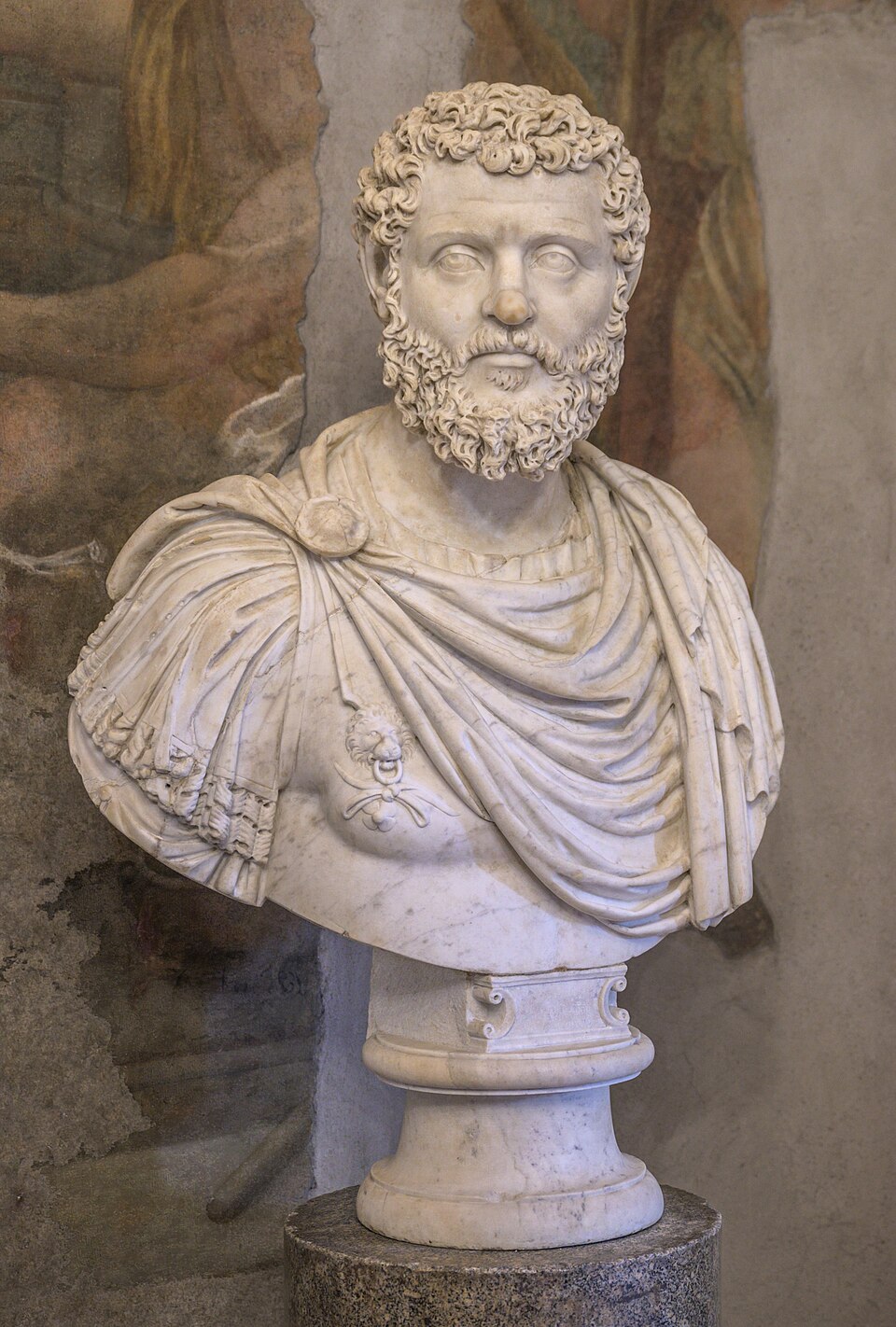
Julianus benefited from influential connections during his early career. According to the Historia Augusta, he was raised under the patronage of Domitia Lucilla, the mother of Emperor Marcus Aurelius. This connection helped him enter public life and advance through the imperial administration.
He progressed through the traditional sequence of Roman public offices, serving as quaestor and aedile before becoming praetor. Although his career was primarily administrative, he also received military responsibilities, including command of the Legio XXII Primigenia, stationed in Germania Superior.
His subsequent appointment as governor of Gallia Belgica brought him greater distinction. Ancient accounts credit him with repelling an invasion by the Chauci, a Germanic people who threatened the province’s northern territories. His performance helped secure his advancement to the consulship in AD 175, which he shared with Publius Helvius Pertinax, the future emperor.
The Fall of Commodus and the Crisis of AD 193
Julianus’s fortunes changed after Marcus Aurelius died in AD 180 and his son Commodus became emperor. Unlike his predecessor, Commodus developed a reputation for political suspicion and harsh treatment of perceived opponents.
Julianus was eventually recalled from his provincial command and appointed to oversee the distribution of public funds to impoverished Italians. His position became more precarious when he was accused of involvement in a conspiracy against Commodus. He escaped execution after being acquitted, while his accuser was put to death.
He subsequently governed Bithynia and served as proconsul of Africa before returning to Rome.
Commodus was assassinated on December 31, AD 192, ending his reign and triggering a succession crisis. His successor, Pertinax, attempted to restore discipline within the Praetorian Guard, the elite military unit responsible for protecting the emperor. However, his efforts to impose stricter standards and reduce the soldiers’ privileges provoked a violent response.
On March 28, AD 193, members of the Praetorian Guard murdered Pertinax after only 86 days on the throne.
The Auction of the Roman Empire
With Pertinax dead, the Praetorian Guard found itself in an extraordinary position. It controlled access to the imperial palace and could influence who would succeed the murdered emperor.
Two prominent men emerged as contenders: Didius Julianus and Titus Flavius Sulpicianus, Pertinax’s father-in-law and the prefect of Rome.
According to Cassius Dio and Herodian, the soldiers effectively offered imperial power to whichever candidate promised the largest financial reward. Julianus arrived at the Praetorian camp and entered a bidding contest with Sulpicianus.
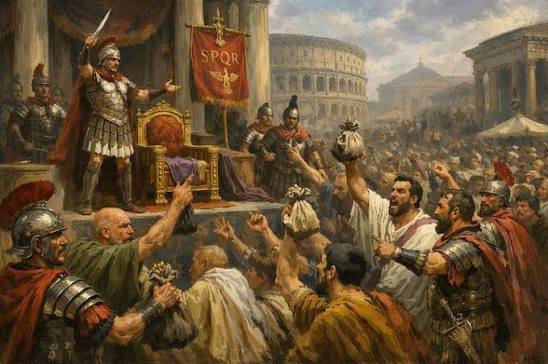
Cassius Dio, who witnessed the political turmoil as a senator, describes the episode as an auction in which the candidates competed by offering increasingly generous payments to individual guardsmen. His account places the final offer at 25,000 sesterces per soldier, although the precise financial arrangements remain difficult to establish independently.
Julianus secured the soldiers’ support and was proclaimed emperor on March 28, AD 193. The Senate subsequently recognized his accession, but its formal approval did little to establish popular legitimacy.
The episode became known as the Auction of the Empire. It was not an ordinary commercial transaction but a scandalous demonstration of the Praetorian Guard’s ability to manipulate imperial succession through military power and financial incentives.
An Emperor Without Popular Support
Julianus quickly discovered that purchasing the Praetorian Guard’s loyalty did not guarantee acceptance throughout the empire.
The population of Rome resented the circumstances surrounding his accession. Ancient accounts describe hostile crowds insulting the emperor and refusing to offer the customary public demonstrations of support.
The Senate was similarly uncomfortable with his position. Although the senators formally recognized him, Cassius Dio describes an atmosphere of intimidation during Julianus’s address to the assembly. Armed soldiers surrounded the Senate house, making the emperor’s apparent dependence on military protection unmistakable.
His greatest problem, however, was the provincial armies.
Three powerful commanders rejected his authority: Septimius Severus in Pannonia, Pescennius Niger in Syria, and Clodius Albinus in Britain. Each had access to substantial military forces, and their challenges transformed the succession crisis into a struggle for control of the Roman Empire.
Septimius Severus Marches on Rome
Septimius Severus, commander of the legions in Pannonia, emerged as Julianus’s most immediate threat. His soldiers proclaimed him emperor, and he began marching toward Rome, presenting himself as the avenger of Pertinax.
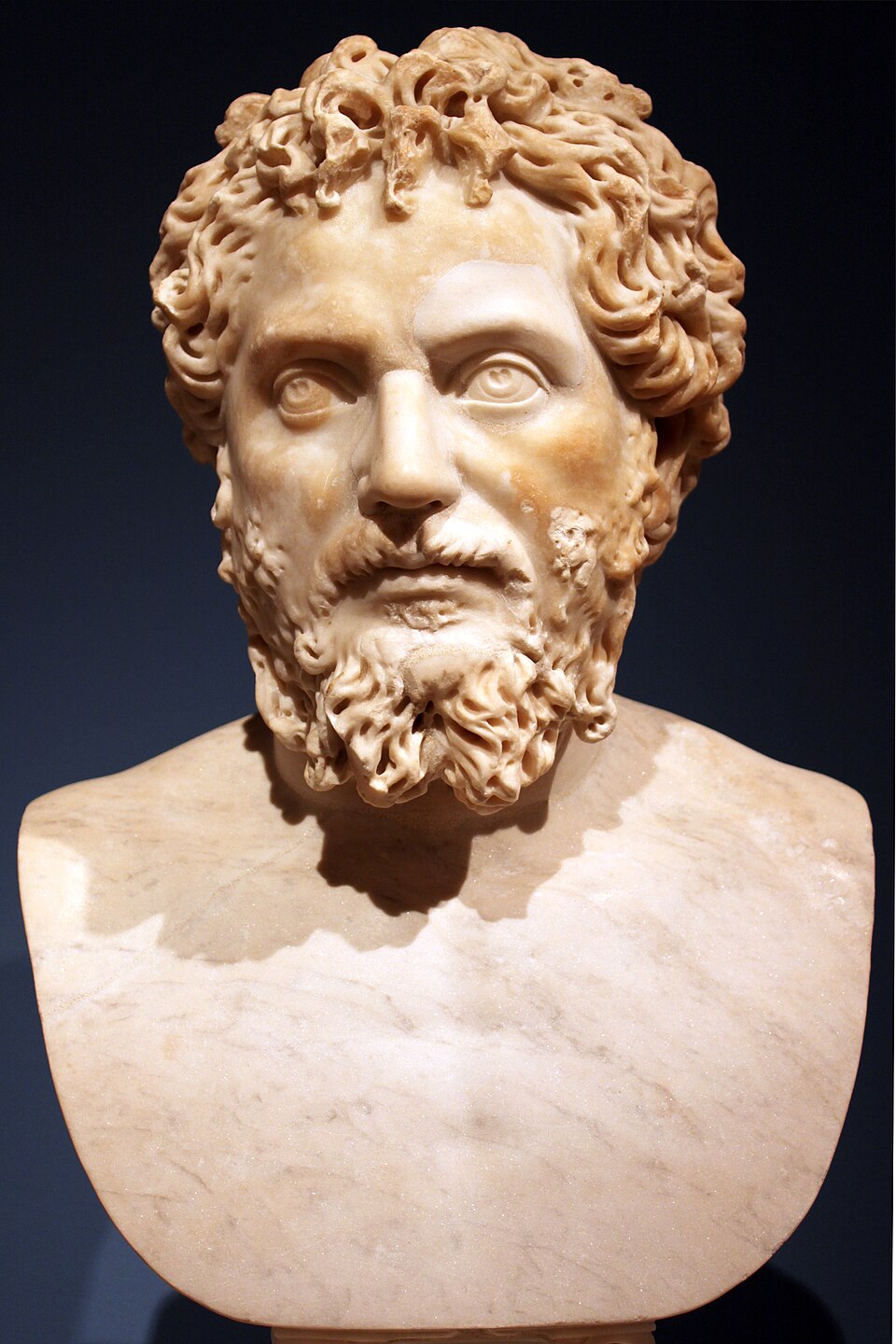
Julianus attempted several measures to stop him. He reportedly sent agents to assassinate Severus, dispatched representatives to negotiate, and eventually proposed sharing imperial authority. None of these efforts succeeded.
Severus continued his advance, while the Praetorian Guard proved unwilling or unable to defend the emperor it had recently elevated. Faced with the arrival of a battle-hardened provincial army, the guardsmen abandoned Julianus.
The Senate, now confident that it could act without facing immediate retaliation from the Praetorians, declared Severus emperor and condemned Julianus to death.
On June 1 or 2, AD 193, depending on the ancient chronological account followed, Julianus was executed in Rome. He was approximately 60 years old and had ruled for just 66 days.
The Legacy of the Auction Emperor
Didius Julianus remains one of the most unusual figures in Roman imperial history. His accession demonstrated how vulnerable the imperial succession could become when military loyalty outweighed established political institutions.
His downfall also marked the beginning of a broader civil conflict known as the Year of the Five Emperors. Septimius Severus eventually defeated his principal rivals, Pescennius Niger and Clodius Albinus, consolidating his position by AD 197.
The episode did not mean that Roman emperors could routinely purchase their positions through open auctions. Rather, it exposed the extraordinary political influence of the Praetorian Guard during a moment of institutional weakness.
Julianus had spent decades building a successful administrative and political career, yet his wealth and connections could not compensate for the absence of widespread military and popular support. His brief reign became a lasting warning about the dangers of allowing an emperor’s personal security force to exercise excessive influence over the Roman state.
