
The Mainz Gladius, sometimes called the Sword of Tiberius, is an early imperial Roman sword discovered in the Rhine River near Mainz, Germany. Today, the weapon is preserved in the British Museum, where it entered the collection in 1866 after being presented by the philanthropist Felix Slade. A replica is displayed in Mainz at the Romano-Germanic Central Museum.
Although the term gladius is commonly associated with the standard sword of the Roman legionary, the Roman army did not use a single unchanging pattern. Sword designs evolved in response to tactical requirements, manufacturing practices, and changing military environments. The Mainz type represents one of the most important stages in that development, bridging the earlier gladius Hispaniensis and the later, more compact Pompeii-type gladius.
A Sword Designed for Both Cutting and Thrusting
The Mainz Gladius is an iron double-edged sword with a blade approximately 50–55 centimeters (20–22 inches) long and about 7 centimeters (2.8 inches) wide. Including the hilt, the complete weapon measures roughly 65–70 centimeters (26–28 inches) and weighs around 800 grams (28 ounces).
Its blade retains the pronounced, waisted or leaf-shaped profile characteristic of early Roman swords. However, its point is more triangular than that of the earlier gladius Hispaniensis. That geometry gave the weapon a pronounced stabbing capability without abandoning its effectiveness as a cutting sword.
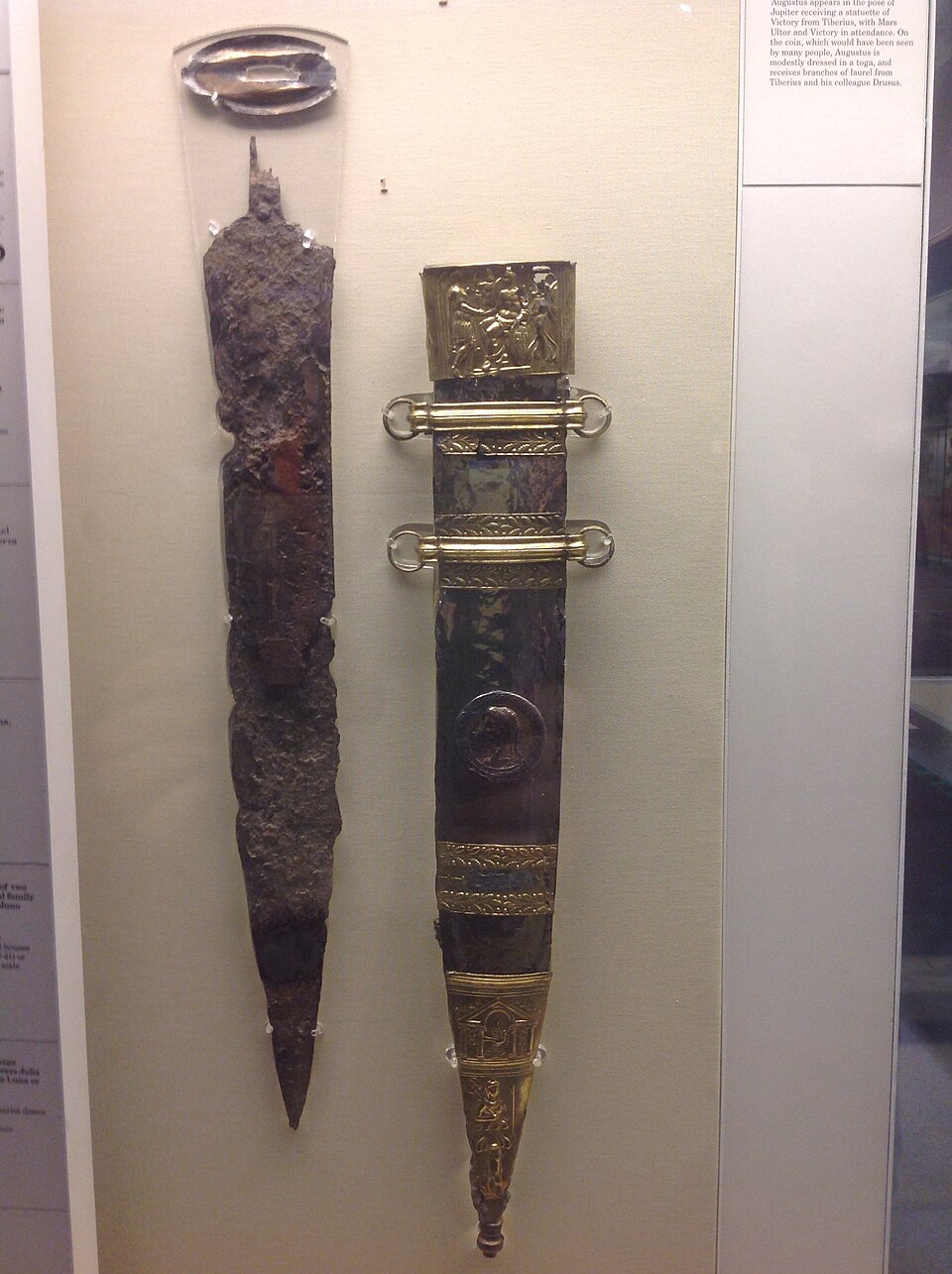
This combination is important for understanding Roman infantry combat. The popular image of the legionary as a soldier who exclusively stabbed with his gladius is an oversimplification. Roman swords were capable of both cutting and thrusting, and blade morphology changed over time. The broad body of the Mainz type provided substantial cutting potential, while its reinforced, sharply defined point made it effective for thrusting.
The sword therefore represents an intermediate stage in the development of the Roman military sword: still broad and visibly influenced by earlier forms, but increasingly optimized for the close-quarters thrusting techniques associated with later imperial legionary equipment.
The Scabbard Is More Important Than the Blade
What makes the Mainz Gladius exceptional is not merely its blade but its scabbard.
The surviving scabbard is constructed from tinned and gilded bronze and is decorated with an elaborate political and military program. Its imagery depicts Augustus seated in the guise of Jupiter, accompanied by the divine figures Victoria and Mars Ultor, while Tiberius, dressed as a victorious Roman commander, presents Augustus with a statuette of Victory.
The scene is more than decorative ornament.
It communicates the political hierarchy of the early Roman Empire. Tiberius appears as the successful military commander, but the ultimate beneficiary of victory is Augustus. Military achievement is therefore presented as something that flows upward to the emperor.
This distinction mattered enormously in the political world Augustus created after the civil wars of the first century BC.
Augustus, Tiberius and the Politics of Victory
The imagery is generally associated with Tiberius’ campaigns in the Alpine regions, particularly his successful military operations during the final decades of Augustus’ expansion.
The Roman conquest of the Alpine peoples was strategically important. Control of the Alpine region strengthened communications between Italy and the northern provinces and helped consolidate Roman authority across the central European frontier.
The imagery on the Mainz scabbard consequently presents military victory as an imperial achievement rather than the private glory of a victorious general.
This was particularly significant under Augustus.
The Roman Republic had repeatedly been destabilized when powerful commanders accumulated military prestige and loyal armies. Julius Caesar’s crossing of the Rubicon demonstrated the ultimate danger of that system. Augustus subsequently constructed a political order in which military authority remained concentrated around the emperor while successful commanders operated within an explicitly imperial hierarchy.
The Mainz scabbard embodies that relationship.
Tiberius is the victorious general, but he does not claim victory as an independent political achievement. He offers the personification of Victory to Augustus. Augustus, meanwhile, is represented in the elevated visual language of Jupiter.
The message is unmistakable: the emperor is the source and ultimate recipient of Roman military victory.
Was It Really a Commander’s Ceremonial Sword?
For much of its modern history, the Mainz Gladius was interpreted as an unusually prestigious weapon, perhaps commissioned by a senior Roman officer to commemorate a major military victory.
That interpretation is understandable. The scabbard is exceptionally elaborate, and its imagery directly connects the weapon with the imperial household and Roman military success.
However, modern scholarship has complicated the assumption that elaborate military equipment necessarily belonged to a senior officer.
Decorated Roman weapons and military fittings were not exclusively confined to the highest ranks. Soldiers could acquire relatively expensive and highly ornamented equipment, and personal military equipment could communicate status, identity, loyalty and achievement.
Consequently, the Mainz Gladius should not automatically be described as the personal weapon of Tiberius or as an emperor’s gift to a particular general. The surviving evidence does not establish such a specific ownership history.
The safest interpretation is that the sword belonged to the broader world of early imperial Roman military culture, where weapons could simultaneously function as practical equipment and highly visible expressions of imperial ideology.
The Mainz Type and the Evolution of the Gladius
The Mainz pattern emerged during the reign of Augustus, with examples traditionally dated to around the late first century BC and early first century AD. It was therefore part of the Roman army’s equipment during the period when Augustus transformed Rome’s military system from the armies of the Republic into a more permanent imperial force.
The type was eventually superseded by the Pompeii-type gladius.
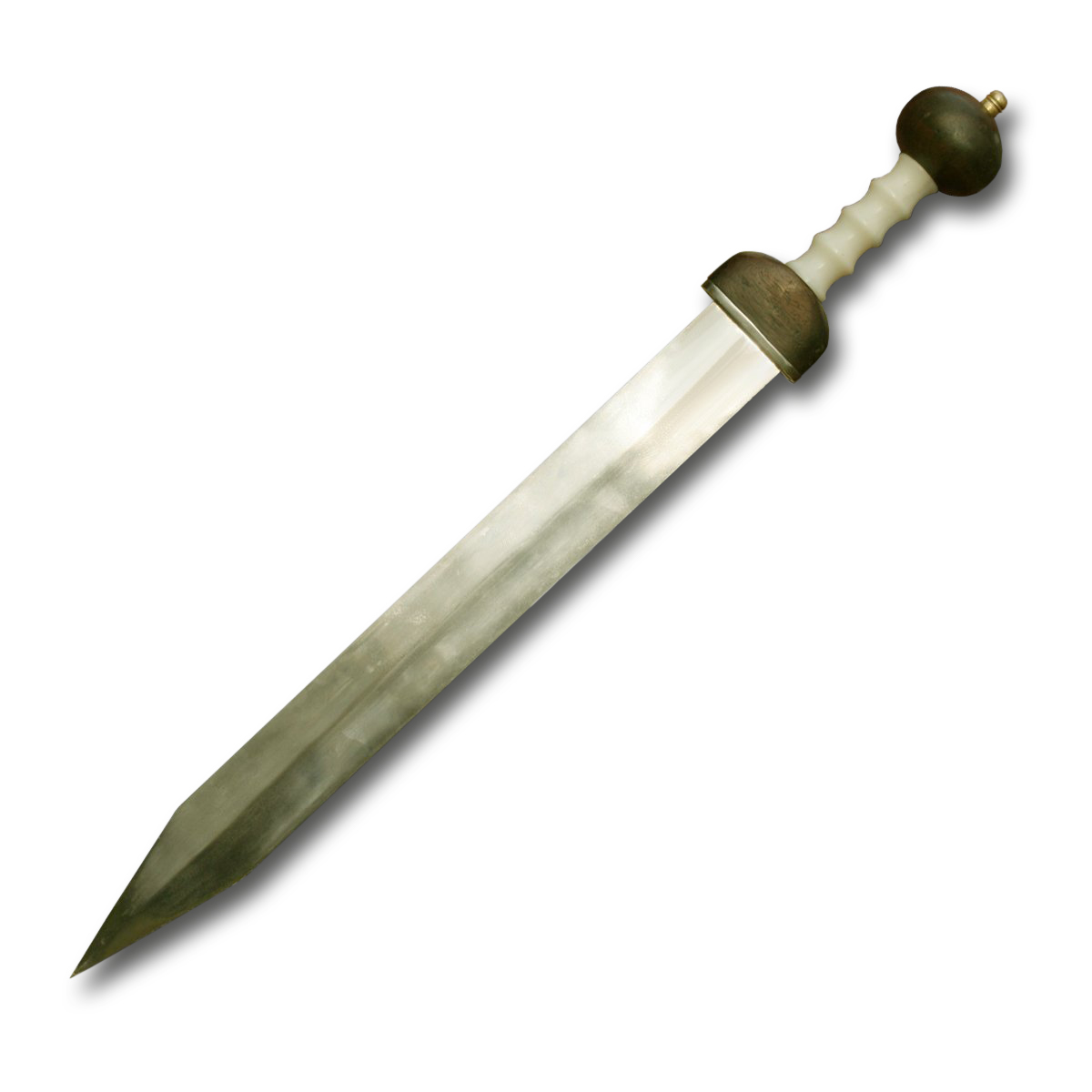
The change was not an instantaneous replacement. Different sword forms coexisted, and Roman military equipment varied considerably according to period, region and individual circumstances.
Nevertheless, the general trend is clear. The Pompeii type has a shorter, more parallel-sided blade and a comparatively shorter, more sharply defined point. Its morphology places greater emphasis on controlled thrusting while retaining useful cutting ability.
The transition from the Mainz form to the Pompeii form illustrates a broader truth about Roman military technology: Roman equipment was not static. The legionary kit continuously changed even though later generations often inherited the same basic vocabulary of shield, sword, spear and armor.
A Weapon Preserved by the Rhine
The circumstances of the Mainz Gladius’ survival are almost as remarkable as its decoration.
The sword was recovered from the Rhine near Mainz. Centuries underwater left the iron blade heavily corroded, but the bronze scabbard survived sufficiently well to preserve its extraordinary decorative program.
The Rhine was one of the most important military frontiers in Roman Europe. Mainz itself became a major Roman military center, eventually developing into Mogontiacum, one of the principal bases of Roman forces along the Rhine.
The river consequently provides an appropriate setting for a weapon associated with the Roman military presence in northern Europe. Yet precisely how the sword entered the Rhine remains uncertain. Its discovery does not, by itself, prove that it was lost during combat or deliberately deposited following a particular battle.
That distinction is important. The elaborate decoration has encouraged historical interpretations connecting the object directly with Roman victories in Germany, but the archaeological evidence cannot establish every stage of its history.
From Roman Military Equipment to Museum Artifact
The Mainz Gladius survived antiquity, although the iron blade suffered extensive corrosion during its long immersion. In 1866, Felix Slade presented the sword to the British Museum, where it remains one of the institution’s notable Roman military artifacts.
Its importance extends beyond the physical weapon.
The Mainz Gladius demonstrates how Roman military technology, imperial propaganda and personal status could converge in a single object. The blade represents the practical evolution of the legionary sword, while the scabbard transforms that weapon into a political statement.
It also challenges the simplistic idea that Roman military equipment can be divided neatly into “functional” and “ceremonial” categories. For Roman soldiers, weapons could perform both roles simultaneously. A sword was an instrument of combat, but its decoration could communicate rank, wealth, allegiance and participation in the imperial military system.
The Mainz Gladius therefore occupies an important position in the history of Roman arms. It belongs to a transitional period when the Roman army was becoming the permanent military institution of an empire, while the political meaning of military victory was being reshaped around the emperor.
Its blade represents an evolving technology.
Its scabbard represents imperial ideology.
Together, they preserve a remarkably direct image of how Augustan Rome wanted military victory to be understood: won by the army, achieved through its commanders, but ultimately belonging to the emperor.
