
Roman warfare is often remembered for disciplined infantry, fortified camps and the standardized equipment of the legionary. Yet behind the famous shield wall was another branch of Roman military power that depended on mathematics, metallurgy, carpentry and a sophisticated understanding of stored mechanical energy.
Roman artillery was not a single weapon. It was a family of machines that evolved over centuries, from compact bolt-shooters capable of accurate direct fire to enormous stone-throwers designed for siege warfare. Some were mobile enough to accompany field armies; others were so large that they were essentially temporary battlefield structures.
The popular image of these weapons as ancient versions of modern firearms is useful only as an analogy. They did not operate like rifles or machine guns, and many commonly repeated performance figures cannot be established securely. Their real significance is more interesting: Roman engineers adapted torsion technology into a standardized military system capable of delivering concentrated mechanical force at distances ordinary infantry weapons could not match.
The Scorpio: Rome’s Precision Bolt-Thrower
The scorpio occupies an important place in the history of Roman artillery. During the siege of Avaricum in 52 BC, Julius Caesar describes Roman artillery operating during the siege works. Roman tormenta derived their power from twisted elastic material rather than from a conventional wooden bow. Caesar’s account and later technical descriptions establish the existence of smaller bolt-firing engines suitable for use against personnel.
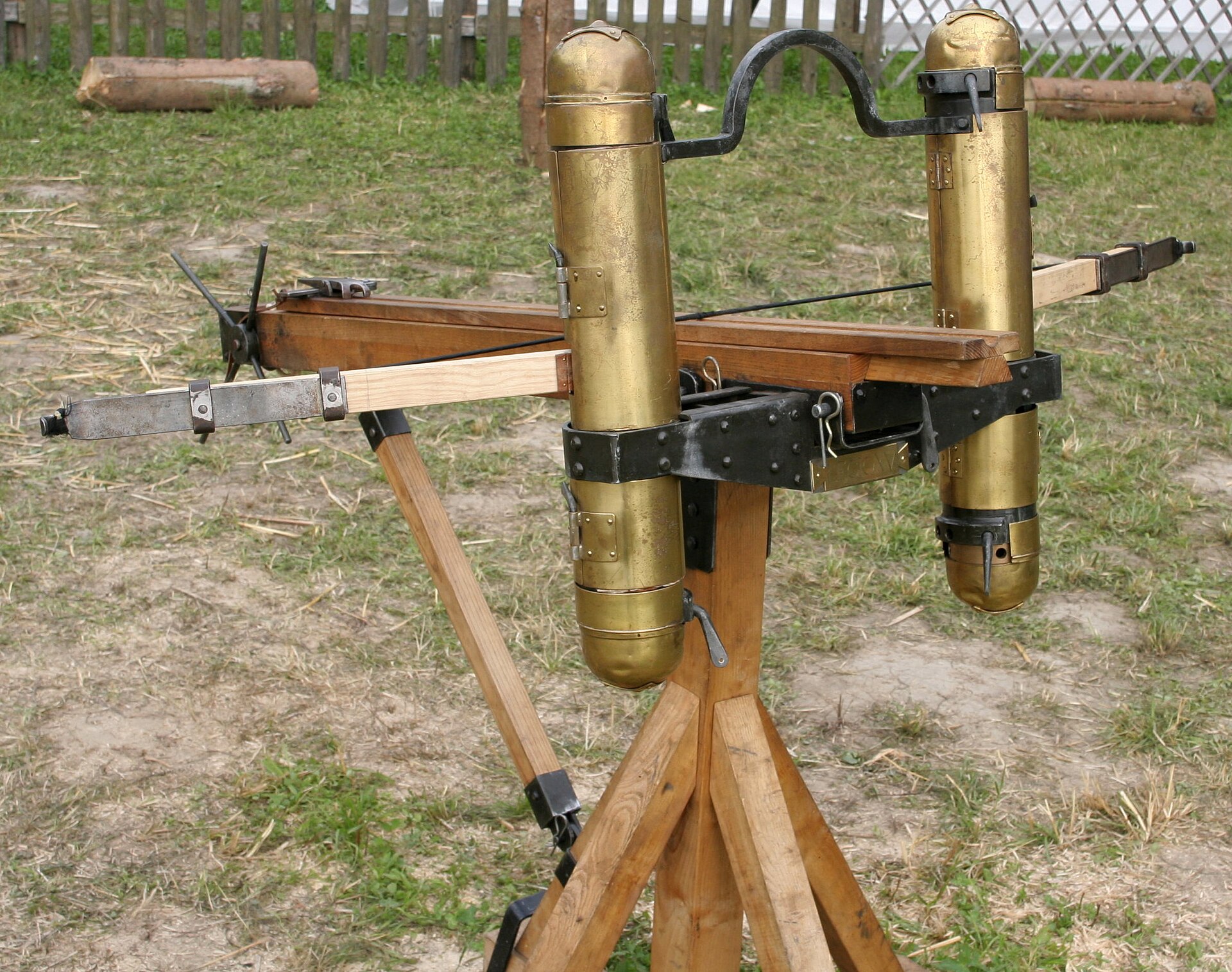
The fundamental principle was torsion.
Two vertical bundles of elastic material were incorporated into the frame. Wooden arms passed through the bundles, and a bowstring connected the arms across the central firing channel. When the string was drawn backward, the arms rotated and twisted the bundles. That deformation stored potential energy. Releasing the string converted it almost instantaneously into kinetic energy in the projectile.
The Romans and Greeks used materials including sinew and hair for these torsion springs. Their effectiveness depended on elasticity, strength and consistent construction. The springs also required careful adjustment: unequal tension between the two sides could send a projectile off line. Vitruvian descriptions emphasize the importance of properly tuning the torsion elements.
This was one of the major advantages of torsion artillery. Instead of relying on the bending of a large wooden bow, engineers could build increasingly powerful weapons by manipulating bundles of elastic fibers.
The scorpio was consequently a compact artillery weapon rather than simply an oversized crossbow. Its bolt could be directed against exposed soldiers, crews operating siege equipment or defenders on walls. Ancient terminology, however, is complicated. The meaning of scorpio, catapulta and ballista changed over time, and later authors could use the same terms for substantially different machines.
That distinction matters because the later Roman writer Ammianus Marcellinus used scorpio for a single-armed stone-thrower that he also associated with the onager.
The Mechanics Behind Roman Artillery
The real technological breakthrough was not simply the projectile. It was the ability to manufacture a reliable elastic engine.
Roman artillery belonged to the broader tormenta family, a name derived from the Latin torquere, meaning “to twist.” The torsion bundles functioned as mechanical springs. When the weapon was cocked, energy accumulated in the twisted fibers. When the trigger released the arms, that energy drove the projectile forward.
This made Roman artillery fundamentally different from ordinary bows.
A bow stores energy primarily through bending. A torsion engine stores it through twisting. The principle allowed engineers to produce machines considerably larger and more powerful than a man-portable bow while maintaining a relatively compact firing mechanism.
But these machines were technically demanding. Their performance depended on the dimensions of the frame, the length and stiffness of the arms, the characteristics of the torsion material, the projectile’s mass and the precise balance between the two spring bundles.
Consequently, claims that a particular scorpio consistently killed individual targets at distances of 400 yards or that its bolts traveled at a precise modern firearm-like velocity should be treated cautiously. Ancient sources do not provide the standardized ballistic testing required to establish such figures.
What can be established is that smaller Roman artillery was capable of direct, relatively accurate bolt fire and was sufficiently useful to accompany Roman military operations.
The Manuballista: Smaller, Stronger and More Portable
Imperial Roman engineers eventually developed smaller artillery designs that represented a significant departure from the earlier wooden-framed machines.
The manuballista, often associated with the Greek cheiroballistra, was a compact bolt-shooter incorporating a metal frame. Its exact terminology and development remain subjects of scholarly debate, but archaeological and textual evidence place this family of weapons firmly within the Roman imperial period.
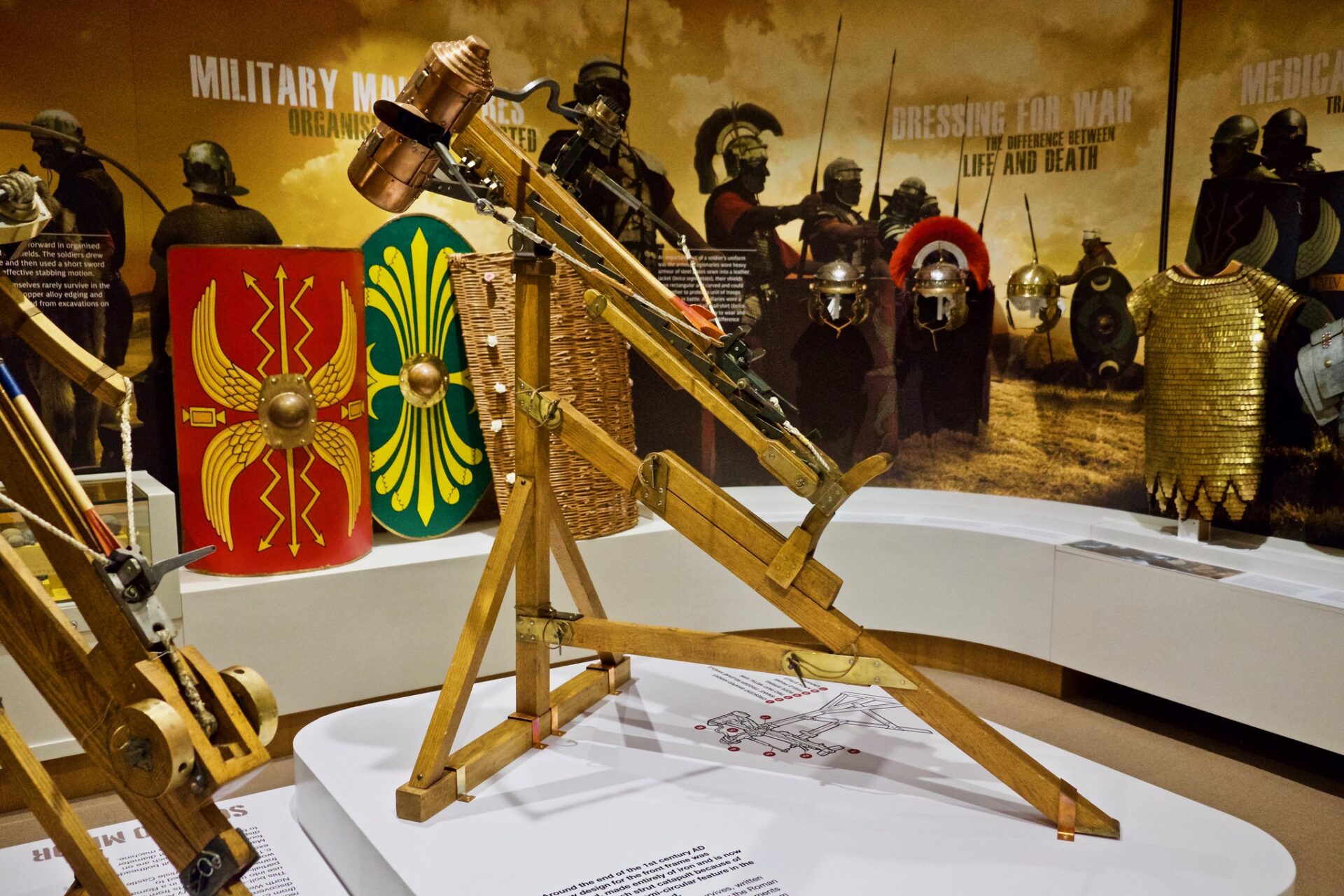
Trajan’s Column provides particularly important evidence. The reliefs depicting the Dacian Wars show Roman artillery in forms consistent with these compact weapons and with cart-mounted versions. Archaeological discoveries, including material from Xanten-Wardt, have provided physical evidence for the mechanisms behind the later designs.
The advantage was portability.
Instead of requiring a massive wooden structure, the later design concentrated the torsion mechanism within a much smaller framework. This allowed the weapon to operate closer to the infantry and made it better suited to campaigning in difficult terrain.
Calling the manuballista an “ancient assault rifle” is dramatic but misleading. It lacked the ammunition capacity, rate of fire and operating characteristics of a firearm. Nevertheless, its tactical role could resemble that of a modern infantry-support weapon: a compact machine capable of delivering considerably more projectile energy than an ordinary individual weapon.
The Ballista: Heavy Artillery for Siege Warfare
Where the scorpio specialized in smaller projectiles, the ballista represented the heavier end of Roman torsion artillery.
The basic mechanism remained recognizable: torsion springs, arms and a central firing channel. But the dimensions and construction were enlarged to accommodate heavier projectiles.
Depending on its design, a ballista could launch large bolts, beams or stones. Ancient and modern technical reconstructions demonstrate considerable variation in size, meaning that there was no single standardized “Roman ballista” with one universal range or projectile weight.
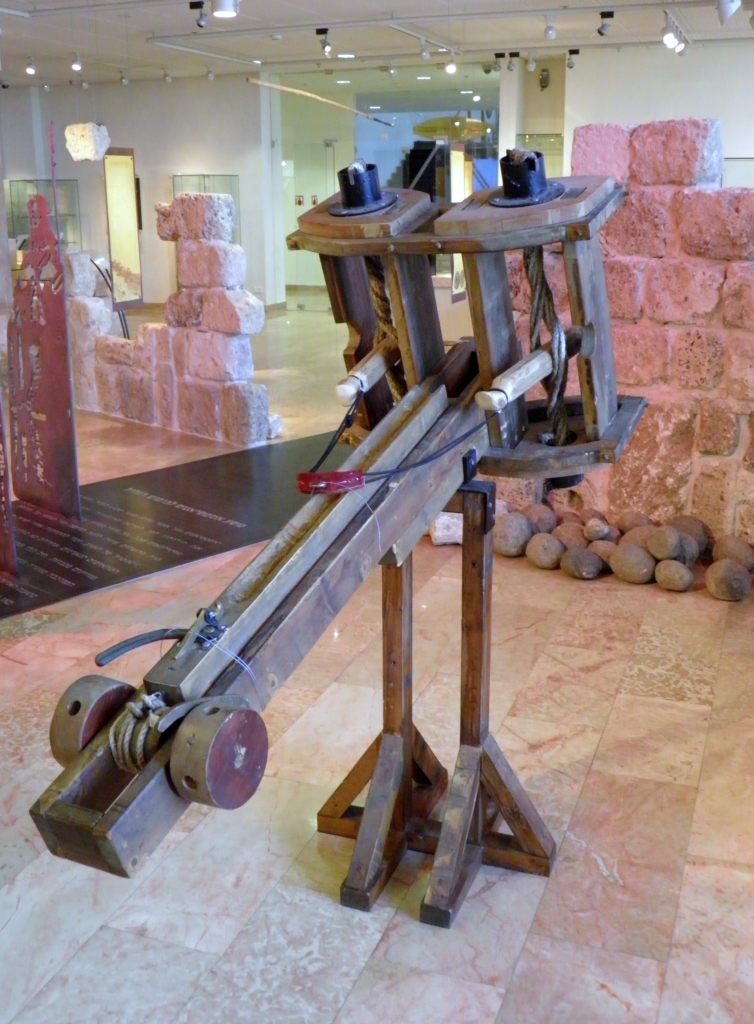
This is important when assessing claims that every large ballista could launch 100-pound stones hundreds of yards. Ancient artillery existed in numerous sizes, and performance depended heavily on the machine’s dimensions and projectile.
The Roman military nevertheless possessed genuinely formidable stone-throwing artillery. Archaeological discoveries reinforce the literary evidence. At Jerusalem, for example, excavations have recovered concentrations of ballista stones associated with the Roman assault on the city’s defenses in AD 70. The archaeological evidence supports Josephus’s account of heavy Roman artillery during the siege.
Josephus’s description is particularly valuable because he personally witnessed the siege. His account emphasizes the destructive effect of the stones on defenders and fortifications, although individual numerical claims should be treated as ancient testimony rather than modern ballistic measurements.
The purpose of heavy artillery was not simply to kill. It was to suppress defenders, damage walls and towers, disrupt defensive positions and create conditions under which Roman infantry could assault the weakened perimeter.
The Carroballista: Mobile Roman Fire Support
The Romans also solved a fundamental artillery problem: mobility.
A siege engine positioned behind a fortified line was useful only while the battle remained within its effective firing area. On an open battlefield, however, the front moved. An artillery piece that could not relocate quickly could become irrelevant—or vulnerable.
The carroballista addressed that problem by mounting a bolt-shooting artillery piece on a cart.
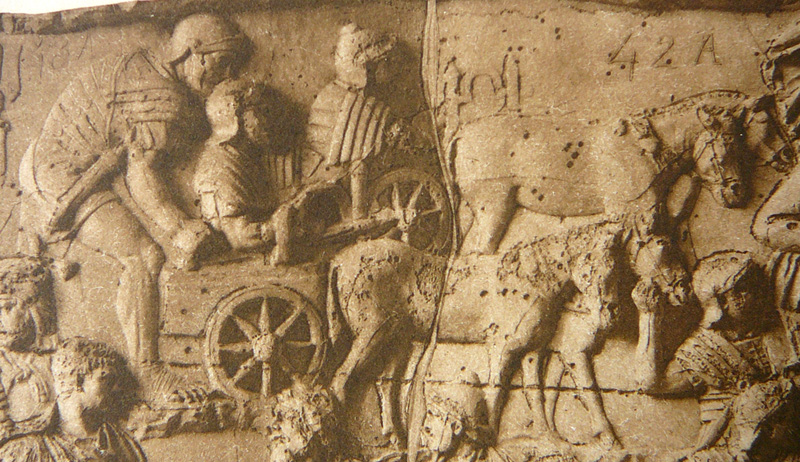
The most important visual evidence comes from Trajan’s Column, completed in the early second century AD. Its reliefs depict Roman soldiers operating artillery mounted on carts. Modern engineering studies have used these representations to reconstruct the likely mechanical characteristics of the weapons.
The concept was remarkably practical. A relatively compact torsion engine could be transported by animals, brought into position and employed in support of infantry operations.
Vegetius, writing centuries later, provides a famous figure of 55 carroballistae per legion, associated with individual centuries. His description also gives an unusually detailed picture of the logistical organization surrounding Roman artillery. However, because Vegetius was a late Roman author drawing on earlier military traditions, his figures should not automatically be projected backward onto every legion of the early Empire.
The surviving evidence nevertheless demonstrates that mobile artillery was an established component of imperial Roman warfare.
The Onager: The Roman Stone-Thrower
The onager belonged to a different class of machine.
Instead of two torsion springs driving two arms, it used a single throwing arm driven by one large torsion bundle. The projectile was generally carried in a sling or receptacle attached to the arm.
When the arm was forced downward, energy accumulated in the twisted fibers. Releasing it caused the arm to accelerate violently upward.
The name onager, meaning “wild ass,” reflected the machine’s violent motion. Ammianus Marcellinus describes the mechanism and compares its action with the kicking behavior of the animal.
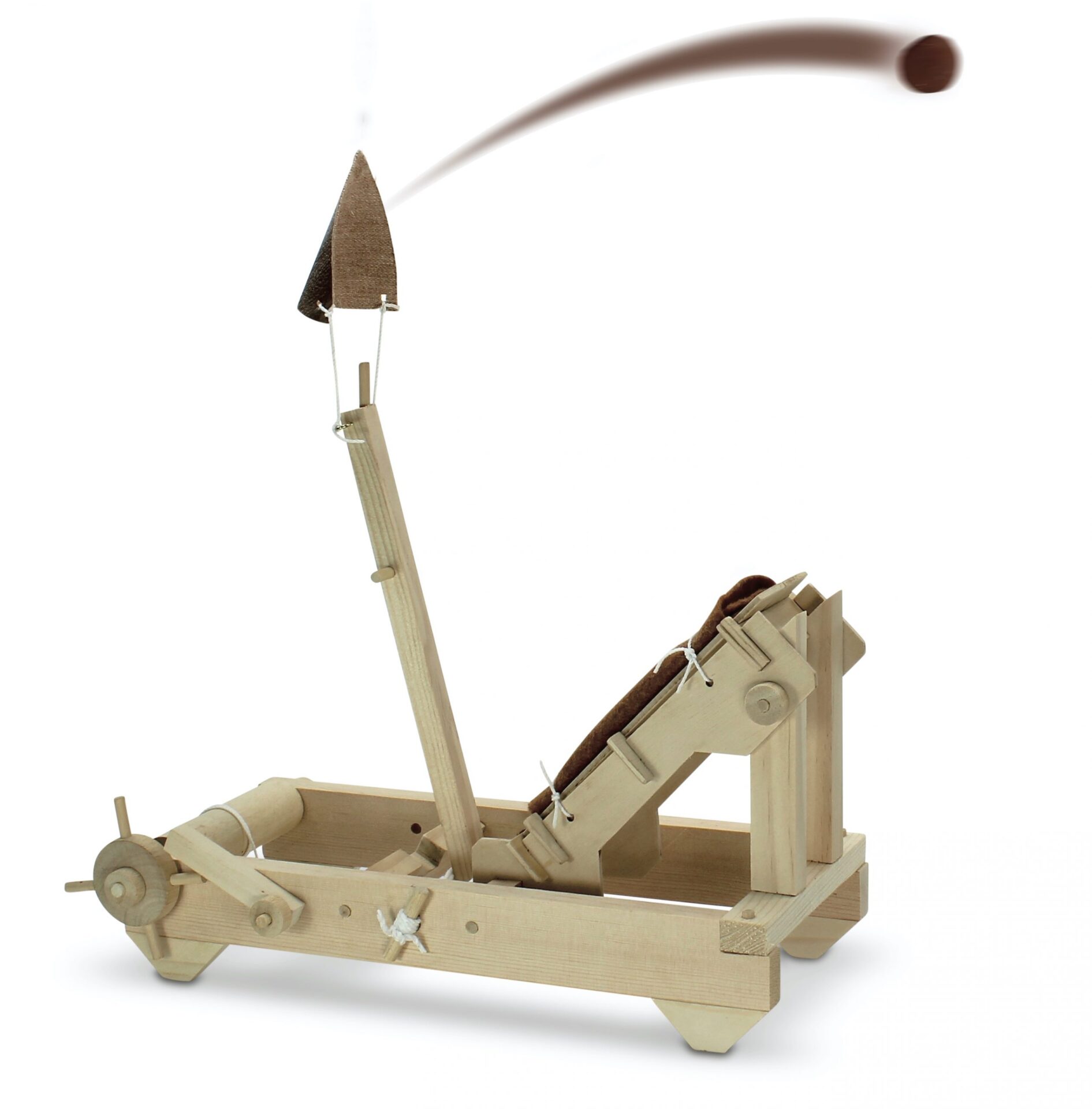
The onager sacrificed some of the precision of the two-armed bolt-shooters in exchange for a simpler method of delivering heavy stones.
That made it particularly useful against fortifications and concentrated formations.
Its greatest weakness was also inherent in its design. The tremendous forces generated by the torsion bundle and the sudden stop of the throwing arm transmitted substantial shock through the frame. Later Roman descriptions therefore emphasize the need for appropriate foundations.
Rather than imagining a perfectly stable machine sitting on a paved road, it is more accurate to picture an artillery engine whose effectiveness depended heavily on how well its operators prepared the ground beneath it.
By the later Empire, the onager had become an important Roman stone-thrower. Ammianus describes its use in fourth-century warfare, demonstrating that torsion artillery remained relevant long after the Roman Republic had disappeared.
The Polybolos: An Ancient Repeating Weapon
The most remarkable machine in this technological family was not actually Roman in origin.
The polybolos was developed in the Greek world, traditionally attributed to Dionysius of Alexandria in the third century BC. The surviving technical tradition associates the weapon with the Rhodian military-engineering environment and describes a sophisticated repeating mechanism.
Its mechanism was extraordinarily ingenious.
A chain-driven system interacted with the weapon’s sliding carriage. As the operator turned the mechanism, the machine could draw the string back, position another projectile, lock the firing mechanism and release the shot without requiring a complete manual reload after every projectile.
This is why the polybolos is sometimes described as an ancient “machine gun.”
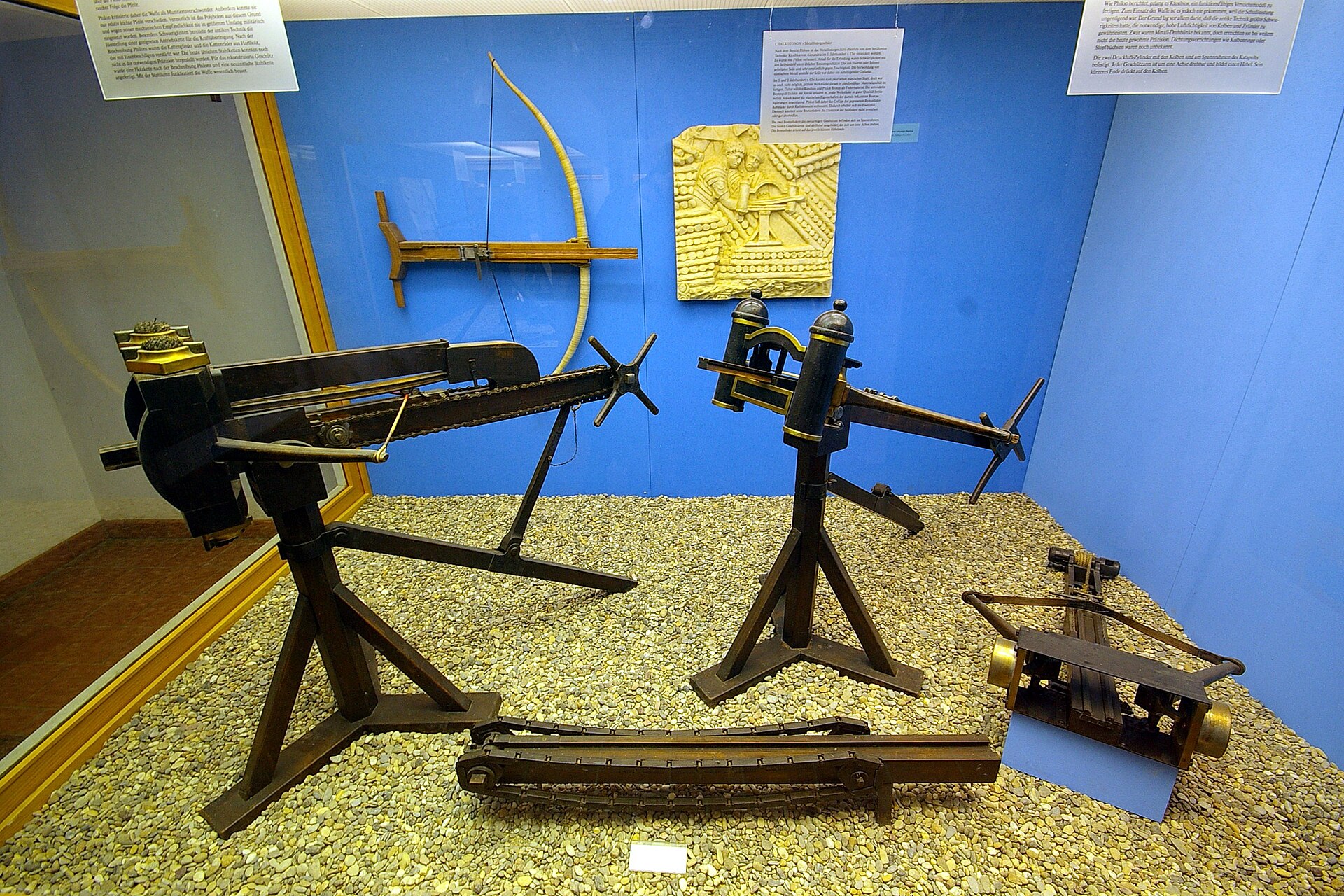
The comparison should not be taken literally. It was not automatic in the modern firearm sense: the operator still supplied the mechanical energy by turning the mechanism, and its ammunition capacity and rate of fire were vastly inferior to modern automatic weapons.
But the underlying concept really was revolutionary.
The machine incorporated a repeating mechanical cycle in which loading, cocking and firing were linked together through a mechanical sequence. It is one of the clearest examples from antiquity of engineers deliberately reducing the amount of human intervention required between shots.
Recent archaeological research has even proposed that damage patterns on the walls of Pompeii may be compatible with the use of repeating artillery during the conflict associated with Sulla’s siege in 89 BC. The researchers stress that no physical polybolos has been recovered, so the identification remains an archaeological hypothesis rather than a demonstrated fact.
That distinction is crucial. The polybolos is historically attested as a Greek repeating weapon; its specific use at Pompeii remains an interpretation of the evidence.
Siege Artillery: When Size Became the Weapon
At the largest end of the spectrum, Roman artillery became less about portability and more about concentrating enormous mechanical force.
Large stone-throwers could attack walls, towers and defensive positions from outside the immediate reach of infantry. Their projectiles could also be used against concentrations of defenders.
The Roman siege system combined artillery with other engineering capabilities: ramps, towers, covered approaches, earthworks, rams, mines and fortified camps.
That combination was more important than any individual machine.
At Jerusalem in AD 70, Roman engineers constructed siege works while artillery bombarded the city’s defenses. Archaeological evidence from the Third Wall includes substantial quantities of ballista stones associated with the Roman assault.
At Masada, Roman engineers famously constructed an enormous siege ramp to bring their forces and equipment into position against the fortress. The achievement demonstrates the defining characteristic of Roman siege warfare: when terrain obstructed an objective, the Romans frequently treated the terrain itself as an engineering problem.
The Real Revolution Was the System
The most impressive feature of Roman artillery was not that one machine could supposedly kill a man hundreds of yards away or that another resembled a modern machine gun.
It was the system surrounding the weapons.
Roman artillery required standardized components, skilled craftsmen, trained crews, suitable ammunition, transport, replacement parts and commanders capable of integrating artillery with infantry and siege engineering.
The machines also evolved.
The compact scorpio belonged to an earlier tradition of precision bolt-shooters. The imperial manuballista/cheiroballistra represented a more compact metal-framed design. The carroballista transformed similar technology into mobile artillery. The ballista delivered heavier projectiles, while the onager simplified the stone-throwing mechanism for later Roman warfare.
The polybolos demonstrates that the underlying mechanical ingenuity was not exclusively Roman either. Greek engineers had already developed sophisticated repeating artillery centuries before the Roman Empire reached its height.
Roman military technology was therefore not created in isolation. Rome inherited, adapted, standardized and deployed engineering traditions from across the Mediterranean.
The Evidence Behind the Legend
Some of the most dramatic stories surrounding Roman artillery require correction.
The famous skeleton at Maiden Castle in Dorset is a good example. Mortimer Wheeler originally interpreted the site’s violent burials as evidence of a Roman attack during the conquest of Britain. One skeleton famously had an iron projectile embedded in its vertebrae.
For decades, this was presented as evidence that a Roman ballista had killed the individual.
Modern research has substantially complicated that interpretation.
Detailed archaeological reassessment concluded that the projectile is more plausibly a spear or javelin and may even have been locally manufactured. Recent radiocarbon analysis has also indicated that the violent deaths represented multiple episodes occurring across generations rather than a single Roman massacre in AD 43.
That does not diminish the reality of Roman artillery. It demonstrates why archaeological evidence must be separated from later storytelling.
Likewise, the popular claims of standardized projectile velocities, guaranteed quarter-mile kills and precisely defined ammunition loads often come from modern reconstructions, secondary sources or extrapolations rather than surviving Roman measurements.
The ancient evidence is still remarkable without exaggeration.
Rome’s Mechanical Battlefield
Roman artillery was the product of an engineering culture that understood how to convert stored mechanical energy into controlled violence.
The scorpio transformed twisted fiber into high-speed bolt fire. The manuballista compressed that technology into a more portable package. The ballista scaled the concept toward heavy siege artillery. The carroballista put artillery on wheels. The onager concentrated torsion into a single powerful throwing arm. And the polybolos demonstrated that ancient engineers could create an astonishingly sophisticated repeating mechanism.
None was a firearm. None was a modern sniper rifle, assault rifle or machine gun.
Yet the underlying engineering philosophy is unmistakably familiar.
Store energy. Control it mechanically. Standardize the components. Increase portability where possible. Match projectile and weapon to the tactical problem. Integrate the machine into a larger logistical system.
That was the real achievement of Roman artillery.
More than two thousand years before industrial weapons manufacturing, Mediterranean engineers had already learned that warfare could be transformed not merely by making weapons larger or stronger, but by engineering the entire process by which mechanical energy became battlefield force.
