
Imagine a wedding day in ancient Rome. The house is busy from early morning. Relatives and friends have gathered, preparations are underway, and the bride is dressed in clothing that immediately identifies her as a bride. Her hair has been arranged according to an old tradition, a brightly colored veil covers her head, and the household is preparing for the rituals that will accompany her departure. Later, she will leave her family’s home.
A procession will carry her through the streets, accompanied by relatives, friends, music, and torches. Eventually, she will arrive at the house of her husband, where another series of rituals will mark the beginning of her new life.
Roman weddings could be elaborate affairs, but there was no single ceremony that every Roman couple followed. Customs changed over time and varied according to social status, family tradition and the legal form of the marriage. What we can reconstruct is a collection of rituals that, taken together, turned a marriage into a highly visible event. And at the center of it all was the bride.
Before the Roman Wedding
Marriage in Rome was not simply a private agreement between two people. Family connections, property, inheritance, and social status all mattered, particularly among the upper classes. An engagement, known as sponsalia, could precede the wedding and involve agreements between the families, including arrangements concerning the bride’s dowry. But it is important not to confuse the wedding ceremony with the creation of the legal marriage itself.
Roman law placed great importance on the intention of the couple to live together as husband and wife. By the late Republic and Imperial period, the common form of marriage was generally sine manu, meaning that the wife did not automatically pass into the legal authority of her husband. Older forms such as confarreatio, coemptio and usus belonged to a different legal tradition and did not describe every Roman marriage. The ceremony was therefore not simply the moment when a Roman marriage legally came into existence. It was something more visible: a public celebration of the union.
The Bride
On the Roman wedding day, the bride’s appearance was carefully arranged. One traditional garment was the tunica recta, a long tunic associated with the bride. Around her waist she wore a belt, traditionally associated with the nodus Herculaneus, the “knot of Hercules.” Ancient authors also associate the bride with a distinctive veil, the flammeum, traditionally described as red or flame-colored.

Her hairstyle was equally distinctive. Ancient sources describe the bride’s hair as divided into six sections, with a ceremonial implement known as the hasta caelibaris associated with arranging it. The practice was an old-fashioned ritual whose exact meaning was already a subject of speculation in antiquity. This is important because the Roman wedding was full of traditions whose origins were already ancient by the time Romans themselves were recording them. A bride could therefore appear simultaneously as a young Roman woman and as a participant in customs that reached back into Rome’s distant past.
Seeking the Gods’ Favor
Religion was woven into Roman life, and marriage was no exception. In earlier periods, private auspices could be sought before a marriage, and religious elements continued to accompany weddings even after some of the older practices had become largely ceremonial. The exact religious rites varied, however, and it would be misleading to imagine that every Roman wedding involved an identical sacrifice performed by a priest. The most explicitly religious form of Roman marriage was confarreatio.
This ancient patrician ceremony involved ten witnesses, formal words, and religious rites, including the use of a special spelt cake, panis farreus. It remained particularly important for certain priestly families, although by the Imperial period it had become relatively rare. For most Romans, however, the wedding was not a grand religious ceremony in this specific sense. Instead, the significance of the day came from the accumulation of rituals surrounding the bride and her movement into her new household.

The Joining of Hands
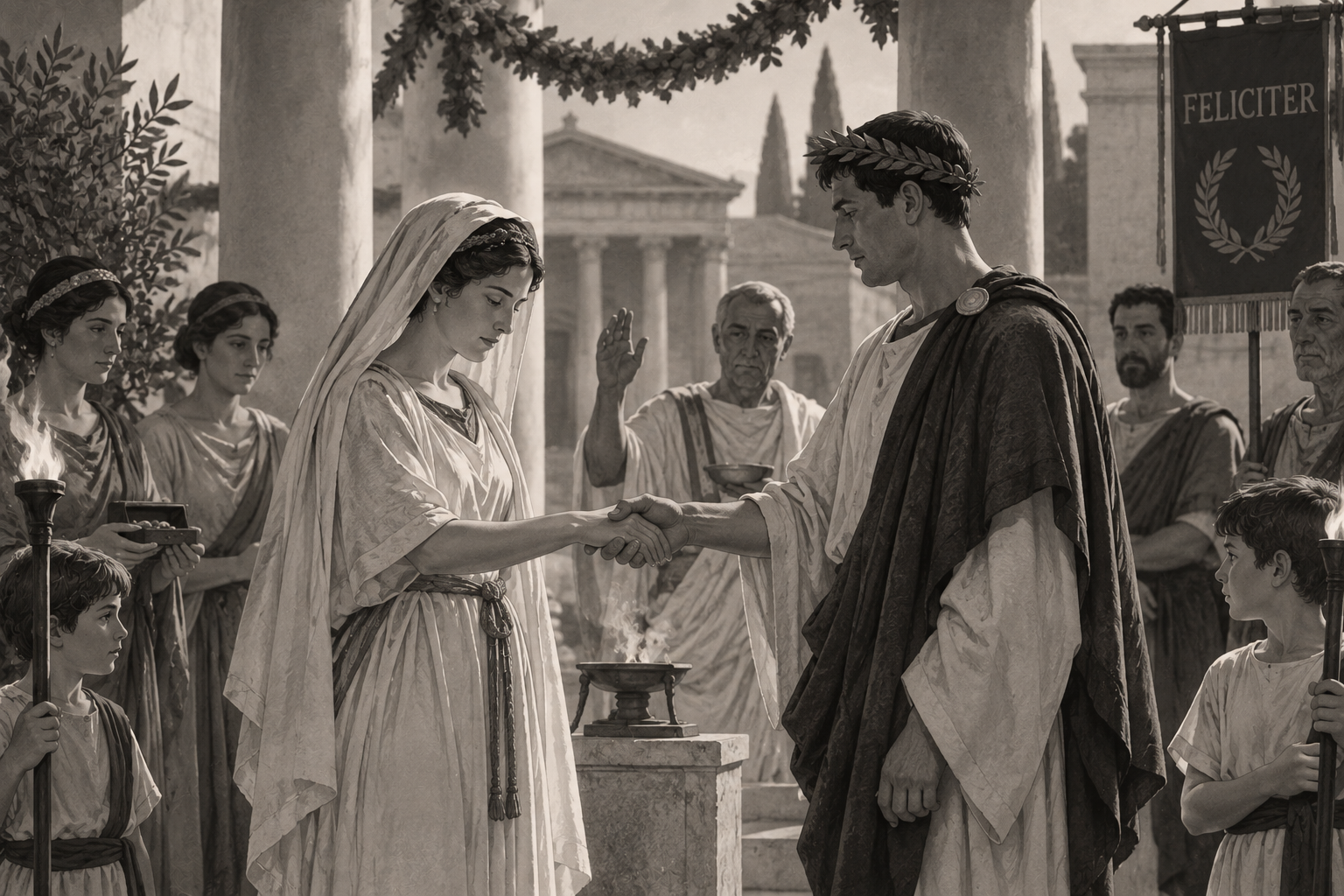
Roman art frequently presents husbands and wives with their right hands joined. This gesture, known as dextrarum iunctio, became one of the most recognizable visual expressions of marriage in Roman art. It appears on reliefs, sarcophagi, and other representations of married couples. It is tempting to imagine this as the Roman equivalent of the modern exchange of wedding vows. But we should be careful.
Roman marriage did not have one universally prescribed “I do” moment. The joining of hands was a powerful symbol of the marital union, but the surviving evidence does not justify turning it into a mandatory part of every Roman wedding. The Romans left us images of marriage more clearly than they left us a single standardized ceremony.
The Wedding Feast
A Roman wedding was also a celebration. Food and wine were shared with family and friends, and wealthy families could turn the occasion into a lavish social event. Poetry and music could form part of the celebrations. Wedding songs known as epithalamia were written for particular couples, and Roman literature preserves several examples of wedding poetry. Catullus, for example, composed wedding poems filled with gods, songs, fertility imagery, and the excitement surrounding the bride’s departure.
But the most important part of the celebration was still waiting. The bride had to leave her home.
The Journey to Her Husband’s House
The most distinctive public element of the Roman wedding was the deductio in domum mariti — the leading of the bride to the house of her husband. This procession transformed the marriage into a public event. Family members, friends, and other participants accompanied the bride through the streets. Ancient descriptions associate the procession with music, singing, and torches. Three boys whose parents were both still living, known as patrimi et matrimi, could accompany the bride, with one carrying a wedding torch.
The bride herself could carry a distaff and spindle, symbols connected with the domestic role expected of a Roman wife. There was also an important social message in the procession. The Latin expression uxorem ducere — “to lead a wife” — reflects the importance of this movement. The bride was not merely attending a celebration; she was being publicly brought into her husband’s home. For everyone watching, the procession announced that a marriage had taken place.
Torches, Songs and Roman Wedding Cries
The procession could be noisy. Torches illuminated the route, while songs and traditional cries accompanied the bride. One of the words associated with Roman weddings was “Feliciter!” — “Good luck!” “Congratulations” or “May it go well!” Other wedding songs could be considerably less restrained. Roman wedding poetry and ritual included playful and sometimes explicitly sexual material, reflecting the Roman understanding of marriage as a union expected to produce children.
The torch itself had a long association with Roman weddings. The fax nuptialis, the wedding torch, was traditionally carried before the bride. Ancient writers also associated wedding celebrations with a specific number of torches, although the exact significance of the number was already debated by Roman authors such as Plutarch. The result was a procession that was difficult to mistake for anything else. Rome knew that a bride was passing through its streets.
At the Threshold
Eventually, the procession reached the groom’s house. Here the rituals became more intimate. Ancient sources associate the bride with the doorway itself. Wool could be placed around the doorposts, and the threshold had symbolic importance. The bride could also be carried across it rather than stepping over it herself, because stumbling on the threshold was considered a bad omen. This is one of the Roman wedding customs that has become surprisingly familiar to modern audiences. But its meaning in Roman society was more serious than the playful gesture seen at many modern weddings. The doorway marked the boundary between two stages of the bride’s life. She was entering her husband’s home.
Fire and Water
Once inside, another ancient custom awaited her. The bride was received with fire and water, which she was required to touch. Plutarch, writing about Roman customs, preserves several possible explanations for this ritual. Fire and water could symbolize the essential elements of human life, as well as the complementary roles of husband and wife. The exact interpretation is uncertain. That uncertainty is itself revealing.
Romans of the Imperial period inherited many customs from an earlier age whose original meanings were no longer completely clear. They continued to perform the rituals even while antiquarians and philosophers debated why they existed. The wedding was therefore not simply a celebration of a new couple. It was also a performance of Roman tradition.
The Bridal Chamber
The final stage of the day of the Roman wedding led toward the marriage bed, the lectus genialis. Roman wedding poetry often imagined the bride entering the bridal chamber, surrounded by the emotions, expectations, and jokes that accompanied the beginning of married life. Women known as pronubae could assist the bride, and ancient descriptions connect the final stages of the ceremony with older women who were considered suitable models for a successful marriage.
The wedding night itself was part of the transition into married life, but Roman sources do not give us a single standardized ritual that every couple followed. What mattered was what the entire day had accomplished. The bride had been publicly recognized. Her marriage had been witnessed by the community. She had been led to her husband’s house. And she had entered a new household.
What Did Roman Marriage Actually Mean?
It is easy to imagine Roman marriage as primarily a romantic ceremony. For some couples, affection certainly existed. But Roman marriage was also deeply connected with family, property, inheritance and children. For elite families especially, marriage could strengthen political alliances, consolidate wealth or produce legitimate heirs.
At the same time, Roman women were not simply transferred from one man’s legal control to another in every marriage. The common Imperial-period sine manu marriage allowed a wife to remain legally connected to her father’s family rather than automatically coming under her husband’s manus. That distinction matters. The wedding ceremony symbolized a new domestic relationship, but the legal position of a Roman wife depended on the form and circumstances of the marriage. And those circumstances changed considerably over Roman history.
How Much of the Roman Wedding Survives Today?
Some Roman wedding customs have an unmistakably modern echo. The bridal veil has an ancient Roman counterpart in the flammeum, although today’s white veil is not simply an unchanged Roman tradition. The Roman wedding procession, the joining of hands, wedding songs, torches, and the public celebration of a couple all have Roman parallels.
The wedding ring also has ancient Roman connections. Rings were used in Roman engagement and marriage customs, although the modern wedding ring tradition developed through many later historical traditions and should not be described as something that simply survived unchanged from Rome.
Even June has an ancient connection with marriage. Roman tradition considered the month favorable for weddings, and its association with Juno — one of Rome’s principal goddesses and a deity strongly associated with marriage — helped give the month its enduring reputation.
And then there is the threshold. A bride being carried into her new home is an ancient Roman image that still has a recognizable counterpart in some modern weddings. But these similarities should not be exaggerated. Modern weddings are not Roman ceremonies in disguise. Their customs have been transformed repeatedly by Christianity, medieval traditions, local cultures, and modern ideas about marriage. What survives are echoes.

Hello, my name is Vladimir, and I am a part of the Roman-empire writing team.
I am a historian, and history is an integral part of my life.
To be honest, while I was in school, I didn’t like history so how did I end up studying it? Well, for that, I have to thank history-based strategy PC games. Thank you so much, Europa Universalis IV, and thank you, Medieval Total War.
Since games made me fall in love with history, I completed bachelor studies at Filozofski Fakultet Niš, a part of the University of Niš. My bachelor’s thesis was about Julis Caesar. Soon, I completed my master’s studies at the same university.
For years now, I have been working as a teacher in a local elementary school, but my passion for writing isn’t fulfilled, so I decided to pursue that ambition online. There were a few gigs, but most of them were not history-related.
Then I stumbled upon roman-empire.com, and now I am a part of something bigger. No, I am not a part of the ancient Roman Empire but of a creative writing team where I have the freedom to write about whatever I want. Yes, even about Star Wars. Stay tuned for that.
Anyway, I am better at writing about Rome than writing about me. But if you would like to contact me for any reason, you can do it at contact@roman-empire.net. Except for negative reviews, of course. 😀
Kind regards,
Vladimir