
A hyper-realistic reconstruction of Julius Caesar has been making the rounds again, and once more the internet has decided it knows exactly what the great man looked like. Here at roman-empire.net we adore a good digital resurrection — but before you accept any glossy CGI face as gospel, it is worth asking a slightly awkward question: what is it actually based on? The short answer is a lump of marble that Caesar never sat for, carved by someone who may never have seen him. Let us dig into the evidence.
The hyper-realistic reconstruction currently doing the rounds online takes as its source the Chiaramonti Caesar, the marble portrait housed in the Vatican Museums. It is a handsome, commanding, faintly stern face — exactly the sort of thing you would want stamped on a coffee mug. It is also, importantly, a posthumous portrait. Scholars date it to roughly 30–20 BC, meaning it was carved somewhere between fourteen and thirty years after a group of senators turned Caesar into Rome’s most famous pincushion on the Ides of March.

That timing matters more than it sounds. By 30 BC, Caesar was no longer a living politician with a receding hairline and a temper — he was Divus Iulius, the deified Julius, and the adoptive father of Augustus, who happened to be running Rome. Sculptors working under Augustus had every incentive to make the founding ancestor look serene, dignified and just a touch divine. The Chiaramonti face belongs to that public-relations tradition. It is a portrait of a legend, not a snapshot of a man.
The one that might actually be from life
If you want the face of the real Caesar — wrinkles, worry lines and all — you have to leave the Vatican and travel to Turin, where the Tusculum portrait lives in the Museo di Antichità. This is the bust the specialists get genuinely excited about, because it is the only surviving sculpture that may actually have been made during Caesar’s lifetime, dated to around 50–40 BC.

The difference is startling. Where the Chiaramonti is smooth and heroic, the Tusculum is unflatteringly honest. The neck is lined and scrawny — the sort of weathering you might expect from a man who spent a decade campaigning in the mud of Gaul. The hair is visibly thinning. And the skull is oddly elongated into a saddle shape at the back, which some anatomists have suggested may reflect a real quirk of Caesar’s head: a premature fusing of the cranial sutures. This is Roman verism, the Republican fashion for depicting age and imperfection as badges of experience rather than flaws to be airbrushed away.
Crucially, the Tusculum face lines up neatly with the coin portraits struck in Caesar’s final year — which gives us a rare external check on whether the marble is telling the truth.
The face pulled out of a river
No account of Caesar’s likeness is complete without the Arles bust, dredged from the bed of the Rhône near the city Caesar himself founded. When French underwater archaeologists hauled it up in 2007, the excavation’s director proposed it might be the oldest surviving portrait of Caesar, possibly carved around 49 BC.

It is a wonderfully lifelike head. It is also a wonderfully disputed one. Plenty of scholars, including some very cautious voices, have pointed out that it does not obviously match the coin portraits, and that “realistic bust of a middle-aged Roman found near a place Caesar liked” is not, on its own, a passport. Nearly two decades later, the Arles head remains a beautiful maybe — a reminder that without an inscription, even the best marble is an educated guess.
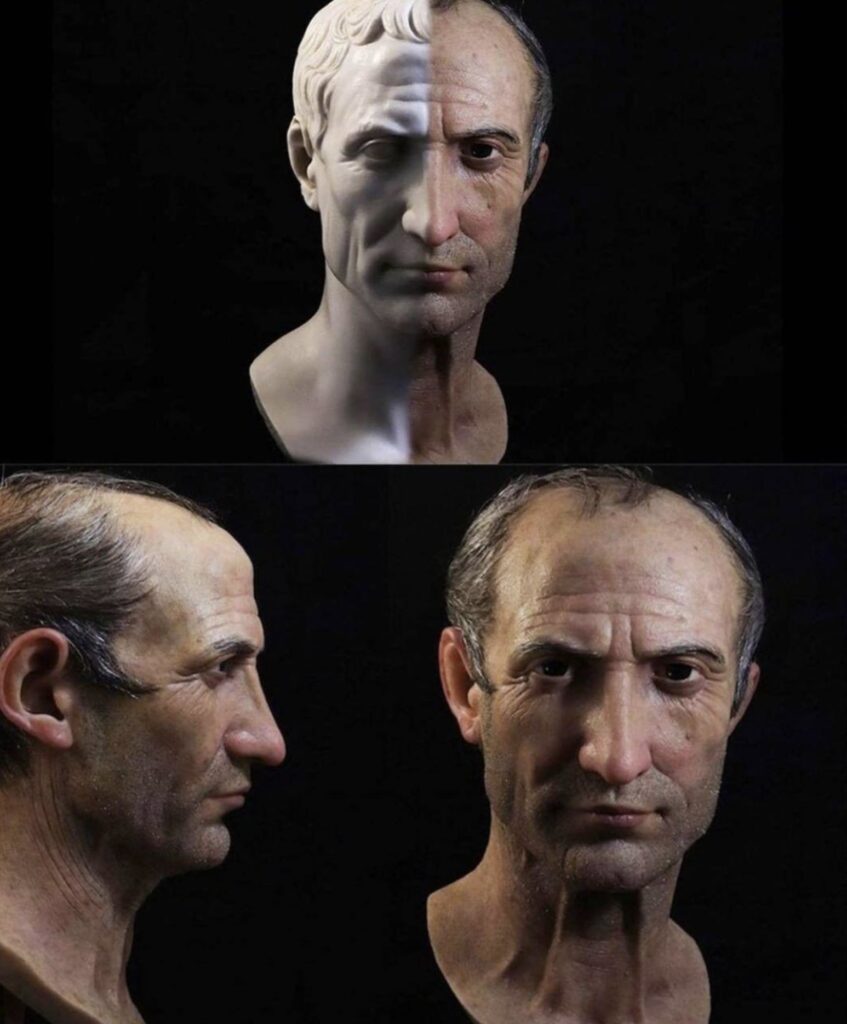
Hyper-realistic silicone reconstruction by French sculptor François Brouat, rebuilding Caesar’s veristic Tusculum portrait in lifelike detail — warts, wrinkles and receding hairline intact. Image © François Brouat.
Caesar on the money: the closest thing to a photograph
Here is a fact that delights numismatists and annoys tyrants: in 44 BC, Caesar became the first living Roman to put his own face on a coin. Until then, the Republic reserved that honour for gods and long-dead ancestors; a living man’s portrait on currency smelled far too much like monarchy. Caesar, never one to be slowed down by tradition, did it anyway.

These little silver discs are gold dust for historians, because they were minted while Caesar was alive and approving the design. And the profile they show is not a flattering fantasy: a long, sinewy neck, a prominent Adam’s apple, hollow cheeks and a high forehead that quietly admits the hairline was in full retreat. The engravers even worked in his laurel wreath — a detail that, as we shall see, was doing double duty.
What the Romans actually wrote down
For once, we do not have to rely on stone alone. The biographer Suetonius, writing about a century and a half later but with access to now-lost sources, gives us a verbal portrait in his Life of the Deified Julius. He describes Caesar as tall and fair-skinned, well-built, with a rather full face and dark, lively eyes. He was, by Suetonius’ account, in excellent health for most of his life — the fainting fits and seizures came only at the end.
And then comes the detail that humanises Caesar more than any marble ever could: the man was touchy about going bald. Suetonius tells us Caesar found his thinning hair a genuine embarrassment, one his enemies gleefully mocked. His solution was a strategic comb-forward from the crown — the ancient world’s original comb-over — and, when the Senate offered him the right to wear a laurel wreath at all times, he seized it. The wreath was officially a symbol of triumph. Unofficially, it was excellent scalp coverage. Conqueror of Gaul, breaker of the Republic, and quietly delighted to have found a dignified hat.
So why does every reconstruction look different?
Put all this together and you can see why no two digital Caesars agree. A reconstruction is only ever as good as the bust it starts from — and the busts themselves disagree, because they were made for different reasons at different times. Start from the Chiaramonti and you get a serene demigod. Start from the Tusculum and you get a tired, balding general. Add a modern artist’s assumptions about skin tone, eye colour and stubble — none of which marble records — and the result tells you as much about the reconstructor as about Caesar.
The honest verdict? We have an unusually good sense of Caesar’s bone structure and bearing, thanks to the coins and the Tusculum bust. Everything past that — the exact shade of his eyes, the texture of his skin, whether he looked kind or cruel — is informed guesswork wearing a very convincing render. Which is precisely what makes the viral image so fun, and precisely why you should enjoy it with one eyebrow raised.
Frequently asked questions
What did Julius Caesar really look like?
Based on his lifetime coins and the Tusculum bust, Caesar was a tall, fair-skinned man with a lined, gaunt face, dark eyes, a prominent Adam’s apple and a noticeably receding hairline. Ancient descriptions and contemporary portraits agree he was balding and lean rather than the smooth, heroic figure of later idealised statues.
Which bust of Julius Caesar is the most accurate?
Most scholars regard the Tusculum portrait in Turin as the closest to his living appearance. It is the only surviving bust likely carved during Caesar’s lifetime, and its features closely match the coin portraits struck in 44 BC.
Was Julius Caesar actually bald?
Yes. The biographer Suetonius records that Caesar was self-conscious about his thinning hair, combed it forward to hide the loss, and welcomed the right to wear a laurel wreath partly because it concealed his scalp. His lifetime coins show the same high, receding hairline.
Do we have any portrait of Caesar made while he was alive?
Possibly one sculpture — the Tusculum bust — and, more securely, the silver coins minted in 44 BC, the year of his death. In that year Caesar became the first living Roman to place his own portrait on the coinage.
Why does Caesar look so different in every statue?
Because the portraits served different purposes. Lifetime works followed the realistic “veristic” style that prized age and character, while posthumous busts made under Augustus idealised Caesar into a serene, godlike ancestor. Political messaging, not photography, shaped the face.
Sources & further reading
- Suetonius, The Deified Julius (Life of Julius Caesar), ch. 45 — ancient description of Caesar’s appearance and baldness.
- “Chiaramonti Caesar,” Wikipedia — en.wikipedia.org/wiki/Chiaramonti_Caesar
- “Tusculum portrait,” Wikipedia — en.wikipedia.org/wiki/Tusculum_portrait
- Vatican Museums, official catalogue entry for the Caesar (Chiaramonti) bust — museivaticani.va
- Italian Art Society, “The Tusculum and Chiaramonti Caesars” (2018).
- Museum of Fine Arts, Boston & the Art Institute of Chicago — catalogue notes on the 44 BC denarii of Julius Caesar.
Image licences: Chiaramonti bust — public domain (Musei Vaticani), via Wikimedia Commons. Tusculum and Arles busts — © Carole Raddato, CC BY-SA 2.0. Denarius — © Classical Numismatic Group (CNG), CC BY-SA 2.5. All via Wikimedia Commons.
