
On 24 August AD 410, something happened that had seemed almost impossible for centuries. The gates of Rome opened to a Gothic army. For centuries, Rome had not been captured by a foreign enemy. Hannibal had once stood at the gates, but they didn’t open; generations of kings and emperors had risen and fallen, and the Roman armies had conquered Britain, Gaul, Spain, Africa, and the Mediterranean world. Now a Gothic king named Alaric was inside the city.
For three days, his soldiers moved through Rome, taking its wealth and terrifying its inhabitants. Yet the story of Alaric is more complicated than the image of a barbarian conqueror finally destroying the Eternal City. For much of his life, Alaric had fought, negotiated, and bargained with the Roman Empire. He wanted land for his people, recognition for himself, and a place within the Roman military system. In the end, after years of failed negotiations, he got something very different. He got Rome.
A Goth in the Roman World
Alaric was probably born around AD 370, somewhere near the lower Danube. He belonged to the Goths, and he was not an outsider who suddenly appeared at the gates of civilization. As a young man, Alaric served in the Roman military. In AD 394, Gothic troops under his command fought for the Emperor Theodosius I against the usurper Eugenius at the Battle of the Frigidus. That experience mattered.
Alaric knew the Roman army. He knew Roman politics. He knew the geography of the Empire and, perhaps most importantly, he understood that military force and Roman diplomacy were inseparable. After Theodosius died in 395, the political balance began to collapse. Alaric and his Goths turned against the Empire. For the next fifteen years, Alaric would repeatedly move between war and negotiation.
The King and the General
By the beginning of the fifth century, he had become one of the most dangerous military leaders in the Roman world. He invaded Italy in 401. The Romans responded under their most capable general, Flavius Stilicho. Stilicho defeated Alaric at Pollentia in 402 and again at Verona the following year. But Rome did not destroy Alaric’s army. Instead, the two sides continued to negotiate. That relationship became increasingly complicated.
At various points, Alaric was treated as an enemy, an ally, and a potential Roman military commander. Stilicho himself saw advantages in using Gothic forces for Roman purposes. Zosimus records that Stilicho and Alaric were involved in plans concerning the disputed provinces of Illyricum. This was the world Alaric inhabited. The Roman Empire did not simply fight the Goths. It hired them, paid them, negotiated with them, and sometimes fought them again. Alaric understood that perfectly. And he wanted his reward.

Then Stilicho Died
The man who had been capable of dealing with Alaric was murdered in AD 408. Stilicho had fallen victim to the poisonous politics surrounding the young Emperor Honorius. Accused of treason, he sought sanctuary in a church at Ravenna, but was arrested and executed on 22 August. The consequences were enormous.
Stilicho’s arrangements with Alaric collapsed. Payments were interrupted. Roman policy became increasingly hostile toward the barbarian troops who had served the Empire. Then came an even greater disaster. Roman soldiers and civilians attacked the families of barbarian troops and their allies living throughout Italy. Thousands of these men fled and joined Alaric. Now Alaric had an army with a reason to march. In September 408, he appeared before Rome.
The First Siege
Rome was not taken by assault; Alaric did something more effective. He surrounded it. The Gothic army cut the city off from its supplies. Hunger spread through the enormous population, and the Romans eventually opened negotiations. The senators attempted to intimidate Alaric by reminding him of the size and courage of the Roman population. His answer became famous.
The Romans were like a field of grass, he suggested: the thicker the grass, the easier it was to mow. But Alaric was willing to negotiate. The Romans eventually agreed to pay a vast ransom in gold, silver, and other valuables. The Goths withdrew. Rome had bought itself time. But the underlying problem had not disappeared. Alaric still wanted a settlement.
He wanted land for his people and a recognized position within the Roman military hierarchy. These were not demands for the destruction of the Empire. They were demands for a place inside it. And Rome’s government still could not give him one.
Rome Besieged Again
Alaric returned, and in late 409, Rome once again found itself cut off. This time the Romans tried something extraordinary. They chose their own emperor. Priscus Attalus, the urban prefect, was elevated to the imperial throne with Alaric’s support. In return, Alaric received a senior military position. For a moment, it seemed that the Gothic king had achieved what he wanted. But Attalus proved unable to solve the most important problem: the supply of grain from North Africa, and the experiment collapsed.
Alaric removed Attalus from power and once again tried to negotiate with Honorius. Again, there was no settlement. The Roman government at Ravenna refused to make the agreement Alaric wanted. Then an attack made matters worse. A Gothic enemy named Sarus, now connected with the imperial government, attacked Alaric and his men. Whatever remained of his trust in negotiations disappeared. He turned back toward Rome. This time, there would be no ransom.
The Sack of Rome
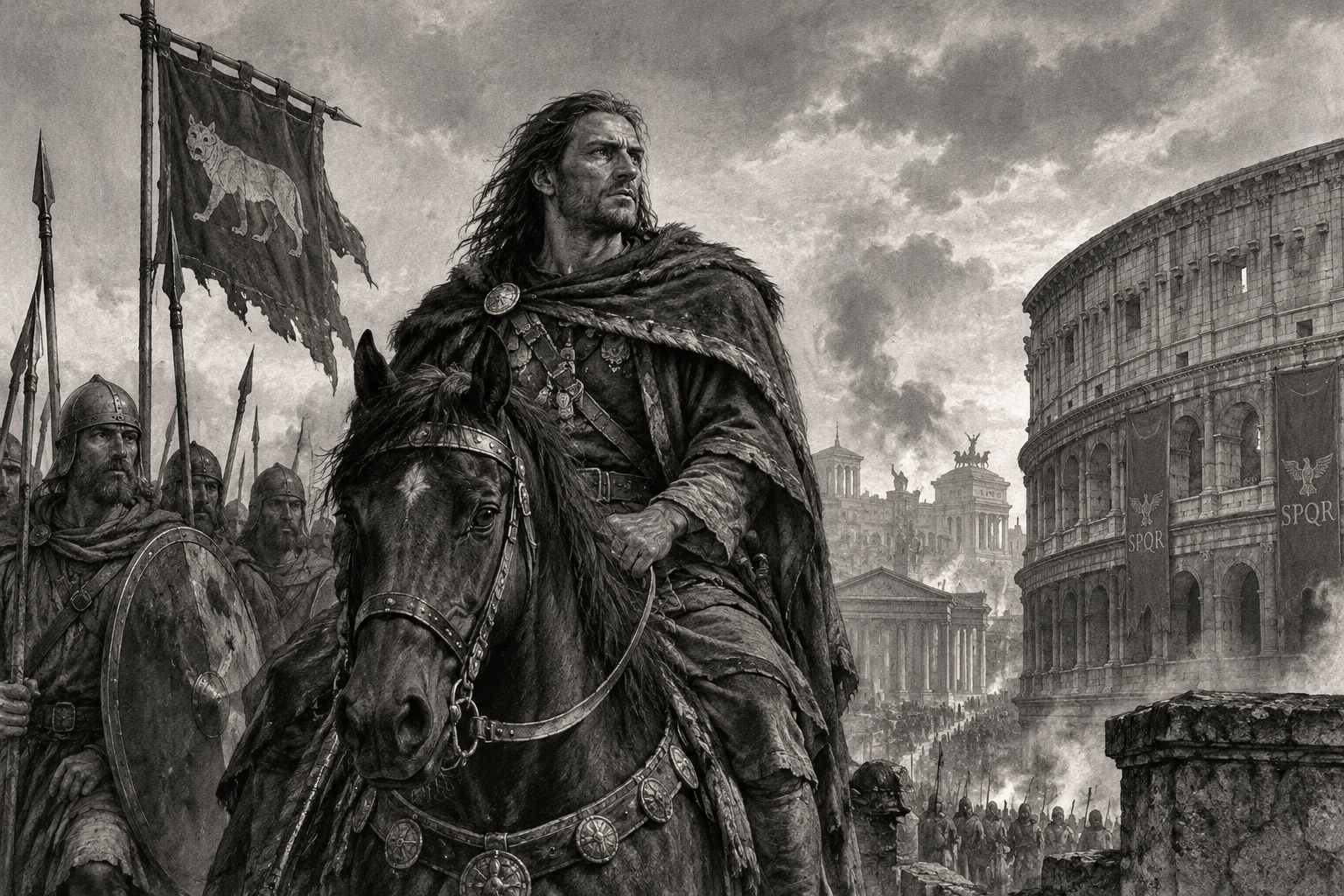
In August 410, he surrounded the city for the third time. Rome had already suffered from hunger, disease, and repeated demands for money. Then, on 24 August, the Goths entered. Exactly how they got through the Salarian Gate remains uncertain. Ancient accounts disagree over the details. What is certain is what followed. For three days, Rome was looted.
The Goths took gold, silver, precious objects, and the wealth accumulated by generations of Roman aristocratic families. Palaces were entered, treasures disappeared, people were captured, and across the Empire, the news travelled with astonishing speed. Rome had been taken. Yet the sack was not the destruction of Rome that later imagination sometimes suggests.

There was violence and plunder, but there was no general burning of the city. Some churches were respected as places of refuge. The Christian writer Orosius, writing only a few years later, specifically records Alaric ordering his men to spare those who had fled to the basilicas of Saints Peter and Paul. Augustine later referred to the same phenomenon. People who had taken refuge in Christian holy places, he argued, had been spared by the barbarians. The sack of Rome became one of the events that inspired his great work The City of God.
None of this makes the sack peaceful, as it was a catastrophe for the people who experienced it, but Alaric had not marched across Italy simply to burn Rome. For years he had tried to force the Roman government to negotiate. Now the negotiations had failed.
The Last March
After three days, he left Rome. He took his army south through Italy, carrying enormous quantities of captured wealth and prisoners. But Rome had not been his final objective. Alaric wanted to cross the sea and reach North Africa. Africa was one of the Empire’s great grain-producing regions, and controlling it would give him enormous strategic leverage. But the plan failed.
His fleet was destroyed by storms while attempting to cross the Strait of Messina. Then, somewhere in southern Italy, Alaric suddenly became ill, although he was still a young man. He had spent years fighting the Roman Empire, negotiating with its emperors and generals, and trying to secure a future for his people. Now, only months after entering Rome, he was dying. He died at Consentia, modern Cosenza, in late 410. He was about forty years old.
The River That Hid a King
The story of Alaric’s burial became almost legendary. According to the Gothic historian Jordanes, Alaric’s followers diverted the river Busento and dug a grave in its riverbed. They buried their king there with treasures taken during his campaigns. Then they allowed the river to return to its course. The captives who had dug the grave were supposedly killed so that no one could reveal the location. Whether every detail of the story is true is impossible to establish. Jordanes was writing more than a century after Alaric’s death. But the image survived.

A Gothic king who had entered Rome, shaken the Roman world, and died before he could complete his final journey was supposedly hidden beneath the waters of a southern Italian river. His people moved on. The new king became his brother-in-law Ataulf, who would continue the complicated relationship between the Goths and the Roman Empire. And Rome remained.

Hello, my name is Vladimir, and I am a part of the Roman-empire writing team.
I am a historian, and history is an integral part of my life.
To be honest, while I was in school, I didn’t like history so how did I end up studying it? Well, for that, I have to thank history-based strategy PC games. Thank you so much, Europa Universalis IV, and thank you, Medieval Total War.
Since games made me fall in love with history, I completed bachelor studies at Filozofski Fakultet Niš, a part of the University of Niš. My bachelor’s thesis was about Julis Caesar. Soon, I completed my master’s studies at the same university.
For years now, I have been working as a teacher in a local elementary school, but my passion for writing isn’t fulfilled, so I decided to pursue that ambition online. There were a few gigs, but most of them were not history-related.
Then I stumbled upon roman-empire.com, and now I am a part of something bigger. No, I am not a part of the ancient Roman Empire but of a creative writing team where I have the freedom to write about whatever I want. Yes, even about Star Wars. Stay tuned for that.
Anyway, I am better at writing about Rome than writing about me. But if you would like to contact me for any reason, you can do it at contact@roman-empire.net. Except for negative reviews, of course. 😀
Kind regards,
Vladimir