
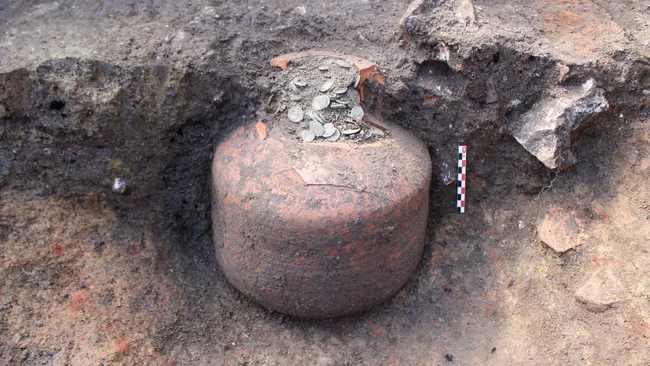
Archaeology has a unique way of bringing the past into the present, often through objects that were once ordinary in their time. Such is the case with a recent discovery in a small French village: two 1,800-year-old piggy banks filled with Roman coins, unearthed during routine excavation work. The find, astonishing both for its age and completeness, offers a rare glimpse into the economic habits of everyday people living in the Roman Empire. Far from being mere curiosities, these objects illuminate the ways in which individuals saved, stored, and sometimes intentionally concealed their wealth in times of uncertainty.
The piggy banks, crafted from simple clay, were remarkably well-preserved. Each contained dozens of Roman coins, primarily denarii and antoniniani, dating to the late 2nd and early 3rd centuries AD. Archaeologists were able to determine the approximate period of these Roman coins thanks to inscriptions and iconography on the coins themselves. The careful arrangement within the clay vessels suggests intentional deposition, not accidental loss. According to the excavation team, such finds are relatively rare because clay objects are fragile, and most perish over time. Yet when they survive, they provide an unparalleled window into the everyday lives of Roman citizens, far removed from imperial grandeur.
Why This Discovery Matters
Finding Roman coins inside piggy banks is significant for several reasons. First, it reveals personal saving practices in Roman Gaul, the region corresponding to modern-day France. While historians often focus on military and administrative achievements, everyday economic behavior is less visible in the archaeological record. These hoards demonstrate that people took measures to protect their wealth, sometimes burying it for safekeeping during periods of instability, such as political upheaval or local conflict.
Second, these finds contribute to understanding the circulation of currency across the empire. Roman coins were not merely decorative or ceremonial; they facilitated commerce and indicated levels of prosperity. By examining wear, minting origins, and denominations, numismatists can reconstruct trade routes, economic connections, and even episodes of inflation or coin shortages. Each coin, therefore, acts as both a monetary and historical document.
Similar Discoveries Across Europe
The French piggy bank find is not unique, though its preservation and context make it particularly valuable. Across Europe, archaeologists have uncovered several comparable Roman coin hoards that shed light on regional practices.
One example comes from a Roman villa in Britain, where multiple ceramic vessels contained hundreds of silver coins dating to the 3rd century AD. These Roman coins were buried beneath the villa floor, possibly to protect savings during a period of Saxon raids. Another find occurred in Germany along the Rhine, where coins were stored in clay jars in what appeared to be a domestic cellar. Both cases suggest that hiding small fortunes at home or near one’s dwelling was a common protective strategy.
What ties these discoveries together is the pattern of deposition: coins often found in fragile containers, buried in discrete or hidden locations, and frequently associated with domestic spaces rather than temples or public buildings. This pattern underscores that Roman citizens, regardless of social rank, engaged in proactive financial behavior, reflecting both prudence and anxiety about future security.
What Happens After a Hoard Is Found
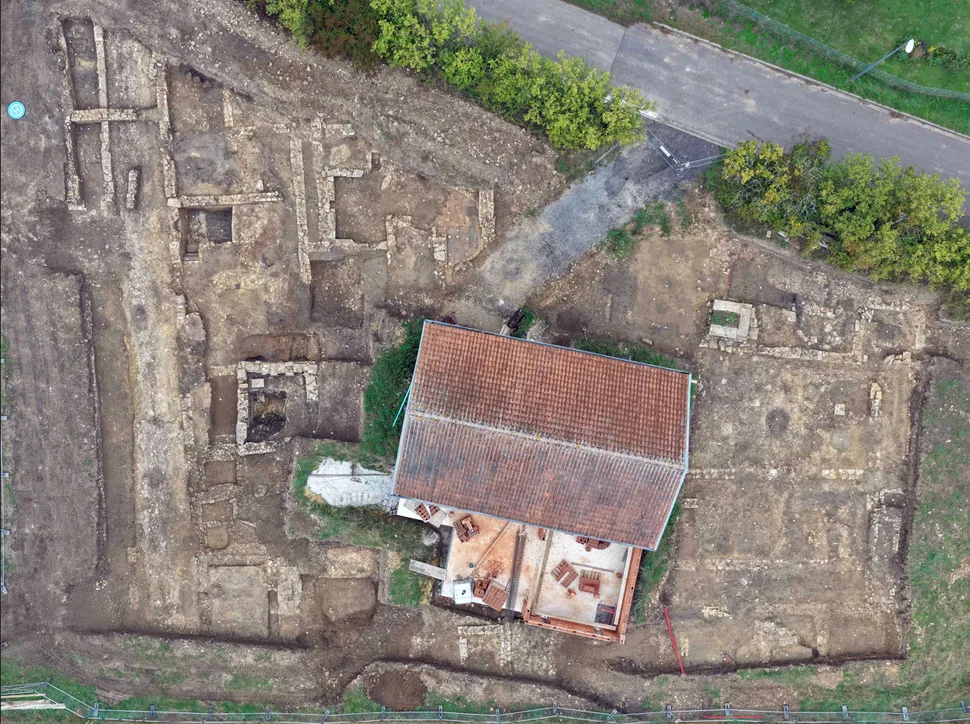
Discovering ancient piggy banks full of Roman coins triggers a careful sequence of archaeological, numismatic, and legal processes. Initially, the site is carefully documented, often through photogrammetry and excavation grids, to preserve the spatial context of each find. Any remaining soil is sifted meticulously to recover fragments, small coins, and related artifacts. Once the hoard is removed, conservators stabilize the coins, removing corrosion and ensuring long-term preservation.
Numismatists then catalog the coins by type, date, and mint, providing valuable data for historians studying economic trends and circulation patterns. These analyses often reveal patterns of commerce, local production versus imported currency, and even responses to broader economic crises within the empire.
Legal and ownership matters can be complex. In many European countries, state authorities claim significant archaeological finds, though landowners may receive compensation. Once ownership is determined, coins are often displayed in local museums or used in traveling exhibits, connecting communities with their Roman past. Publication in academic journals typically follows, ensuring that the discovery contributes to global historical knowledge.
Beyond the Roman Coins — Insights Into Roman Life
Piggy banks, although utilitarian, are also cultural artifacts. They demonstrate that saving money was a universal human behavior, transcending social classes. In some cases, coins may have been buried as offerings to deities, blending financial prudence with spiritual practice. The French find, like its counterparts elsewhere in Europe, also hints at the mobility of coins. They were often minted far from where they were ultimately stored, indicating trade networks that spanned the empire.
These discoveries remind historians that while monumental structures, military campaigns, and elite lifestyles dominate textbooks, ordinary Romans managed their finances carefully and creatively. Each hoard offers a tangible connection to lives lived nearly two millennia ago, showing how people responded to economic, social, and political pressures in very human ways.
The Afterlife of Hoards
Once excavated, these hoards often inspire further research and exploration. Archaeologists may return to the site to search for additional finds, uncovering domestic layouts, workshops, or other buried hoards. In some cases, the coins themselves inform conservation strategies for other artifacts from the same period. Museums frequently feature these hoards in exhibits, sometimes reconstructing the original context to help visitors visualize Roman domestic and civic life.
Moreover, public interest in coin hoards often stimulates educational initiatives. Schools, community programs, and historical societies use these discoveries to teach about the Roman economy, society, and daily life. The ripple effect extends far beyond the original find, enriching both scholarship and public understanding.

Conclusion — Tiny Vessels, Big Stories
The 1,800-year-old piggy banks unearthed in France do more than reveal the presence of Roman coins; they illuminate everyday life in a complex empire. They connect us with ordinary people who navigated economic uncertainty with the same instincts we recognize today: saving, protecting, and planning for the future. Similar hoards across Europe reinforce that this behavior was widespread and culturally significant.
As each coin is cataloged, analyzed, and displayed, these modest clay containers continue to tell stories of trade, trust, and human ingenuity. For historians, numismatists, and the public alike, these “Roman coins” discoveries are more than treasure; they are keys to understanding the lived experience of ancient Rome.

Hello, my name is Vladimir, and I am a part of the Roman-empire writing team.
I am a historian, and history is an integral part of my life.
To be honest, while I was in school, I didn’t like history so how did I end up studying it? Well, for that, I have to thank history-based strategy PC games. Thank you so much, Europa Universalis IV, and thank you, Medieval Total War.
Since games made me fall in love with history, I completed bachelor studies at Filozofski Fakultet Niš, a part of the University of Niš. My bachelor’s thesis was about Julis Caesar. Soon, I completed my master’s studies at the same university.
For years now, I have been working as a teacher in a local elementary school, but my passion for writing isn’t fulfilled, so I decided to pursue that ambition online. There were a few gigs, but most of them were not history-related.
Then I stumbled upon roman-empire.com, and now I am a part of something bigger. No, I am not a part of the ancient Roman Empire but of a creative writing team where I have the freedom to write about whatever I want. Yes, even about Star Wars. Stay tuned for that.
Anyway, I am better at writing about Rome than writing about me. But if you would like to contact me for any reason, you can do it at contact@roman-empire.net. Except for negative reviews, of course. 😀
Kind regards,
Vladimir