
In an exclusive interview with Roman-Empire.net, the archaeologists behind the discovery reveal how a search for a possible imperial tomb led instead to the remarkable discovery of a private Roman bath hidden inside a monumental palace tower.
Deep in eastern Serbia, around 20 kilometres northwest of Negotin, there is an archeological imperial site from the Late Roman world. Vrelo–Šarkamen is a fortified imperial residence dating to the beginning of the fourth century AD. The complex is generally associated with the Roman tetrarch Maximinus Daia and includes a memorial complex with an imperial mausoleum and tumulus. Earlier excavations also uncovered fragments of a red porphyry statue of an emperor seated on a throne, and a collection of gold jewellery probably belonging to the emperor’s mother. These show us the importance of the entire complex. Now, Šarkamen has produced another extraordinary discovery.
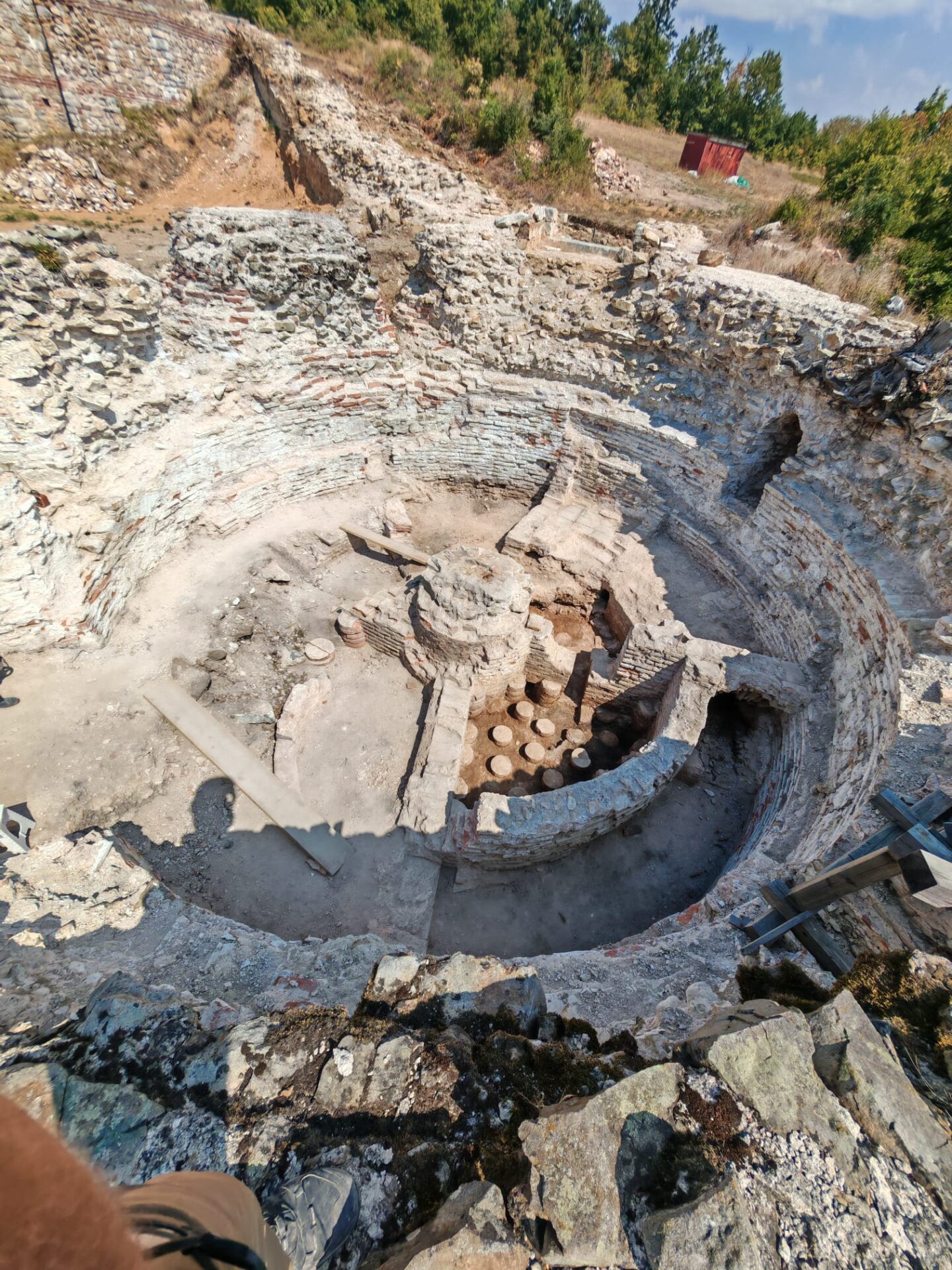
Excavations in the lowest level of the southwestern corner tower have revealed a sophisticated private Roman bath, or balneum. The complex included a furnace, an exceptionally well-preserved hypocaust heating system, heated rooms, bathing tubs, and a sudatorium, a Roman steam room. But the most intriguing part is its location. The Roman bath was built inside a circular palace tower. According to the archaeological team, no direct parallel is currently known elsewhere in the territory of the former Roman Empire for a private bath of this design, installed in the lowest level of a corner tower within an imperial residence.
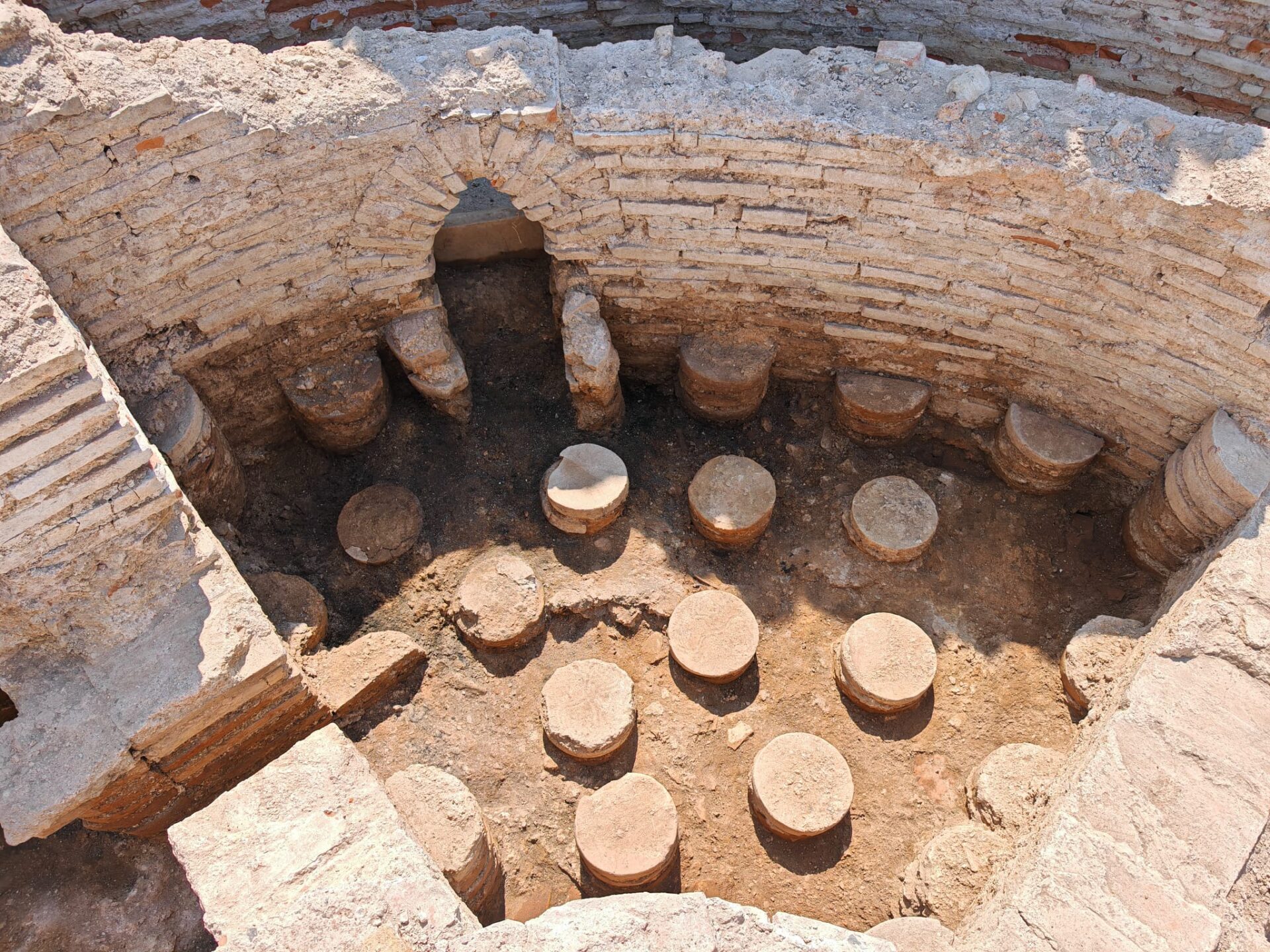
The excavations and research that led to this discovery were jointly led by Dr Marija Jović of the Institute of Archaeology in Belgrade and Gordan Janjić, museum adviser at the Museum of Krajina in Negotin. Both archaeologists have played a leading role in the continuing research at Vrelo–Šarkamen and in the investigations that uncovered the Roman bath complex.
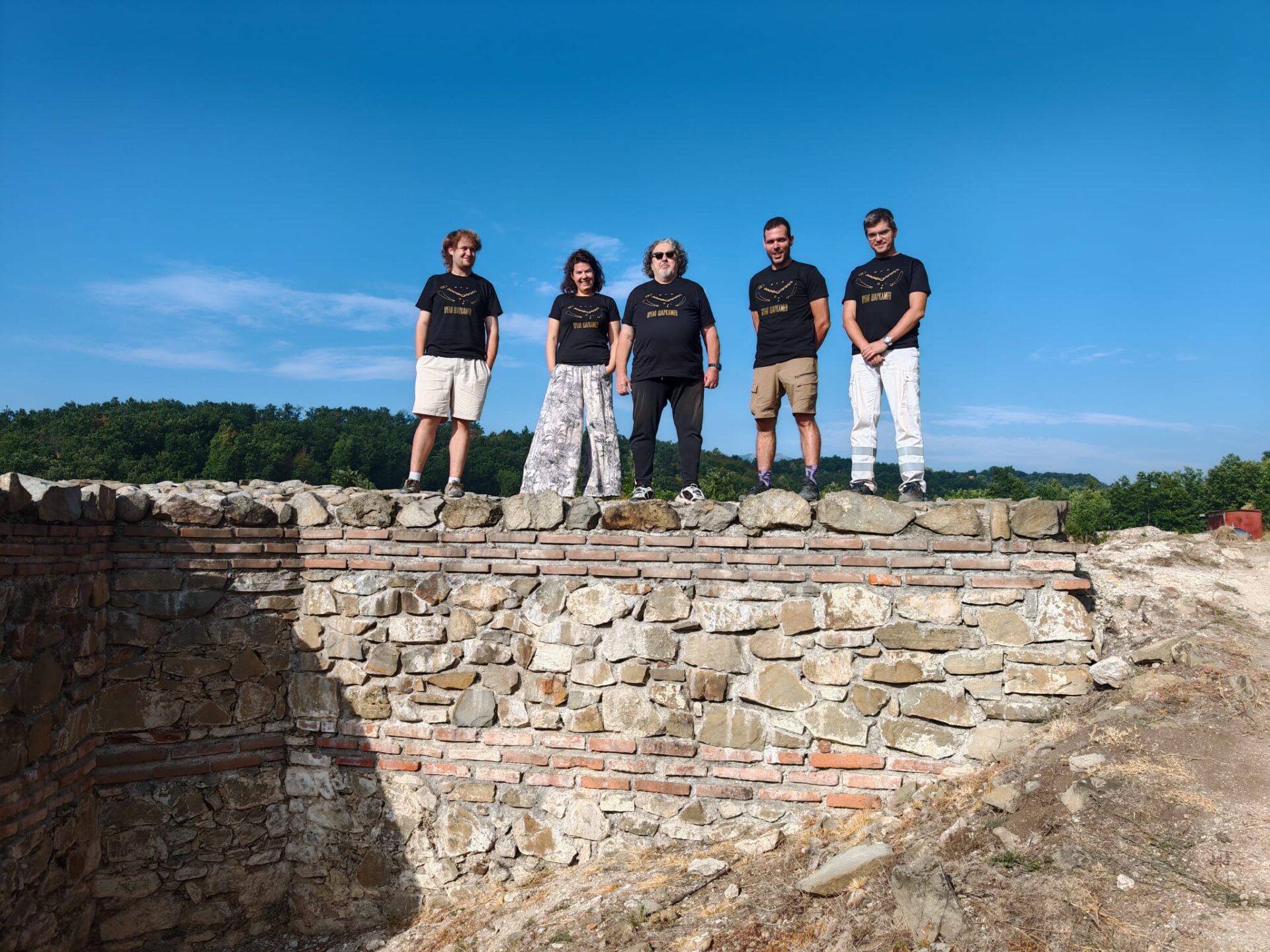
In an exclusive interview with Roman-Empire.net, Marija Jović and Gordan Janjić explain how the discovery unfolded.
What led to the discovery of the bath, and how was it identified?
GORDAN JANJIĆ:
Excavations of the southwestern corner tower of the fortified residence at Šarkamen have been underway since 2024. When we look today at the level from which we began—practically from the very top of the preserved tower—and at how far we have come in a relatively short time, we are sometimes surprised ourselves by the scale of the work that has been done.
The first serious indications that something quite special was hidden in the lowest level of the tower came at the end of the 2025 summer campaign, when a vaulted opening appeared. Once it became clear that the lowest level of the tower had been vaulted, I must admit that I secretly hoped for an even more spectacular scenario—that we had come across an imperial tomb.
In the context of Šarkamen, where we already have an imperial mausoleum and finds connected with the Tetrarchic elite, such an idea did not seem entirely impossible.
MARIJA JOVIĆ:
I was very happy to support Gordan in that idea because, of course, the possibility of discovering an imperial tomb was extremely tempting. However, during the campaign in November and December 2025, it became clear that the vaulted opening was not the entrance to a tomb, but part of a heating system.
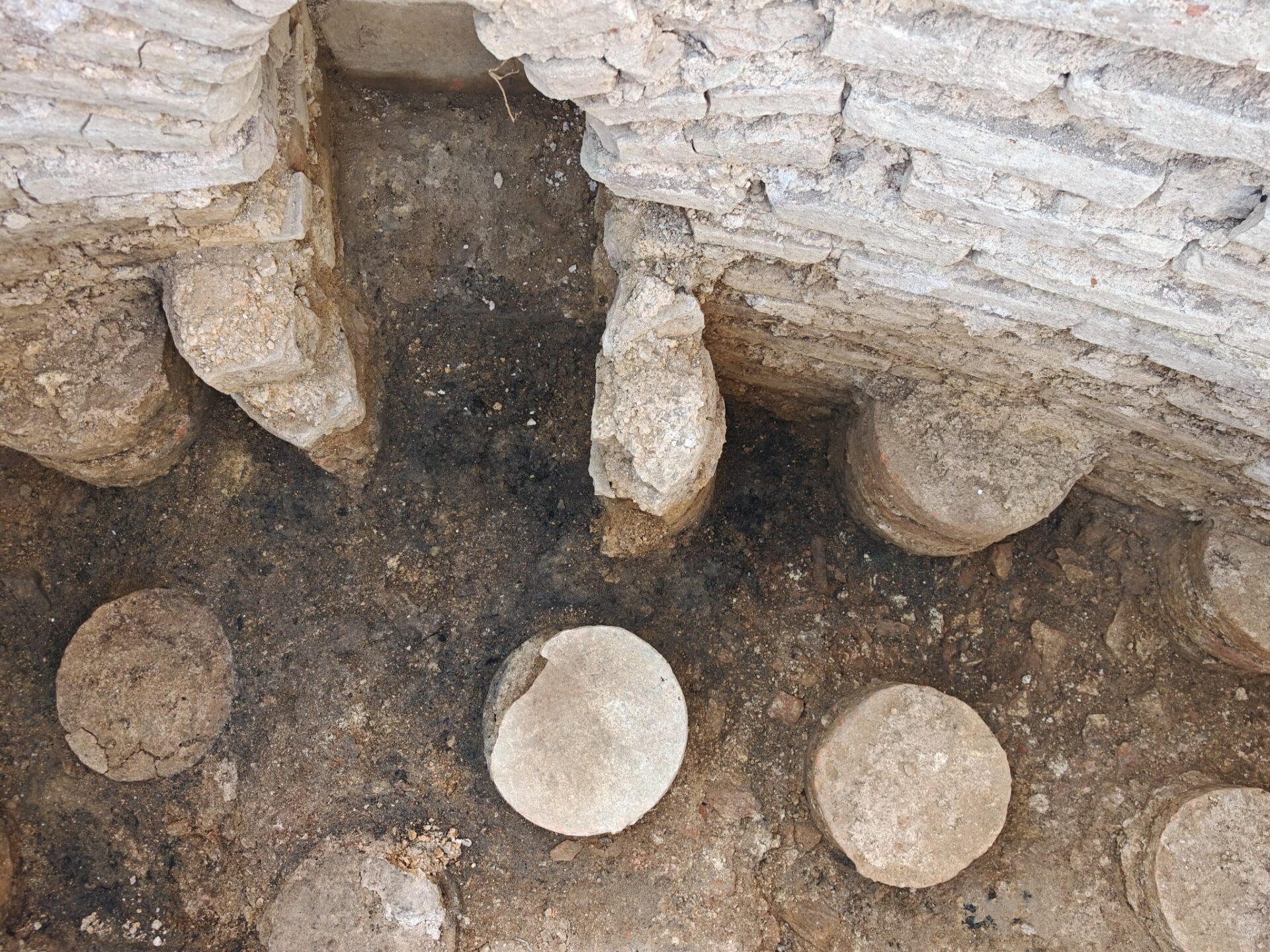
When we realized that we had a furnace in front of us and that a completely preserved hypocaust system lay behind it, I admit that there was a slight disappointment for the first few seconds that it was not a tomb after all. But that was almost immediately replaced by enormous excitement—we realized that there was a private imperial bath inside the tower.
And then the discoveries practically followed one after another, day by day: we identified the system of underfloor and wall heating, the bathing tubs, and then the sudatorium, or sauna. What had begun with a completely different assumption thus developed into a discovery that changed our understanding of the function of the entire lowest level of the tower.
Šarkamen had long been known for its monumental architecture and its connection with the Tetrarchic period, but this Roman bath demonstrates that the complex was not simply a fortified structure or ceremonial residence.
The architecture of the newly discovered balneum is perhaps its most unusual feature. Roman bath complexes were normally arranged according to the practical requirements of moving between rooms of different temperatures. The circular interior of the Šarkamen tower, however, presented the ancient architects with a very different challenge.
What does its circular shape and position inside the tower tell us about its function?
MARIJA JOVIĆ:
It is precisely the location and shape of this balneum that make the discovery at Šarkamen exceptional. Right now, we do not know of a direct parallel anywhere in the territory of the former Roman Empire—a private bath of this design, located in the lowest level of a corner tower of an imperial residence.
The interior of the tower is circular, with a diameter of around nine metres, and it was precisely this space that dictated the architecture of the entire balneum. The ancient architect faced a rather complex task: how to fit all the elements necessary for the functioning of a Roman bath into a limited space with a circular ground plan. The rooms, bathing tubs, heating system and communication between the individual parts of the balneum therefore had to be adapted to the geometry of the tower.
The result is a very carefully conceived and, as far as we can currently say, unique architectural solution.
GORDAN JANJIĆ:
The very location of the balneum in the lowest level of the tower tells us, above all, about its distinctly private character and the need for this space to be separated from the other parts of the imperial residence. The balneum was covered by a dome pierced by six window openings, so natural light reached the interior in a controlled and relatively limited way.
When we add the heat, the water and the isolation of the space inside the massive tower, we can assume that an intimate, perhaps even somewhat mysterious atmosphere was deliberately created here. Of course, we must be careful when speaking about the personal intentions of the emperor, but the architectural solution itself clearly points to a need for privacy and comfort.
We might say that inside what appears to be a defensive element of the residence, its complete opposite was created—a hidden and luxurious private oasis intended for rest and enjoyment.
The structure was not simply a small room with a heated floor. The archaeological evidence reveals a carefully organized bathing complex with both technical and luxurious elements. The complex was divided between areas used for the technical operation of the heating system and spaces intended for bathing and relaxation.
The Imperial Residence and Maximinus Daia
The discovery of the bath also raises an important question: what does it tell us about the wider imperial complex and its connection with Maximinus Daia?
Šarkamen is generally associated with the tetrarch Maximinus Daia, who ruled during the turbulent final years of the Tetrarchic system. The site is particularly important because its fortified residence, mausoleum and memorial landscape closely resemble the imperial residential and memorial complex of Galerius at Felix Romuliana. The connection is supported by archaeology rather than by a surviving inscription naming the emperor.
The crucial discovery came in 1996, when archaeologists found a collection of gold jewellery in the imperial mausoleum. The find provided an important clue to the identity of the complex and helped connect Šarkamen with the Tetrarchic imperial family. Yet one of the great paradoxes of Šarkamen is that, despite the importance of the site, very few ordinary portable objects have been recovered.
What do the finds tell us about the connection with the imperial residence and Maximinus Daia?
MARIJA JOVIĆ AND GORDAN JANJIĆ:
We must admit that the finds at Šarkamen perhaps give us the greatest difficulty—because there are almost none of them.
GORDAN JANJIĆ:
Šarkamen is a very specific site in that respect—during the research carried out so far, more objects made of gold have been found than all the other movable finds combined. Paradoxically, it was precisely the discovery of the Empress-Mother’s jewellery three decades ago that provided the key to understanding the character of the entire complex.
The discovery of an exceptional set of gold jewellery in the imperial mausoleum in 1996 made it possible to connect Šarkamen with the tetrarch Maximinus Daia and to recognize the monumental fortification as an imperial residence that he was building for himself, as a place to which he intended to withdraw after the end of his reign and where he would spend the years of his imperial “retirement.”
MARIJA JOVIĆ:
Even within such a clearly defined and enclosed unit as the southwestern tower, only a few movable finds were discovered during the excavations—an iron nail, the disk of a ceramic lamp and several fragments of window glass.
GORDAN JANJIĆ:
The absence of movable finds was once one of the arguments supporting the assumption that the fortified residence had never been completely finished.
However, the results of more recent research, and particularly the discovery of such a complexly constructed balneum with a heating system and other clearly defined functional elements, now give us reason to reconsider that interpretation.
MARIJA JOVIĆ:
After all, even if we imagine that there had only been a large construction site here, we can make a simple comparison with a modern construction site. Nails, parts of tools, broken objects and all kinds of small items are left behind by workers. At Šarkamen, we hardly have even such material.
Therefore, the absence of finds does not necessarily mean the absence of life or the use of the space—it may actually tell us about completely different circumstances surrounding the abandonment, emptying or organization of the complex, which we still need to understand in greater detail. This is one of the reasons why the newly discovered Roman bath is so important. Architecture can sometimes provide evidence where small finds do not.
Questions Still Hidden Beneath Šarkamen
For all that has been discovered, the balneum has also created a new series of questions. How exactly were its individual rooms organized? How did people enter the bath from the rest of the imperial residence? Perhaps most importantly, where did its water come from? The answers may lie in future excavations.
What questions remain open, and what do you expect from future excavations?
MARIJA JOVIĆ:
Šarkamen functions in an interesting way from year to year—almost every new piece of knowledge we gain through research opens several new questions at the same time. The same is true of the balneum. Its discovery has given us answers about the function of the lowest level of the southwestern tower, but we now have to determine precisely the purpose of all the rooms inside the bath and reconstruct the way in which it functioned.
One of the important questions is, how the balneum was accessed from the other parts of the residence. At this moment, however, perhaps our greatest puzzle is the water supply system. We have certain assumptions about how it may have been arranged, but only the continuation of the research will show whether we are on the right track.
GORDAN JANJIĆ:
Future research will not be limited to the balneum. We have the continuation of research on the southern rampart ahead of us, followed by another tower of the fortified residence. We are particularly looking forward to that because of the experience we now have with the southwestern tower. When we began investigating it, we could not have imagined that an imperial balneum was hidden in its lowest level.
That is why today we really cannot predict what awaits us in the next tower. A major open question also remains the central area of the fortified residence, which still needs to be investigated in greater detail. Šarkamen has shown us several times so far that we should not assume in advance what we are going to find.
Perhaps that is precisely the most exciting part of future research. The discovery of the imperial bath has transformed a single corner of the palace into one of the most intriguing archaeological spaces in the Late Roman Balkans. What appeared from the outside to be a monumental defensive tower concealed a very different world beneath it: heat, water, bathing pools, steam and carefully controlled light beneath a domed roof.
At Šarkamen, one vaulted opening that archaeologists initially hoped might lead to an imperial tomb instead opened the way to something else entirely—a hidden private bath and a new understanding of one of the most remarkable imperial residences in the Roman world

Hello, my name is Vladimir, and I am a part of the Roman-empire writing team.
I am a historian, and history is an integral part of my life.
To be honest, while I was in school, I didn’t like history so how did I end up studying it? Well, for that, I have to thank history-based strategy PC games. Thank you so much, Europa Universalis IV, and thank you, Medieval Total War.
Since games made me fall in love with history, I completed bachelor studies at Filozofski Fakultet Niš, a part of the University of Niš. My bachelor’s thesis was about Julis Caesar. Soon, I completed my master’s studies at the same university.
For years now, I have been working as a teacher in a local elementary school, but my passion for writing isn’t fulfilled, so I decided to pursue that ambition online. There were a few gigs, but most of them were not history-related.
Then I stumbled upon roman-empire.com, and now I am a part of something bigger. No, I am not a part of the ancient Roman Empire but of a creative writing team where I have the freedom to write about whatever I want. Yes, even about Star Wars. Stay tuned for that.
Anyway, I am better at writing about Rome than writing about me. But if you would like to contact me for any reason, you can do it at contact@roman-empire.net. Except for negative reviews, of course. 😀
Kind regards,
Vladimir