
The newly published findings from Kaunos, in southwestern Turkey, tell us a story about the building that changed its purpose through the ages. What began as a Roman hospital in the early centuries of the empire was later transformed into a Byzantine church and monastic complex, preserving within its stones a continuous record of life flow, health, faith, and above all, community.
This is more than a fascinating excavation. It is a reminder that ancient cities were not static. They changed and rebuilt themselves according to the needs of their people. In Kaunos, those needs shifted from medicine to monastic devotion — and amazingly, the physical setting remained the same.
Kaunos: A City Between Worlds
To understand the significance of this discovery, one must first understand Kaunos itself — a city with a long, layered, and deeply multicultural history.
A Frontier Between Cultures
Kaunos sat on the border between Caria and Lycia, two ancient regions of southwestern Anatolia. This borderland position made the city a natural crossroads. Its harbor opened to the Mediterranean, enabling trade routes that drew merchants, sailors, physicians, and religious figures over many centuries.
As a result, Kaunos developed a cultural identity that blended Carian, Greek, Roman, and later Byzantine elements. The city’s legendary founder, Kaunos, said to be the son of Apollo, reflects the mythical prestige that surrounded it in antiquity.

Urban Wealth and Natural Setting
Kaunos is best known today for its astonishing rock-cut tombs, carved high into limestone cliffs overlooking the ancient harbor. These monuments, with their imposing temple-like facades, testify to the wealth and status of Kaunos in the Classical and Hellenistic periods.
The city also possessed:
-
A large theatre, capable of seating thousands
-
Baths and gymnasia, classic features of Greco-Roman civic life
-
An agora, the bustling commercial heart of the city
-
A sprawling harbor district that connected Kaunos to regional maritime trade
-
Rich agricultural land, known especially for figs, olives, and salt pans
Its strategic location made it a coveted place. Persians, Athenians, Spartans, Ptolemies, Rhodians, Romans — all sought control over the city at some point.
Kaunos Under Roman Rule
By the 2nd century AD, Kaunos had fully integrated into the Roman world. This brought new forms of infrastructure, administration, and social organization, including public buildings such as baths, temples, and, as now confirmed by archaeology, a Roman hospital, one of the very few documented in the region.
The Roman period was prosperous. Maritime trade thrived. Public architecture expanded. The city adopted Latin legal frameworks while maintaining Greek as its everyday language.
Survival Through Byzantine Times
Even after the fall of the Western Roman Empire, Kaunos continued to flourish under the Byzantine Empire. Christianity reshaped its urban landscape. Temples were repurposed, churches were built, and monastic communities grew.
This continued activity, extending into the Middle Ages, is part of what makes the newly uncovered hospital-church complex extraordinary. It embodies, in a single site, the entire arc of Kaunos’s transformation.
The Roman Hospital: A Center of Healing
Archaeologists have now confirmed that the structure originally served as a Roman hospital, most likely dating to the 2nd or 3rd century AD. Roman hospitals, known as valetudinaria, were usually associated with military installations, but civilian hospitals did exist in important regional centers.

Medical Tools Tell the Story
Among the most compelling findings were surgical and medical instruments — clear indicators of a functioning medical institution. These include items typically used for:
-
wound treatment
-
minor surgical procedures
-
general health care
-
preparation of ointments and remedies
Such tools offer rare physical evidence of Roman medical practice in this part of Anatolia.
Layout and Architecture
The structure was designed around a central courtyard with multiple surrounding rooms, a layout well-suited to:
-
treating patients
-
isolating infections
-
storing medical supplies
-
housing physicians and attendants
Its location near the harbor suggests it may also have served travelers, merchants, and sailors — populations frequently exposed to illness and injury.
In short, this was a place of healing, staffed by professionals who practiced medicine grounded in Galenic principles and the long traditions of Greco-Roman science.
A Dramatic Transformation: From Hospital to Church
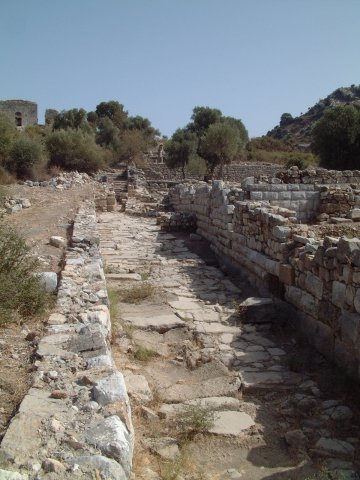
By the 6th century AD, during the early Byzantine period, the site underwent a complete transformation. The Roman hospital was converted into a Christian church and later incorporated into a larger monastic complex built on a higher terrace.
Architectural Reconstruction
The Byzantine builders reused substantial parts of the Roman structure. This kind of adaptive reuse was common as Christianity spread across Anatolia. The courtyard became part of the monastic zone, and new walls, apses, and liturgical spaces were added.
The newly uncovered church is described as exceptionally well-preserved, with clear architectural features including:
-
a nave
-
side rooms
-
monastic living quarters
-
evidence of devotional activity
This suggests a thriving religious community. The monks may have been drawn to the site precisely because of its earlier association with healing, a concept rooted in early Christian thought.
A Living Religious Center
Coins discovered at the site, including one from the 14th century issued by the Aydinogullari Beylik, prove that the location continued to be visited and used long after the Byzantine Empire lost control of the region.
This makes the site not merely a relic, but a continuous point of spiritual significance across many centuries.
A Microcosm of Anatolian History
The story of the Kaunos hospital-church reveals several broader themes central to understanding the history of Anatolia.
Continuity Through Change
Buildings often changed function as empires rose and fell. Yet their physical presence anchored communities through:
-
political shifts
-
religious transformations
-
economic changes
-
cultural blending
Kaunos exemplifies this pattern. Roman science gave way to Christian devotion, but the structure survived.
The same walls that once hosted physicians and patients later welcomed monks and pilgrims. This seamless shift reflects the ancient belief — both Roman and Christian — that healing was not only physical but spiritual.
Few archaeological sites preserve such a long and clearly visible sequence of transformations. Here, however, one can:
-
stand in a Roman courtyard
-
touch Byzantine monastic walls
-
trace the paths of medieval visitors
all in one place.
Conclusion: A Place Where Time Does Not Break
The rediscovery of the Roman hospital and Byzantine church at Kaunos does far more than add another chapter to the site’s archaeology. It reveals a living continuum. A building where doctors practiced medicine became a house of prayer. A center of bodily healing became a center of spiritual healing — and the people of Kaunos, century after century, kept returning.
In its stones we see the resilience of a city that adapted to every era without ever losing its identity.
Kaunos remains, as always, a meeting point between worlds — between Caria and Lycia, between the ancient and the medieval, between medicine and faith, between the Roman Empire and Byzantium.
And thanks to this discovery, its story is richer than ever.

Hello, my name is Vladimir, and I am a part of the Roman-empire writing team.
I am a historian, and history is an integral part of my life.
To be honest, while I was in school, I didn’t like history so how did I end up studying it? Well, for that, I have to thank history-based strategy PC games. Thank you so much, Europa Universalis IV, and thank you, Medieval Total War.
Since games made me fall in love with history, I completed bachelor studies at Filozofski Fakultet Niš, a part of the University of Niš. My bachelor’s thesis was about Julis Caesar. Soon, I completed my master’s studies at the same university.
For years now, I have been working as a teacher in a local elementary school, but my passion for writing isn’t fulfilled, so I decided to pursue that ambition online. There were a few gigs, but most of them were not history-related.
Then I stumbled upon roman-empire.com, and now I am a part of something bigger. No, I am not a part of the ancient Roman Empire but of a creative writing team where I have the freedom to write about whatever I want. Yes, even about Star Wars. Stay tuned for that.
Anyway, I am better at writing about Rome than writing about me. But if you would like to contact me for any reason, you can do it at contact@roman-empire.net. Except for negative reviews, of course. 😀
Kind regards,
Vladimir