
When the Danube Falls: The Roman World Emerging From the River
For ages, the Danube hid a Roman bridge. Then, in the summer of 2026, the river became so low that parts of it began to appear again. Near the village of Gigen in northern Bulgaria, archaeologists suddenly found themselves looking at the foundations of one of the bridges built by the Roman Empire. Precisely, it had been ordered by Emperor Constantine the Great.
It had connected two Roman territories across the Danube, and for centuries, almost all of it had been hidden beneath the river. Now the water was giving it back. The discovery is one of the strangest archaeological consequences of Europe’s extraordinary summer drought. And the Constantine Bridge is not the only Roman history that has suddenly become easier to see.

A Bridge Built by Constantine
The story begins in AD 328, when Constantine the Great was no longer simply fighting for control of the Roman Empire. He was transforming it. He had founded Constantinople and reorganized the army. Also, he had become the first Roman emperor to openly embrace Christianity.
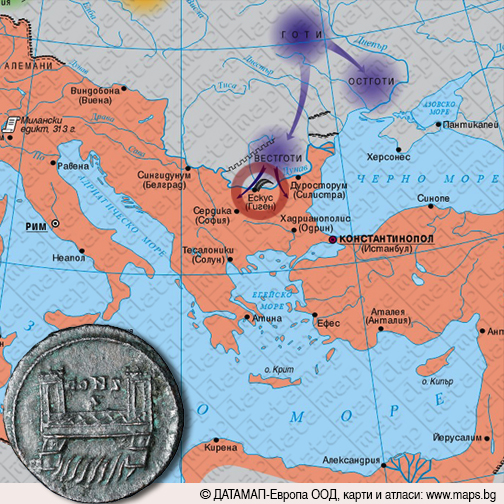
Still, Constantine was also interested in practical things like moving armies. The lower Danube remained one of the most important military frontiers in the Roman world. To control it, Rome needed roads, forts, supplies, and, above all, ways to cross the river. So Constantine ordered the construction of a massive bridge. It connected the Roman city of Ulpia Oescus, near modern Gigen in Bulgaria, with Sucidava on the northern bank, in present-day Romania.
When it was completed, it stretched for more than two kilometres, one of the longest bridges of the ancient world. Reuters reports that the bridge probably remained in use for only several decades.
Why Did Constantine Need It?
The bridge was not built simply because Constantine wanted to impress people. The Romans had spent centuries treating the Danube as a frontier. Constantine was interested in reasserting Roman power north of the Danube, including in territories associated with the abandoned province of Dacia. A permanent bridge made that much easier. The river, which had always been an enormous obstacle, suddenly became a road. And the Romans had built that road out of stone and timber.
The Bridge Did Not Last Long
There is something almost tragic about the Constantine Bridge. For all the effort required to build it, it apparently had a surprisingly short life. By around AD 367, it is believed to have been largely destroyed. The exact circumstances remain uncertain, but the timing is fascinating. The Roman Empire was entering another difficult period along the Danube. Emperor Valens was campaigning against the Goths, and the river was once again at the center of Roman military strategy.
When Valens crossed the Danube during his campaign, he used a bridge of boats rather than Constantine’s permanent bridge. That suggests that Constantine’s great bridge was already out of service. Then the river covered what remained. And slowly, the bridge disappeared from view.
The Danube Hid More Than a Bridge
This is what makes rivers so fascinating to archaeologists. They destroy things, but they can also preserve them. A building abandoned on dry land may be robbed for stone, plowed apart or covered by later construction, but the structure that disappears beneath water can sometimes survive in a completely different way. The Danube protected parts of Constantine’s bridge from later generations. For centuries, the river kept the remains out of sight. Until 2026.
The Summer the River Became a Time Machine
Europe has experienced an extraordinary period of heat and drought this summer. Major rivers have fallen dramatically, including the Danube and Rhine. At certain points, the Danube has reached exceptionally low levels, disrupting shipping and exposing areas of the riverbed that are normally underwater. For archaeologists, however, the disappearing water created an extraordinary opportunity. Parts of the Constantine Bridge’s foundations became visible near Gigen.
Researchers from the Regional Historical Museum in Pleven moved quickly to document them. They used aerial photography and drones to record the remains while the water was low. As archaeologist Pavel Popov explained, such moments are extremely valuable because the river temporarily reveals a structure that is normally hidden beneath it.
Britain Is Revealing Roman Ruins Too
The Danube is not the only place where the drought has changed what archaeologists can see. Thousands of kilometres away, Britain’s unusually hot and dry summer has produced another kind of archaeological window. This time, the discoveries are not emerging from water. They are appearing in grass.
At Portchester Castle in Hampshire, the walls of a remarkably well-preserved Roman coastal fort still dominate the landscape. But dry conditions have revealed additional archaeological features inside the fort. Different types of soil retain different amounts of moisture. Where ancient walls lie beneath the ground, vegetation above them may struggle because the buried stone changes the depth and drainage of the soil. Where ancient ditches were filled in, the opposite can happen. The filled ditch may contain richer soil and retain more moisture.
During a normal summer, these differences can be almost invisible. During a severe drought, the lines appear, and old foundations become visible. The ground begins to reveal the buildings beneath it. At Portchester, the drought has exposed crop marks that provide a clearer view of features that normally disappear into the surrounding grass. Country Life reported that similar drought-related discoveries have appeared elsewhere in Britain, including a previously unknown Iron Age or Romano-British farmstead in Wales.
Sometimes Drought Reveals the Past. Sometimes It Threatens It.
There is an uncomfortable side to this story. Extreme dryness can help archaeologists discover buried sites, but it can also damage them. At Magna, a Roman fort on Hadrian’s Wall in northern England, archaeologists are studying exactly this problem. The site contains waterlogged and organic-rich archaeological deposits capable of preserving materials that normally disappear completely. These materials can survive for centuries because waterlogged conditions prevent the normal processes of decay. But when the ground dries, that protection can disappear.
The Heritage Fund explains that a five-year archaeological project at Magna is specifically examining how climate change is affecting the site’s buried archaeology and how that heritage can be protected for the future. So the same climate conditions that reveal archaeology in one place can threaten it in another.

A River Can Be an Archaeological Archive
The Constantine Bridge gives us another reason to think about what lies beneath Europe’s rivers. The Roman Empire depended heavily on rivers. Roman forts were built beside it, and so were ports. Probably, there are some ships. And when structures were abandoned, many ended up in or beside the water. The river therefore became an enormous archaeological archive. But it is an archive that we cannot simply open whenever we want. In 2026, the Danube has opened one of its pages.
For a short time, archaeologists can see the foundations of Constantine’s bridge without excavating them from beneath the river. And perhaps identify details that have remained hidden since the 4th century.

Hello, my name is Vladimir, and I am a part of the Roman-empire writing team.
I am a historian, and history is an integral part of my life.
To be honest, while I was in school, I didn’t like history so how did I end up studying it? Well, for that, I have to thank history-based strategy PC games. Thank you so much, Europa Universalis IV, and thank you, Medieval Total War.
Since games made me fall in love with history, I completed bachelor studies at Filozofski Fakultet Niš, a part of the University of Niš. My bachelor’s thesis was about Julis Caesar. Soon, I completed my master’s studies at the same university.
For years now, I have been working as a teacher in a local elementary school, but my passion for writing isn’t fulfilled, so I decided to pursue that ambition online. There were a few gigs, but most of them were not history-related.
Then I stumbled upon roman-empire.com, and now I am a part of something bigger. No, I am not a part of the ancient Roman Empire but of a creative writing team where I have the freedom to write about whatever I want. Yes, even about Star Wars. Stay tuned for that.
Anyway, I am better at writing about Rome than writing about me. But if you would like to contact me for any reason, you can do it at contact@roman-empire.net. Except for negative reviews, of course. 😀
Kind regards,
Vladimir