
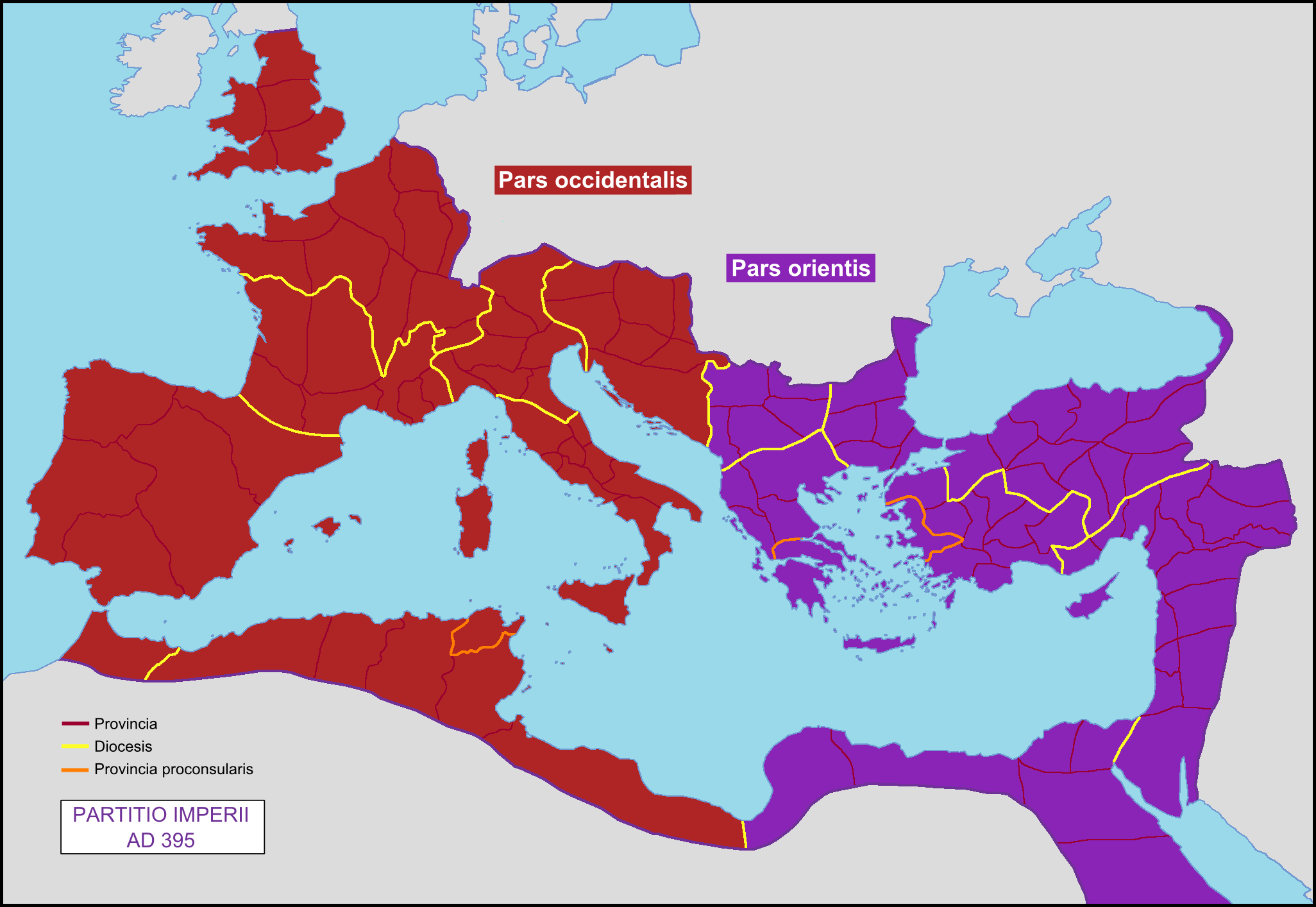
For some people, the Roman Empire ended in 476 AD when the last Western emperor was deposed. But in reality, Rome did not simply disappear. In the East, it survived, evolved, and eventually became what modern historians call the Byzantine Empire, which remained a powerful force that survived another thousand years.
The transformation from the ancient Eastern Roman world to Byzantium was not sudden or dramatic. It was a gradual process that changed the Eastern Roman Empire so much that many don’t even consider it Roman anymore. Political reforms, cultural change, religious transformation, and military crises were just the tip of the iceberg. By the seventh century, the Roman Empire had become something new: a medieval Christian empire centered on Constantinople, Greek in language and culture, yet still proudly Roman in identity.
A Gradual Transformation, Not a Sudden Fall
The shift from the Roman Empire to Byzantium was not marked by a single date or event. Instead, it evolved slowly over several centuries. Historians now view the transformation as a long process that reached a decisive turning point in the seventh century.
By that time, the Roman state had changed dramatically in territory, culture, language, religion, and political structure. It had lost many of its western lands, including Rome, adopted Christianity as its defining faith, and increasingly relied on Greek rather than Latin. Yet despite these changes, the empire continued to see itself as Roman, and its rulers still claimed the legacy of Augustus and Constantine.
This continuity is essential to understanding Byzantium. The people we call “Byzantines” never used that name themselves. They considered their state the Roman Empire and called themselves Romans. The term “Byzantine Empire” was introduced centuries later by historians trying to distinguish the medieval eastern state from ancient Rome.
The Rise of Constantinople – Byzantium
One of the most decisive moments in the transformation came in the early fourth century. Although Rome was still unified, Emperor Constantine the Great founded a new imperial capital on the site of the Greek city of Byzantium. Dedicated in 330 AD and renamed Constantinople, the city would become the political, cultural, and economic center of the Eastern Roman Empire.
Constantine’s decision reflected broader changes already underway. The eastern provinces were wealthier, more urbanized, and better positioned to defend against threats from Persia and other rivals. By shifting the center of power eastward, Constantine laid the foundation for the empire’s future. Also, Constantine had more support in the East in his quest to become the Emperor.
Constantinople was envisioned as a “New Rome,” built with grand forums, palaces, and churches. It combined Roman political traditions with Greek culture and Christian identity. Over time, it would eclipse Rome itself as the true heart of imperial power.
Reforms That Reshaped the Empire
The transformation of Rome into Byzantium was fueled by administrative and military reforms. Emperors such as Diocletian and Constantine reorganized the empire to make it more stable and governable after the crises of the third century. It wasn’t easy to control such a vast Empire.
Diocletian introduced a new system of rule known as the Tetrarchy, dividing authority among multiple emperors to improve defense and administration. He also expanded the bureaucracy, reorganized provinces, and strengthened taxation to support the army and state. That also brought some new civil wars to the Empire.
Constantine rose thanks to them and continued to build upon these reforms. He restructured the government, separated civil and military authority, and introduced a new gold currency, the solidus, that would remain a stable standard for centuries. These changes created a more centralized and resilient state. They also marked a shift away from the classical Roman model toward a more hierarchical and bureaucratic system that would characterize Byzantium.
Christianity and Cultural Change
Religion played a central role in the empire’s transformation. Constantine legalized Christianity in the early fourth century, and later emperors made it the state religion. Over time, Christianity became the ideological foundation of imperial authority.
This shift changed Roman identity. Temples gave way to churches, and emperors increasingly portrayed themselves as defenders of the Christian faith. The empire’s laws and institutions began to reflect Christian values, reinforcing a distinct cultural and religious character.
Language also evolved. While Latin remained the official administrative language for centuries, Greek gradually became dominant in the eastern provinces. By the seventh century, Greek had replaced Latin in most official contexts, further distinguishing the eastern empire from its ancient Roman past. Despite these changes, the empire preserved many classical traditions. Roman law, urban life, and imperial ceremonies continued, creating a unique blend of old and new.

The Fall of the West and Survival of the East
The collapse of the Western Roman Empire in the fifth century accelerated the transformation. In 476 AD, the last Western emperor was deposed, leaving the eastern empire as the sole heir of Roman authority. From Constantinople, emperors continued to rule a vast territory stretching across the eastern Mediterranean. They preserved Roman legal traditions, maintained complex administrative systems, and defended their borders against numerous enemies.
Under Emperor Justinian in the sixth century, the empire even attempted to reconquer lost western provinces. His generals briefly restored imperial control over parts of Italy, North Africa, and Spain. Justinian also oversaw the compilation of Roman law in the Corpus Juris Civilis, ensuring that Roman legal principles would influence European systems for centuries. These achievements demonstrated that the Roman state had not vanished. It had adapted and survived in a new form.
The Seventh-Century Turning Point
The most dramatic phase of transformation came in the seventh century. During this period, the empire faced devastating wars and rapid territorial losses.
New Arab armies inspired by Islam conquered Syria, Palestine, Egypt, and much of North Africa within a few decades. These regions had been among the empire’s richest and most populous provinces. Their loss fundamentally altered the empire’s economy and geography. As a result, the Eastern Roman Empire became smaller, more defensive, and more culturally unified. Greek replaced Latin entirely in administration, and the empire developed new military and administrative structures suited to its reduced territory.
Historians often view this period as the true birth of Byzantium. The ancient Roman world had ended, replaced by a distinctly medieval empire centered on Constantinople. Yet this new state still saw itself as Roman and preserved the legacy of its ancient predecessor.
Continuity and Identity
One of the most remarkable aspects of Byzantium is its continuity with Rome. The empire’s rulers maintained Roman titles, laws, and imperial ideology. They viewed themselves as direct successors of the Caesars and guardians of Roman civilization.
Even as Greek culture and Christianity shaped the empire’s character, its core institutions remained rooted in Roman traditions. Cities preserved elements of classical urban life, and imperial administration continued to follow Roman models. This continuity defined Byzantium. It was both Roman and something new, a medieval empire that preserved ancient traditions while adapting to a changing world.
The Legacy of Rome in Byzantium
The transformation of the Roman Empire into Byzantium ensured that Roman civilization did not vanish with the fall of the West. Instead, it survived for nearly a millennium, preserving classical knowledge, legal traditions, and imperial institutions. From Constantinople, Byzantine emperors defended Europe against invasions, fostered art and architecture, and transmitted ancient learning to later generations. Their empire served as a bridge between antiquity and the medieval world.
When Constantinople finally fell in 1453, the last remnant of the Roman Empire disappeared. Yet its influence lived on, in law, religion, culture, and the very idea of empire. It’s still alive.

Hello, my name is Vladimir, and I am a part of the Roman-empire writing team.
I am a historian, and history is an integral part of my life.
To be honest, while I was in school, I didn’t like history so how did I end up studying it? Well, for that, I have to thank history-based strategy PC games. Thank you so much, Europa Universalis IV, and thank you, Medieval Total War.
Since games made me fall in love with history, I completed bachelor studies at Filozofski Fakultet Niš, a part of the University of Niš. My bachelor’s thesis was about Julis Caesar. Soon, I completed my master’s studies at the same university.
For years now, I have been working as a teacher in a local elementary school, but my passion for writing isn’t fulfilled, so I decided to pursue that ambition online. There were a few gigs, but most of them were not history-related.
Then I stumbled upon roman-empire.com, and now I am a part of something bigger. No, I am not a part of the ancient Roman Empire but of a creative writing team where I have the freedom to write about whatever I want. Yes, even about Star Wars. Stay tuned for that.
Anyway, I am better at writing about Rome than writing about me. But if you would like to contact me for any reason, you can do it at contact@roman-empire.net. Except for negative reviews, of course. 😀
Kind regards,
Vladimir
Related Posts
- Uncovering the Causes and Legacy of the Fall of Rome
The Fall of Rome has been a subject of fascination for centuries, with many speculating on the factors that led to its decline. What can the fall of this once-great…
- Emperor Romulus Augustus
Life: c. 465 – after 511? Became emperor on 31 October AD 475. Abdicated 4 September AD 476. Date of death unknown. Romulus Augustus was the son of Orestes who…
- How Far Did the Romans Travel?
The Roman Empire is often imagined as a Mediterranean-centered civilization bounded by the Atlantic Ocean in the west, the Rhine and Danube in the north, the Sahara in the south,…