
Few Roman military institutions have left a legacy as controversial as the Praetorian Guard. Created as the emperor’s elite household force, the Guard eventually became a political institution capable of influencing succession, intimidating emperors, and, on several occasions, determining who occupied the imperial throne.
At the center of that story stood the Castra Praetoria, the Guard’s permanent headquarters in Rome. More than a barracks, it was a fortified military complex whose location, architecture, and political importance reflected the extraordinary position the Praetorians occupied within the Roman state.
Its history began under Emperor Tiberius.
The Creation of the Praetorian Camp
When Augustus established the Principate, the Praetorian cohorts served as the emperor’s personal security force, but they were initially dispersed among different locations in and around Rome. Their concentration into a single permanent base occurred during the reign of Tiberius, largely through the influence of his powerful praetorian prefect, Lucius Aelius Sejanus.
Tacitus records that Sejanus persuaded Tiberius that concentrating the Praetorian cohorts in one fortified installation would strengthen discipline and make the Guard more effective. Construction took place around 20–23 AD, with the complex traditionally dated to 23 AD.
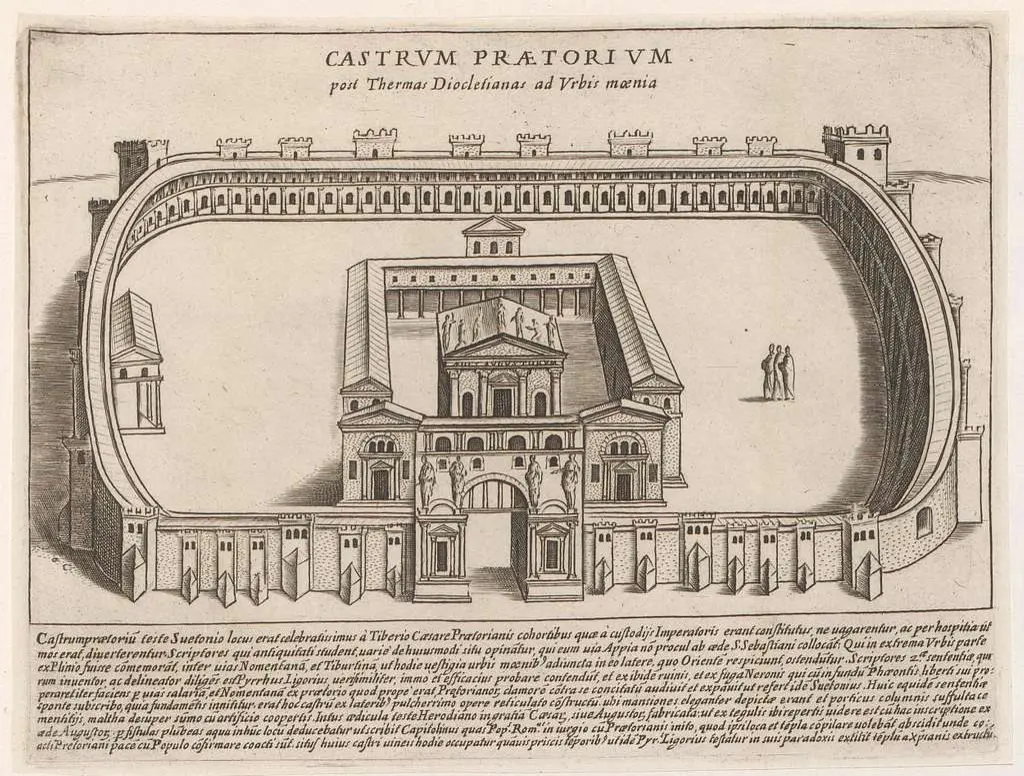
The location was strategically significant. The camp stood on the Viminal Hill, between the ancient roads leading toward Nomentum and Tibur, in an area that occupied the northeastern edge of Rome’s developed urban landscape.
The completed complex covered approximately 16–17 hectares, with dimensions of roughly 440 by 380 meters. Its walls enclosed barracks, administrative buildings, storage facilities, an armory, a hospital and open areas suitable for military exercises. Archaeological investigations have also identified long barrack blocks within the complex.
The camp was therefore not simply a collection of sleeping quarters. It was a self-contained military installation designed to house a substantial concentration of Rome’s most politically sensitive troops.
Architecture and Roman Military Engineering
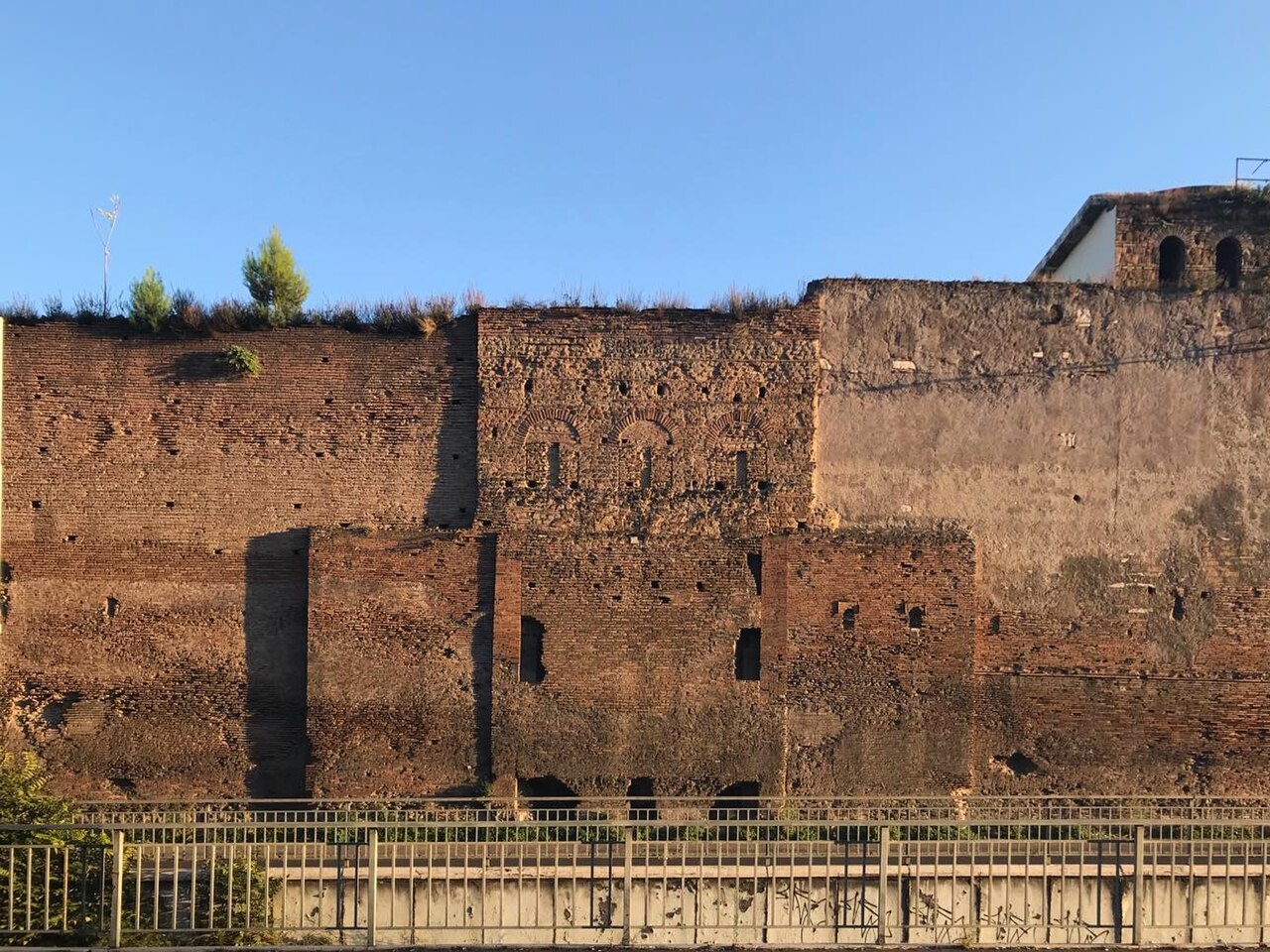
The Castra Praetoria was built with substantial masonry walls, making it an unusually permanent military installation for troops stationed inside the imperial capital.
The surviving remains demonstrate sophisticated Roman construction techniques. The original walls were later modified and heightened, while internal buildings included barracks arranged along organized streets and service structures necessary for a large military population.
The camp is sometimes associated with the principles described in De Munitionibus Castrorum, a treatise traditionally attributed to Hyginus Gromaticus. That attribution, however, should be treated cautiously. Modern scholarship generally refers to its author as Pseudo-Hyginus, because the identity of the writer is uncertain. The work itself is generally placed somewhere around the late first or early second century AD, meaning it cannot simply be treated as the construction manual used for the Castra Praetoria in the reign of Tiberius.
This distinction matters. Roman military camps followed recognizable principles of planning, but the archaeological evidence does not justify claiming that the Castra Praetoria was literally constructed according to a surviving manual written later.
Where Soldiers Became Kingmakers
The importance of the Castra Praetoria extended far beyond its walls.
One of its earliest major political episodes occurred in 41 AD, following the assassination of Emperor Caligula. Claudius, Caligula’s uncle, was brought to the Praetorian camp after the emperor’s murder. There, the Guard recognized him as emperor and provided the military backing necessary for his accession.
Claudius’s elevation established an important precedent: the Praetorian Guard could play a decisive role in the transfer of imperial power. The camp consequently became a physical symbol of the military influence that stood behind the throne. Ancient coinage even commemorated Claudius’ reception by the Praetorians.
Over subsequent decades, the relationship between emperor and Guard became increasingly complicated. The Praetorians were expected to protect the emperor, but their proximity to the center of government also gave them leverage that frontier armies generally lacked.
The Imperial Auction of 193 AD
The most notorious episode associated with the Castra Praetoria occurred during the political catastrophe of 193 AD.
Emperor Pertinax was murdered by members of the Praetorian Guard on March 28 after attempting to impose greater discipline on them. The resulting power vacuum transformed the camp into the setting for one of the strangest successions in Roman history.
Titus Flavius Claudius Sulpicianus, Pertinax’s father-in-law and the urban prefect, was inside the camp attempting to secure the soldiers’ support. Didius Julianus, meanwhile, arrived outside after learning that the Guard was negotiating over the succession.
According to Cassius Dio and Herodian, the competing offers escalated rapidly. Sulpicianus reportedly offered 20,000 sesterces per Praetorian, while Julianus raised the amount to 25,000. The Guard accepted Julianus’s offer and proclaimed him emperor.
The episode became famous as the “auction of the Empire.” The basic fact that Julianus secured Praetorian support through an enormous donative is well established, although the ancient accounts should not necessarily be interpreted as a literal formal auction conducted in a modern sense. Modern scholarship has also emphasized that the Guard had motives beyond simple financial gain, including concerns over retribution for Pertinax’s murder.
Julianus’s reign lasted only from March to June 193. His elevation triggered opposition from provincial armies, and Septimius Severus eventually marched on Rome. The Praetorian Guard’s privileged position was about to be transformed.
The Beginning of the End
The Castra Praetoria remained an important military and political installation during the third century. Its walls witnessed the continuing instability of imperial politics, including the violent death of Emperor Elagabalus in 222.
In 238 AD, the camp itself became a battlefield. During the revolt against Emperor Maximinus Thrax, Roman civilians attacked the Praetorian headquarters. The episode demonstrated the degree to which the Guard had become hated within sections of the urban population.
The camp’s strategic importance increased again under Emperor Aurelian.
Beginning around 271 AD, Aurelian constructed the great defensive circuit that would become the Aurelian Walls. Rather than demolishing the Castra Praetoria, engineers incorporated much of its existing perimeter into the new city fortifications. Three sides of the Praetorian complex effectively became part of Rome’s defensive system. The original walls were strengthened and raised, demonstrating how the old military installation could be repurposed for the defense of the entire capital.
This is an important correction to the common impression that the Castra Praetoria simply disappeared during the construction of the Aurelian Walls. Much of its fabric was actually preserved because it was useful.
Constantine and the Fall of the Praetorians
The decisive blow came under Constantine the Great.
In 312 AD, Constantine marched on Rome against his rival Maxentius. The Praetorian Guard remained associated with Maxentius and fought at the Battle of the Milvian Bridge.
Constantine’s victory brought the Guard’s political career to an end. He subsequently disbanded the Praetorians and dismantled their headquarters. Ancient sources and archaeological evidence indicate that the portions of the camp not incorporated into the Aurelian Walls were deliberately destroyed or dismantled.
The destruction was both practical and symbolic. Constantine was eliminating a military organization that had repeatedly interfered in imperial succession and replacing it with a new imperial military structure loyal to his regime.
The Castra Praetoria therefore ceased to function as the headquarters of the Praetorian Guard, but its walls did not vanish.
What Survives Today
The extraordinary survival of the site is one of the most remarkable aspects of its history.
Sections of the original complex remain integrated into the modern urban landscape of Rome. Archaeological excavations have uncovered portions of barracks and other structures, while sections of the ancient perimeter remain visible alongside the later Aurelian fortifications.
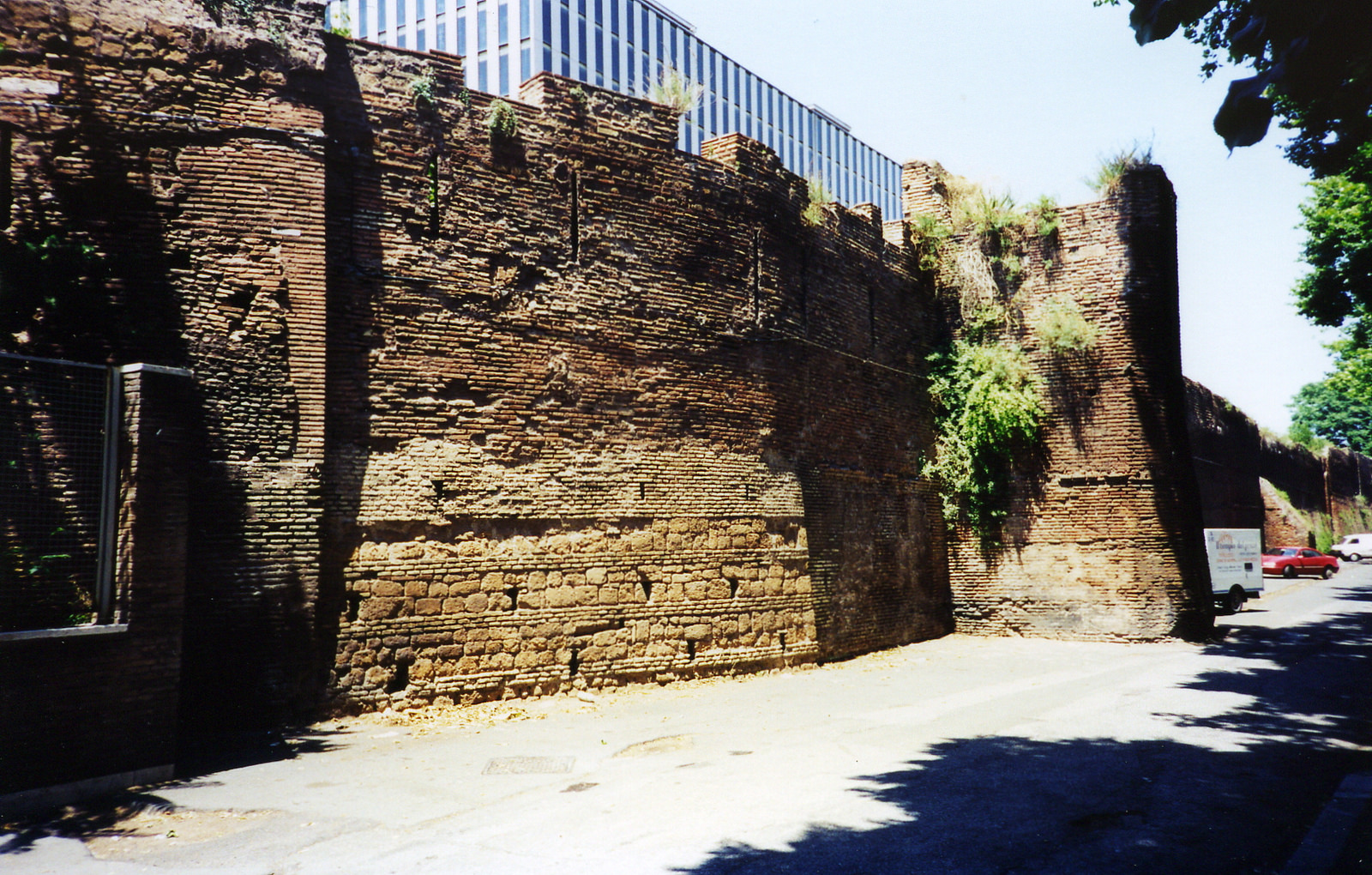
The area is now associated with Castro Pretorio, a modern district whose name preserves the memory of the ancient camp.
The modern National Central Library of Rome occupies part of the archaeological area. Its present building was inaugurated in 1975, following a major architectural project that deliberately incorporated the archaeological remains of the Praetorian camp and the Aurelian Walls into the development of the site.
The result is an unusual historical layering: a modern library stands above and beside the remains of a Roman military headquarters that once housed the soldiers who could make or break emperors.
A Fortress That Outlived Its Soldiers
The history of the Castra Praetoria mirrors the changing nature of Roman imperial power.
Built under Tiberius to consolidate the emperor’s elite guard, it became the setting for Claudius’s accession, witnessed the Praetorians’ intervention in imperial succession, survived their violent confrontation with Rome’s population, and was ultimately rendered obsolete when Constantine destroyed the institution it had been built to serve.
Yet the physical structure endured.
The Praetorian Guard disappeared in 312, but portions of its headquarters survived through incorporation into the Aurelian Walls, later archaeological preservation and modern development. Today, the remains at Castro Pretorio offer a rare physical connection to one of the most consequential military institutions of imperial Rome.
The Castra Praetoria was built to protect emperors. In time, it became a place where emperors were made, challenged and destroyed. Its surviving walls therefore represent more than Roman military architecture: they preserve the physical setting of a fundamental truth about the Principate—the soldiers stationed closest to the emperor could become a political force in their own right.
