
Hadrian ruled one of the most powerful empires the ancient world had ever known. He travelled farther than almost any Roman emperor, commanded armies, transformed the appearance of Rome, and left monuments that still define his legacy nearly two thousand years later, but this is a much different story.
Hadrian was married to Vibia Sabina, one of the most important empresses of Rome. But ancient writers described their marriage as deeply unhappy. At the same time, Hadrian’s relationship with the young Bithynian Antinous became one of the most famous and mysterious relationships in Roman history.
The problem is that the emperor’s private life is difficult to reconstruct. The literary sources are limited, often hostile and sometimes separated from Hadrian’s lifetime by generations. Meanwhile, inscriptions, coins and statues present a very different public image.
Hadrian and Sabina: A Marriage Made for Dynasty
Hadrian married Vibia Sabina around AD 100, long before he became emperor. The marriage was politically important. Sabina was the daughter of Salonina Matidia and the grandniece of the emperor Trajan. Hadrian himself had strong connections to Trajan’s circle, but his eventual succession was not without controversy. A marriage into Trajan’s family strengthened his position within the imperial dynasty.
Like many aristocratic marriages in Rome, this one created alliances and reinforced political legitimacy. That does not mean Hadrian and Sabina could not have cared for one another. It simply means that we have no reliable evidence telling us what their relationship was like in its early years.
What is clear is that Sabina became an important part of Hadrian’s public image after he became emperor in AD 117. She travelled widely, appeared on imperial coinage and eventually received the title Augusta in AD 128. Sabina accumulated more honours than any imperial woman since Livia and became the first woman whose image appeared continuously on regular Roman coinage. But the surviving literary tradition gives their marriage a terrible reputation.
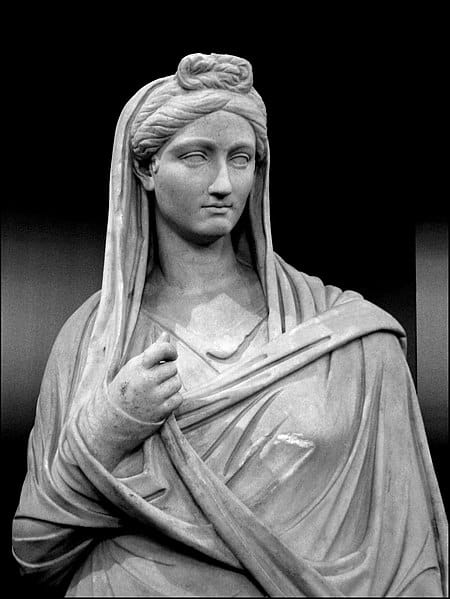
Source: Flickr: Vibia. Author: Iessi, 10 October 2006., CC BY 2.0 https://creativecommons.org/licenses/by/2.0, via Wikimedia Commons
A Loveless Marriage?
The most famous stories come from the Historia Augusta, but this source is full of exaggerations and sensational anecdotes. Modern scholars treat it with considerable caution, particularly when it claims to reveal the private thoughts and conversations of emperors. According to this tradition, Hadrian found Sabina so difficult that he supposedly remarked that, if he had been an ordinary private citizen, he would have divorced her. It is a memorable story. Whether Hadrian actually said it is another matter.
The same hostile tradition claimed that Sabina herself had such a low opinion of her husband that she deliberately avoided giving him a child, fearing that his heir would inherit his worst qualities. The couple remained childless throughout their marriage. Ancient accounts also paint a dark picture of Hadrian’s treatment of his wife. Later traditions went so far as to claim that he treated Sabina cruelly and ultimately drove her to suicide, perhaps even by providing poison himself.
These accusations cannot simply be accepted as established fact. The possible reality may have been unhappy, politically convenient, distant, or something more complicated. The sources do not allow us to watch the marriage from inside.
Hadrian’s Other Desires
Hadrian’s relationship with Sabina was not the only subject of ancient gossip because the Historia Augusta portrays him as a man with a sexual appetite and attributes relationships with both women and men to him. As with much of the emperor’s private life, individual stories are difficult to verify. One thing is clear, however: Hadrian’s reputation was not that of an emperor whose emotional and sexual life remained strictly within the boundaries of his marriage.
It is also important not to force modern categories too neatly onto the ancient world. Romans did not divide people into “heterosexual” and “homosexual” identities in the modern sense. Ideas about status, age, masculinity and sexual roles could matter as much as the sex of one’s partner. But there was one name above all others…

Antinous: The Emperor’s Beloved
Antinous came from Bithynia, in northwestern Asia Minor. Cassius Dio identifies him as a native of Bithynium, later known as Claudiopolis. Beyond that, we know nothing about him. What we do know is that Antinous eventually became part of the emperor’s entourage and travelled with Hadrian through the eastern provinces of the empire.
The contrast between Antinous’ life and his posthumous fame is striking. While he was alive, he was a young man from the provinces with no known political career and no place in the imperial succession. After his death, his image would become one of the most recognizable in Roman art. Cassius Dio’s account leaves little doubt about Hadrian’s extraordinary attachment to him. The historian directly connects the honours Antinous received after his death with the emperor’s love.
Modern readers often ask the obvious question: were Hadrian and Antinous lovers? The surviving evidence strongly suggests an intimate relationship, and ancient writers understood Hadrian’s feelings for Antinous as something far more profound than ordinary friendship. We cannot reconstruct the private details of that relationship, nor should we invent them. But the scale of Hadrian’s reaction to Antinous’ death makes one thing impossible to ignore. Antinous mattered to him enormously.
The Nile, AD 130
In AD 130, Hadrian was travelling through Egypt. The imperial journey had already taken him across much of the eastern Mediterranean. Then, during a journey along the Nile, Antinous died. The exact circumstances of his death remain unknown. According to the simplest account, Antinous drowned in the Nile. This was apparently the explanation associated with Hadrian himself. But another story circulated; we could call it gossip.
Cassius Dio records the claim that Antinous may have voluntarily sacrificed himself for Hadrian. The story was connected to prophecy and the belief that one person’s death might somehow prolong or protect another person’s life.
Was Antinous’ death an accident? Did he deliberately take his own life? Was he involved in some ritual sacrifice? Ancient writers offered competing explanations, and none can be established beyond doubt. Perhaps that uncertainty is one reason the story has remained so compelling. Hadrian’s response, however, is much easier to see.
Hadrian’s Grief and the Creation of Antinous
Antinous died, but Hadrian ensured that he would not disappear. Near the place where the young man died, the emperor founded a new city: Antinoöpolis. That alone would have been an extraordinary memorial, but the commemoration of Antinous went much further.
Images of the dead young man appeared across the Roman world. Antinous was represented in statues, busts, reliefs and religious imagery. His face was repeatedly transformed through different artistic traditions. In some works he appears with Greek divine attributes; in others, Egyptian religious symbolism shaped his image.

Antinous, who had been a relatively obscure young man during his lifetime, became one of the most recognizable faces of the Roman Empire. Cassius Dio records that Hadrian established sacred images of Antinous and associated him with a new star that the emperor claimed had appeared after his death.
A cult developed around Antinous in different parts of the empire. His status is sometimes simplified by saying that Hadrian “made his lover a god.” The honours surrounding Antinous combined imperial patronage, local religious traditions and the remarkable willingness of communities across the empire to embrace his cult. Nevertheless, there was nothing ordinary about the scale of Hadrian’s response. He was in grief. But he was still married to Sabina.
Sabina’s Death and Hadrian’s Final Years
Sabina died around AD 136 or 137, only a short time before the emperor himself. The hostile literary tradition surrounding their marriage continued to shape her reputation, but Hadrian publicly honoured his wife after her death and had her deified. Her public importance during his reign had already been considerable, and her death did not erase her place in the imperial dynasty. Hadrian died in AD 138. By then, both of the people most closely associated with his private life were gone.
Sabina remained part of Rome’s official memory as an Augusta and eventually a deified empress. Antinous left behind something stranger. A young man who had held no political office and belonged to no ruling dynasty had become immortalized in marble across the Roman world.
Literature and Further Reading
Ancient Sources
- Cassius Dio, Roman History, Book 69.
- Historia Augusta, Life of Hadrian.
- Pausanias, Description of Greece.
Modern Literature
- T. Corey Brennan, Sabina Augusta: An Imperial Journey. Oxford University Press, 2018.
- Royston Lambert, Beloved and God: The Story of Hadrian and Antinous. Viking, 1984.
- Thorsten Opper, Hadrian: Empire and Conflict. British Museum Press, 2008.
- Anthony R. Birley, Hadrian: The Restless Emperor. Routledge, revised edition.
- James Morwood, Hadrian. Yale University Press, 2013.
- Craig A. Williams, Roman Homosexuality. Oxford University Press.

Hello, my name is Vladimir, and I am a part of the Roman-empire writing team.
I am a historian, and history is an integral part of my life.
To be honest, while I was in school, I didn’t like history so how did I end up studying it? Well, for that, I have to thank history-based strategy PC games. Thank you so much, Europa Universalis IV, and thank you, Medieval Total War.
Since games made me fall in love with history, I completed bachelor studies at Filozofski Fakultet Niš, a part of the University of Niš. My bachelor’s thesis was about Julis Caesar. Soon, I completed my master’s studies at the same university.
For years now, I have been working as a teacher in a local elementary school, but my passion for writing isn’t fulfilled, so I decided to pursue that ambition online. There were a few gigs, but most of them were not history-related.
Then I stumbled upon roman-empire.com, and now I am a part of something bigger. No, I am not a part of the ancient Roman Empire but of a creative writing team where I have the freedom to write about whatever I want. Yes, even about Star Wars. Stay tuned for that.
Anyway, I am better at writing about Rome than writing about me. But if you would like to contact me for any reason, you can do it at contact@roman-empire.net. Except for negative reviews, of course. 😀
Kind regards,
Vladimir