
Beneath the magnificent dome of St. Peter’s Basilica lies a remarkable archaeological landscape that tells a story spanning nearly 2,000 years. Hidden beneath one of Christianity’s most recognizable landmarks are ancient Roman burial chambers, early Christian memorials, the remains of Constantine’s first basilica, and the tomb traditionally identified as the resting place of Saint Peter.
But the underground history of the Vatican extends beyond religion and archaeology. Fortified escape routes, centuries of papal political power, and an extraordinary collection of historical documents reveal how the papacy developed into one of the most influential institutions in European history.
The Vatican’s underground world is not a single network of secret tunnels. It is a collection of historically distinct spaces, each preserving a different chapter of Rome’s past. Understanding them requires looking beyond the Renaissance architecture above ground and returning to the ancient Roman city that once occupied the Vatican Hill.
The Vatican Grottoes: A Burial Place Beneath St. Peter’s Basilica
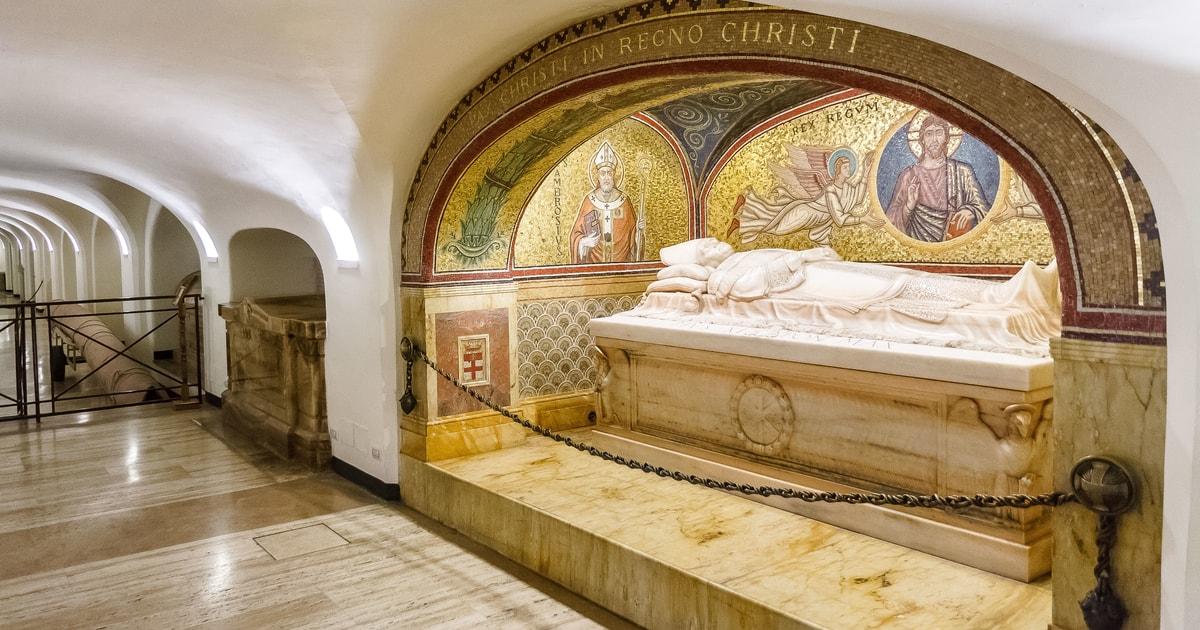
The Vatican Grottoes lie beneath the floor of St. Peter’s Basilica. They contain chapels, corridors, monuments, and numerous papal tombs, making them an important burial and devotional space within the Catholic Church.
More than 90 popes are traditionally reported to have been buried in the grottoes, although the burial arrangements and historical circumstances vary considerably. The tombs reflect different periods of papal history, from the early modern era to more recent centuries.
The grottoes are not simply an underground cemetery. Their architecture and monuments preserve the memory of successive generations of Church leadership. For Catholics, this continuity also carries religious significance: the papacy understands its authority through apostolic succession, the belief that the bishops of Rome inherit the spiritual office associated with Saint Peter.
The grottoes, however, are only one layer of the underground complex. Beneath them lies an even older archaeological site: a Roman necropolis that existed centuries before the construction of the first basilica.
The Roman Necropolis: A Cemetery Preserved Beneath the Basilica
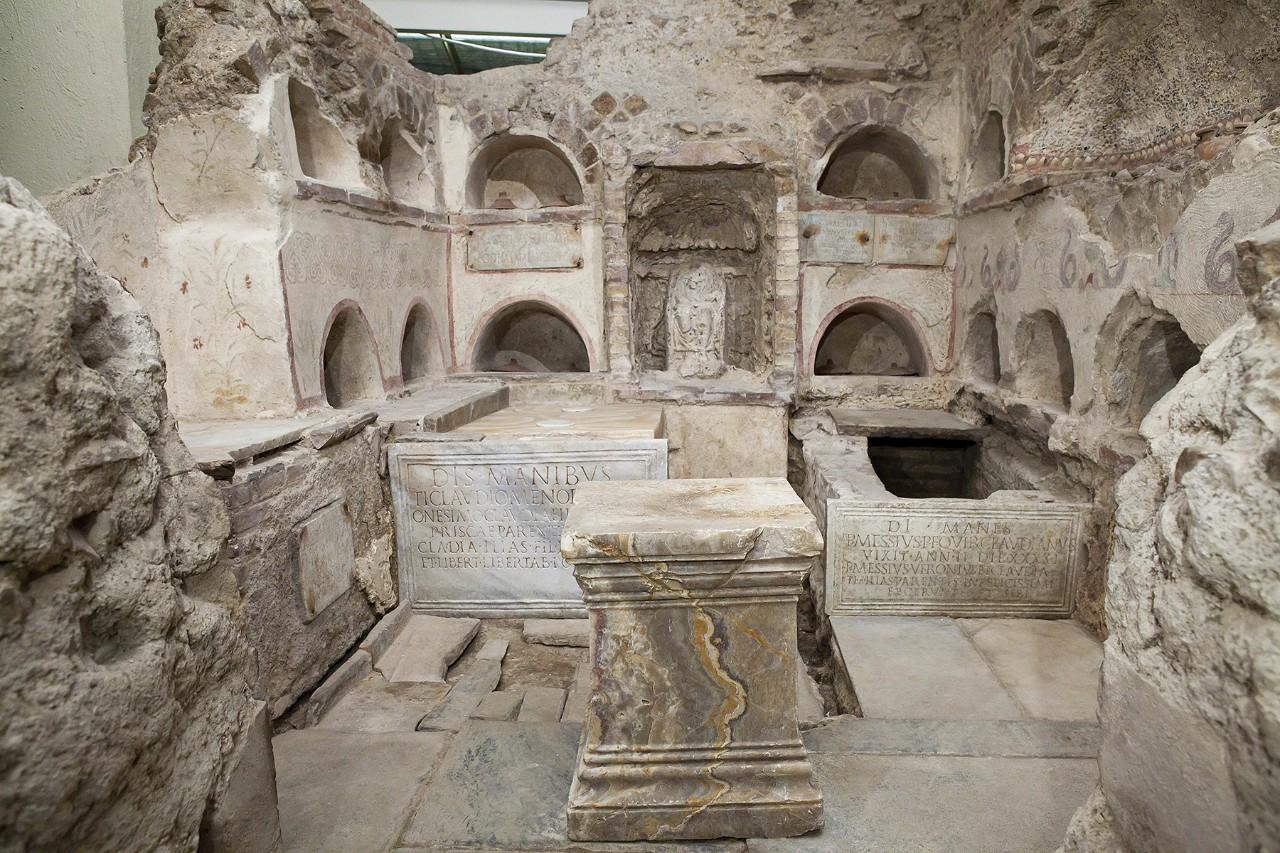
The Vatican Necropolis is considerably older than the basilica above it. Archaeological investigations revealed a Roman cemetery containing elaborate brick mausoleums, burial chambers, inscriptions, and an ancient funerary road.
The cemetery developed between the first and fourth centuries AD. Its location was significant because Roman law and custom generally prohibited burials within the city walls. Cemeteries therefore developed along roads outside the inhabited urban center.
The necropolis beneath St. Peter’s occupied the southern slopes of the Vatican Hill, near the ancient circus associated with Emperor Nero. Its burial buildings belonged to a community that included both pagans and Christians, offering an unusually valuable glimpse into Roman funerary practices.
Excavations eventually uncovered 22 principal mausoleum buildings, which archaeologists estimate could accommodate approximately 1,000 burials. Some contained elaborate decorations, inscriptions, and religious imagery reflecting the beliefs and social standing of their occupants.
The archaeological evidence also illustrates the religious diversity of imperial Rome. Pagan imagery, traditional Roman funerary symbolism, and Christian motifs appear within the same broader burial landscape.
This coexistence is particularly important for understanding Christianity’s gradual development within Roman society. Christianity did not replace traditional Roman religious practices overnight. Its expansion occurred over several centuries, during which different religious communities continued to live, worship, and bury their dead within the same urban environment.
How Constantine Built a Basilica Over the Cemetery
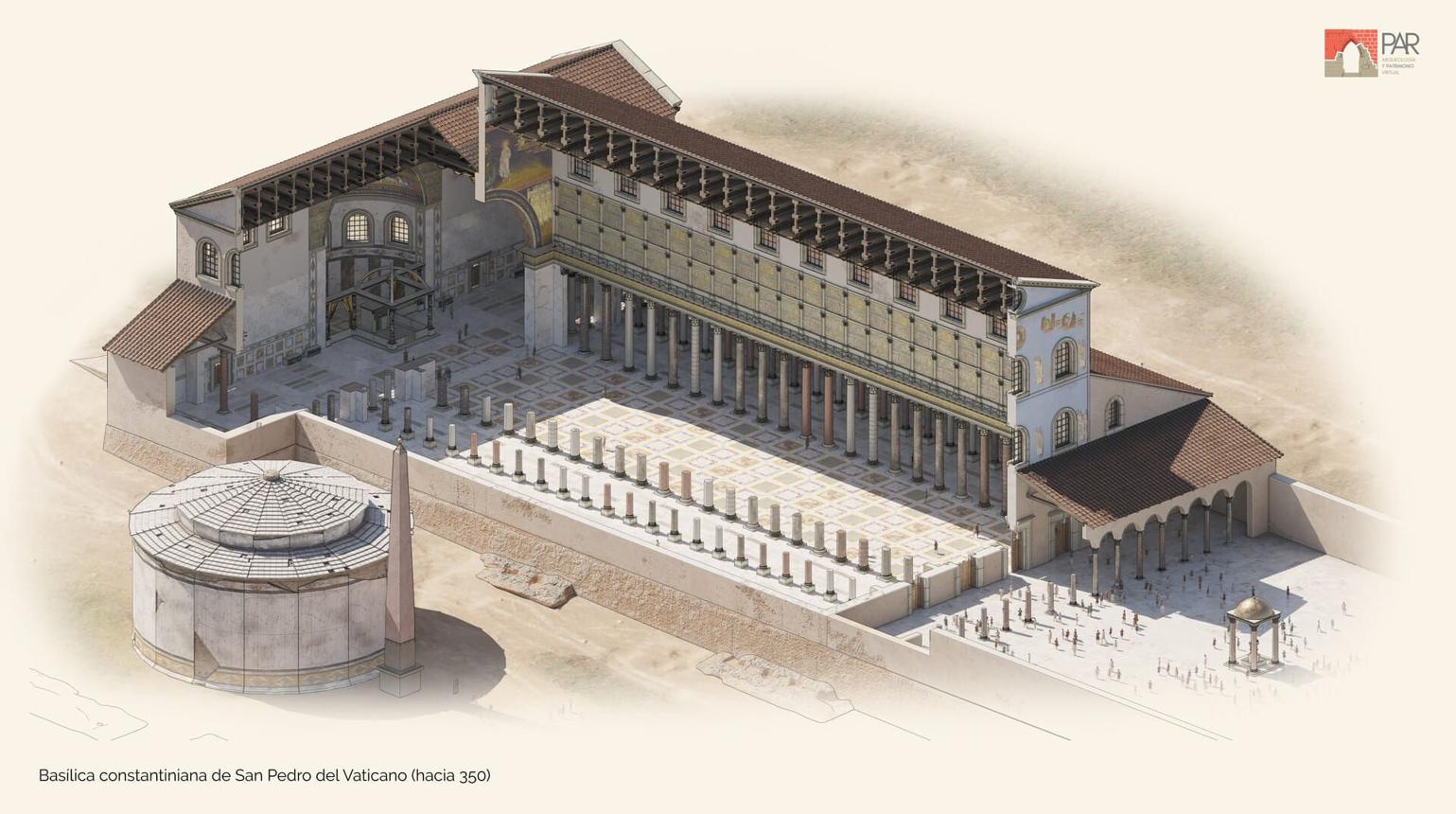
The transformation of the Vatican Hill began during the reign of Emperor Constantine I, who ruled from AD 306 to 337.
After Constantine’s victory over Maxentius at the Battle of the Milvian Bridge in AD 312, imperial support for Christianity increased. His subsequent policies helped transform Christianity from a periodically persecuted religion into an increasingly influential institution within the Roman Empire.
Constantine eventually commissioned a monumental basilica over the location traditionally identified as Saint Peter’s burial place. Construction took place during the fourth century under the emperor and Pope Sylvester I.
The project presented a considerable engineering challenge. The proposed building occupied a sloping hillside containing an established Roman cemetery. Rather than simply removing the entire burial complex, the builders modified the landscape, demolished portions of the upper structures, and moved enormous quantities of earth to establish a suitable platform.
According to the official archaeological account of St. Peter’s Basilica, the project required moving more than 40,000 cubic metres of earth to level the Vatican Hill. The existing tomb structures were partly incorporated into the foundations, helping preserve the lower portions of the necropolis.
The result was an extraordinary example of late Roman engineering. The original Constantinian basilica stood for more than a millennium before its gradual replacement by the present Renaissance structure, whose construction began in the early sixteenth century and continued into the seventeenth.
The Roman cemetery survived because of this transformation. What could have disappeared through demolition instead became an archaeological record preserved beneath successive generations of religious architecture.
The Tomb of Saint Peter: The Foundation of the Vatican’s Religious Importance
At the heart of the necropolis lies one of Christianity’s most important archaeological locations: the tomb traditionally identified as the burial place of Saint Peter.
According to Christian tradition, Peter was one of Jesus’s principal disciples and an important early leader of the Christian community in Rome. He is traditionally believed to have been martyred during the reign of Nero, although the precise circumstances and date of his death remain uncertain.
The location of his burial became an important destination for early Christian pilgrims.
One of the most significant pieces of evidence is a small funerary monument commonly known as the Trophy of Gaius. It is associated with a statement attributed to the Christian writer Gaius, preserved by Eusebius of Caesarea in his fourth-century Ecclesiastical History. Gaius referred to memorials associated with the apostles Peter and Paul in Rome.
Archaeologists discovered the monument during excavations conducted between 1939 and 1949. Nearby inscriptions and graffiti containing references to Peter and Christ provide evidence that Christians venerated the location before Constantine’s basilica was constructed.
The archaeological evidence establishes that the site was an important early Christian memorial. However, identifying the precise human remains as those of Peter is more difficult.
Fragments of bones discovered during the excavations were subsequently associated with the apostle. In 1968, Pope Paul VI announced that the remains were believed to belong to Saint Peter. Pope Francis later permitted several fragments to be publicly displayed in 2013.
These remains have not provided definitive scientific proof of Peter’s identity. Their association with the apostle rests on the archaeological context, historical tradition, and early Christian veneration of the location.
Nevertheless, the significance of the site extends beyond the question of identification. It demonstrates how an early Christian burial tradition became the foundation for one of the most important religious complexes in the world.
The Passetto di Borgo: The Pope’s Fortified Escape Route
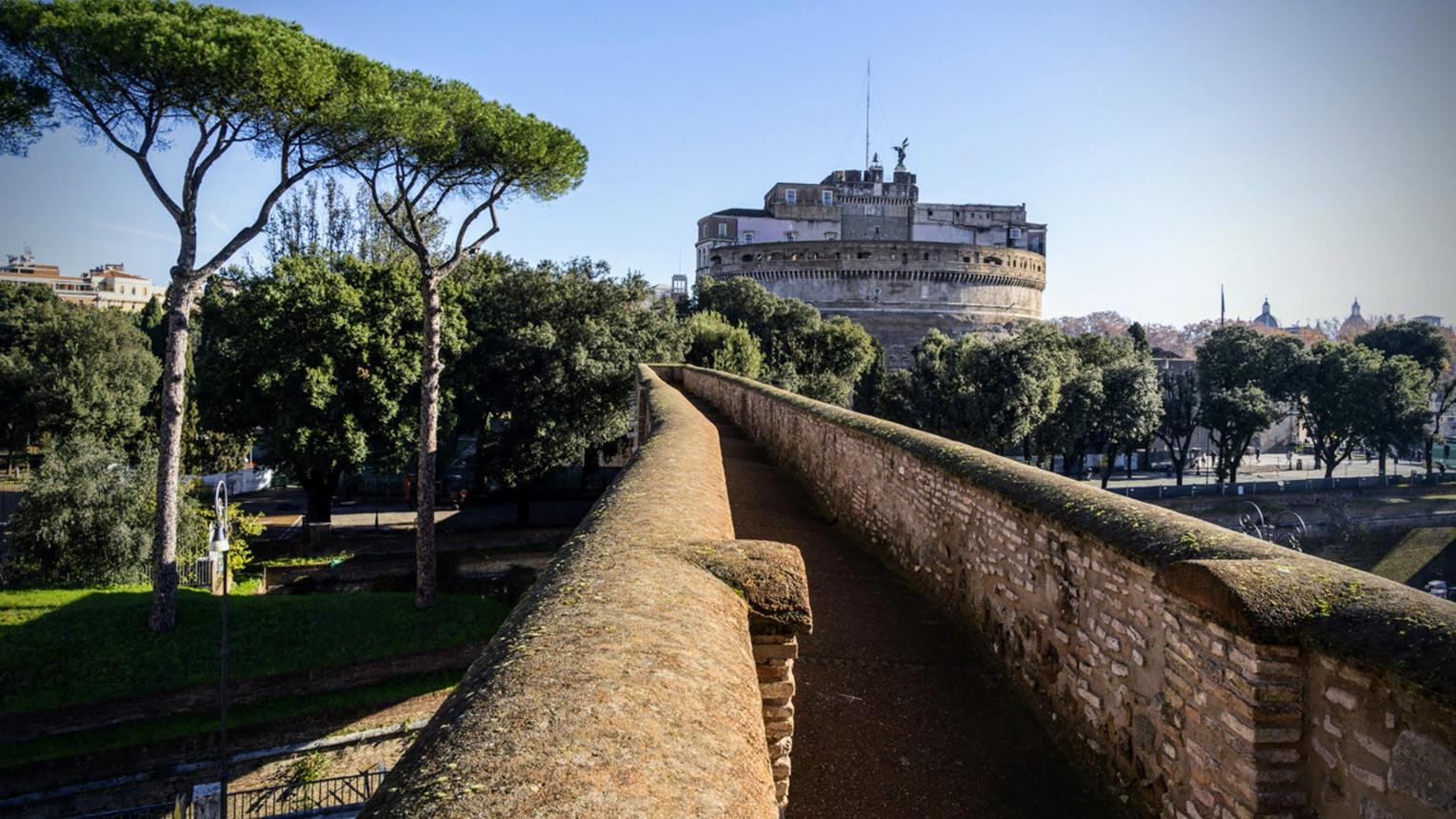
The underground history of the Vatican is closely connected to another remarkable structure above ground: the Passetto di Borgo, a fortified elevated passage connecting the Vatican with Castel Sant’Angelo.
The passage was designed to provide the pope with a protected route to the heavily fortified castle during periods of military danger.
Its origins are associated with the defensive works of the medieval papacy. Pope Nicholas III commissioned the connection in 1277, although subsequent popes expanded and modified the structure. Alexander VI, whose pontificate lasted from 1492 to 1503, contributed to the covered passage that survives today.
The Passetto became particularly important during two major crises.
Alexander VI and the French Invasion of 1494
In 1494, King Charles VIII of France invaded Italy, bringing his army toward Rome. Pope Alexander VI sought refuge in Castel Sant’Angelo, using the fortified passage to reach the castle.
The incident demonstrated the political and military vulnerability of the papacy during the Italian Wars, when rival Italian states and powerful European monarchies competed for influence over the peninsula.
The Sack of Rome in 1527
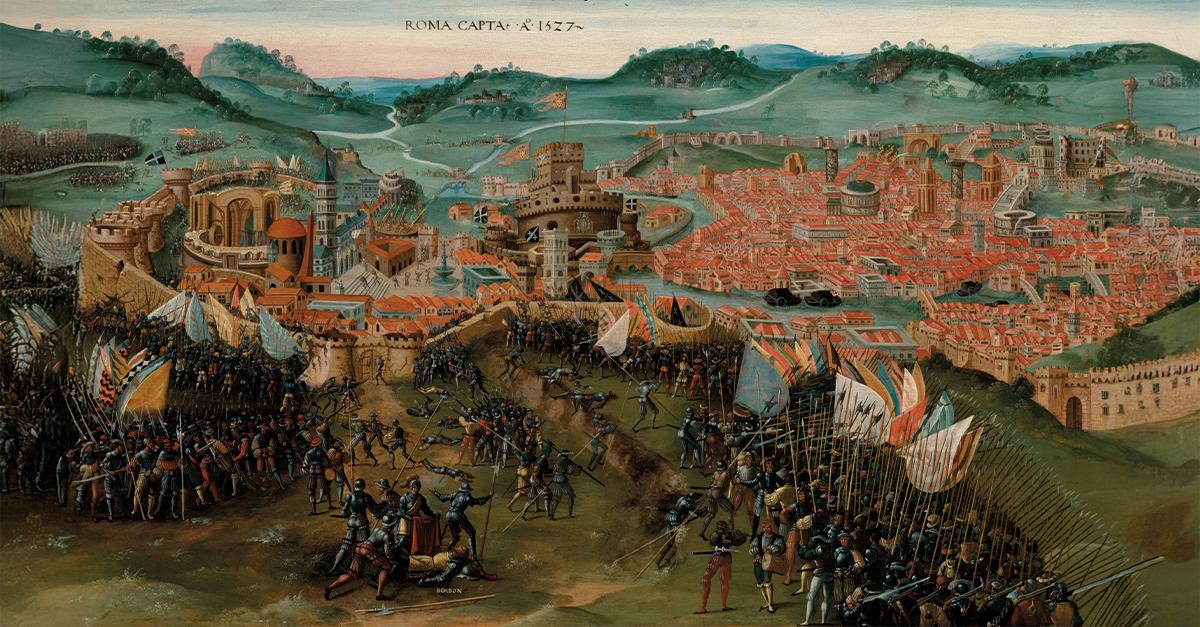
The Passetto’s most famous episode occurred during the Sack of Rome in May 1527.
Troops serving Emperor Charles V, Holy Roman Emperor, entered Rome and subjected the city to widespread violence and looting. The imperial army included German Landsknechts, Spanish soldiers, and Italian troops.
Pope Clement VII, whose pontificate lasted from 1523 to 1534, escaped through the Passetto and took refuge inside Castel Sant’Angelo.
Swiss Guards fought to protect his retreat, suffering devastating losses. The episode became one of the defining moments in the history of the Swiss Guard and the political humiliation of the papacy.
Importantly, the Passetto did not originate as a secret tunnel built specifically after the Sack of Rome. Its medieval defensive origins predated the event by centuries.
Today, the passage is preserved as a historical monument. Following restoration, it reopened to guided public visits in December 2024, allowing visitors to explore a structure once reserved for papal security.
The Papal States: When the Pope Was Also a Political Ruler
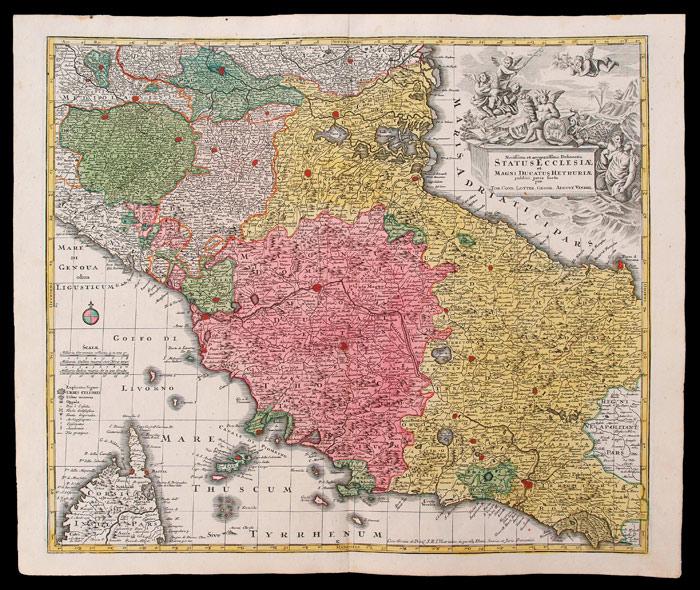
The Passetto also illustrates an important aspect of Vatican history that is sometimes overlooked: for centuries, the pope exercised both religious authority and territorial political power.
Beginning in the eighth century, the papacy gradually established control over territories in central Italy that became known as the Papal States.
Their origins are traditionally associated with the Donation of Pepin in 756, when the Frankish ruler Pepin the Short transferred territories to papal authority.
The Papal States survived in various forms until Italian unification in the nineteenth century. Their territory was lost during the process of unification, culminating in the capture of Rome by Italian troops on September 20, 1870.
During this long period, the pope was not merely the spiritual leader of Western Catholicism. He was also a territorial ruler who maintained diplomatic relationships, collected taxes, administered justice, and commanded military forces.
Consequently, the Papal States became involved in numerous European conflicts, including the War of the Eight Saints (1375–1378), the Italian Wars, and conflicts involving rival Italian powers.
These wars reflected the political realities of medieval and Renaissance Italy, where religious authority and territorial interests frequently overlapped.
The Sack of Rome in 1527 demonstrated the consequences of this political involvement. The papacy could become a target of powerful secular rulers, despite its enormous religious influence.
The Papal States eventually disappeared during Italian unification. The modern sovereign State of Vatican City was established much later, through the Lateran Treaty of 1929 between the Holy See and the Kingdom of Italy.
This distinction is important: the modern Vatican City is not simply the surviving territory of the medieval Papal States. It is a separate, much smaller sovereign state established through a twentieth-century agreement.
The Vatican Apostolic Archives: Centuries of Documentary History
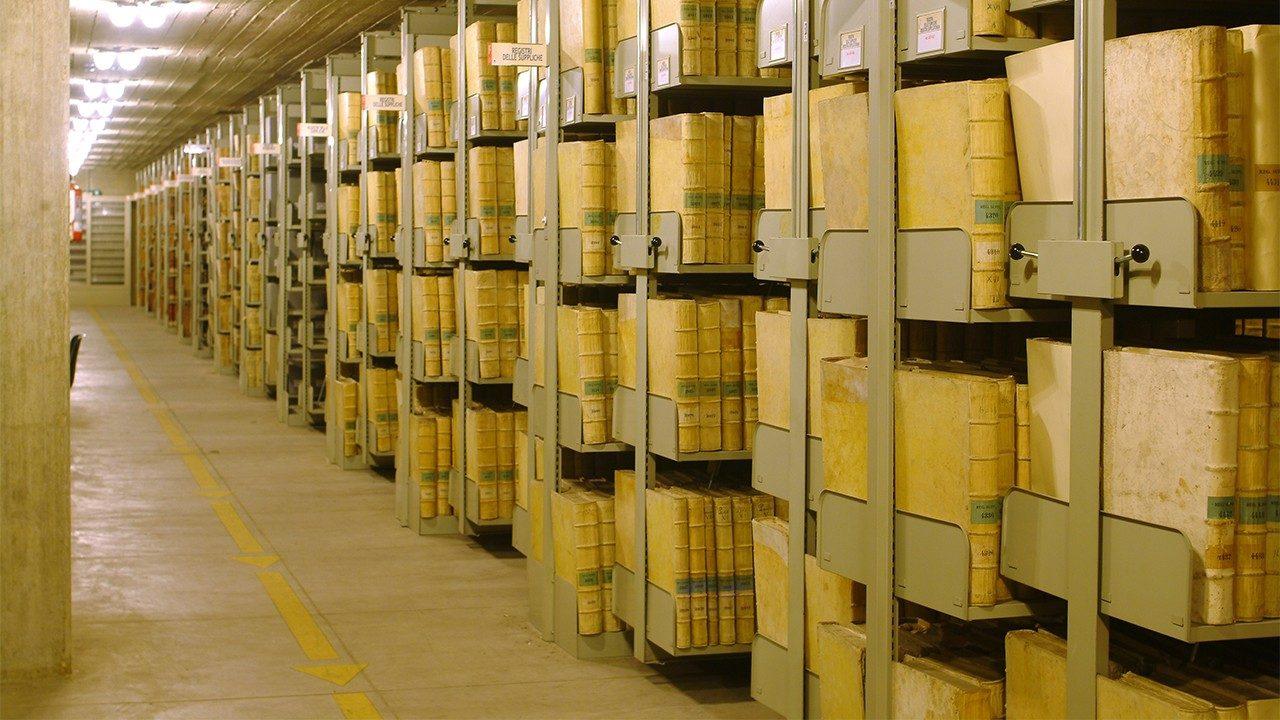
Another extraordinary part of Vatican history is preserved not beneath St. Peter’s Basilica but within the Vatican Apostolic Archives.
Formerly known as the Vatican Secret Archives, the institution received its present name in October 2019 under Pope Francis.
The word secret in its former title came from the Latin secretum, referring to something private or reserved for a particular authority. It did not necessarily mean that the institution contained forbidden or deliberately concealed information.
The archives preserve approximately 85 kilometres of shelving and documentary material spanning roughly twelve centuries, from the eighth to the twentieth centuries. Their collections include correspondence, diplomatic records, administrative documents, and materials relating to the history of the Catholic Church and European states.
Among the historically important documents are:
-
Correspondence between popes, monarchs, and political leaders.
-
Records relating to the trials of the Knights Templar.
-
Documents associated with Galileo Galilei’s proceedings before the Roman Inquisition.
-
Henry VIII’s request to Pope Clement VII concerning the annulment of his marriage to Catherine of Aragon.
-
Records connected with major diplomatic and religious disputes throughout European history.
These documents offer historians an extraordinary opportunity to investigate the relationship between religious institutions, political authority, and European society.
Who Can Access the Archives?
Contrary to popular descriptions of the archives as completely inaccessible, qualified researchers can consult their collections.
However, admission is restricted. Researchers generally need a university master’s degree or equivalent qualification, an appropriate research project, identification, and a letter of introduction from a recognized academic institution or qualified historian.
Access is also subject to chronological restrictions. The current general consultation limit extends through the pontificate of Pope Pius XII, which ended in October 1958.
These restrictions mean that not every document is available to researchers. However, restricted access alone does not establish that the Vatican is concealing evidence of wrongdoing.
The distinction matters because the archives have become the subject of numerous conspiracy theories, particularly concerning the Second World War, the Knights Templar, and alleged financial dealings.
The historical record should be examined through surviving documents and verifiable evidence rather than speculation about what unpublished material might contain.
The Vatican’s Most Important Archaeological Discovery
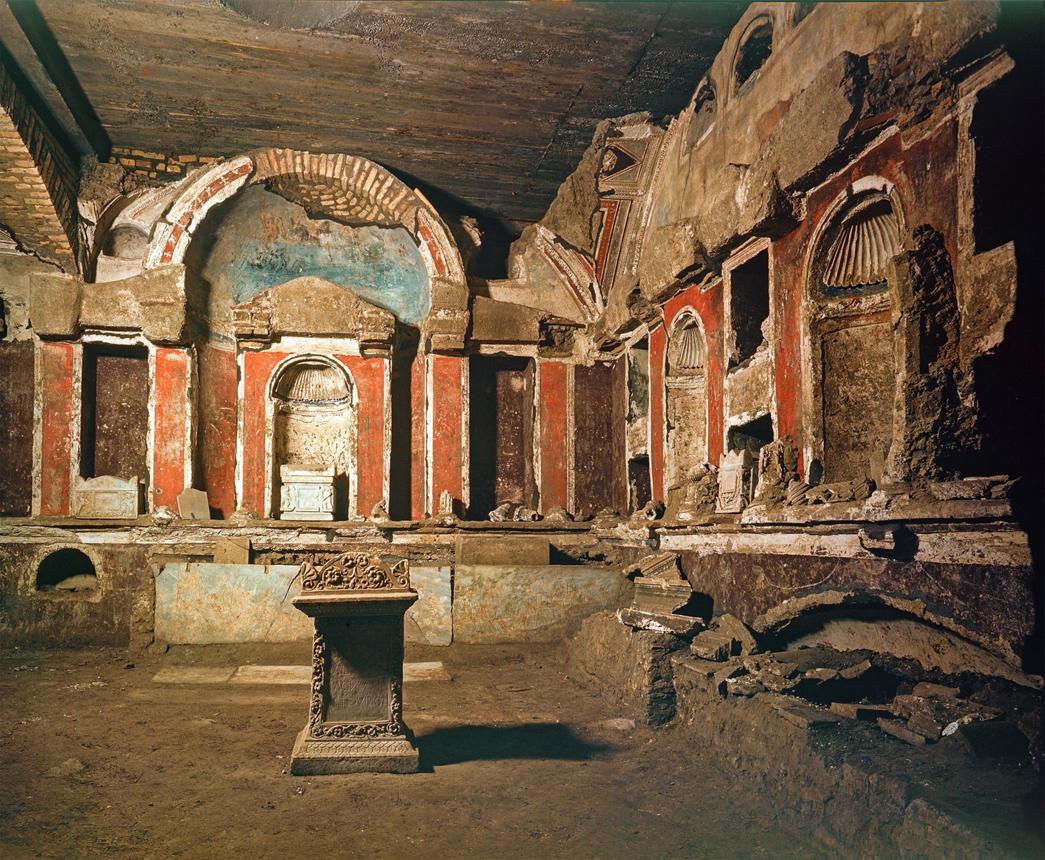
The rediscovery of the Roman necropolis beneath St. Peter’s Basilica is arguably the most remarkable archaeological achievement associated with the Vatican’s underground history.
The excavations began in 1939, during the pontificate of Pope Pius XII. They continued for approximately a decade, eventually revealing a substantial Roman burial complex that had remained inaccessible since the construction of Constantine’s basilica.
The discoveries provided archaeologists with an unusually complete picture of Roman funerary architecture and religious life.
The mausoleums contained painted decorations, inscriptions, sarcophagi, and other evidence of the beliefs and social identities of the people buried there.
Some tombs displayed traditional Roman religious imagery, while others contained symbols associated with Christianity.
Rather than revealing a sudden transformation from paganism to Christianity, the necropolis provides physical evidence of a gradual religious transition.
The archaeological record also demonstrates how Roman building practices could preserve earlier structures beneath later monumental architecture.
The ancient cemetery survived not because Constantine intended to create an archaeological museum, but because his builders incorporated the modified landscape and portions of the burial structures into the foundations of the basilica.
This unintended preservation eventually allowed modern archaeologists to investigate a section of Roman history that would otherwise have been lost.
Conclusion: The Vatican as a Living Record of Roman History
The history beneath the Vatican reveals considerably more than the foundations of a famous Christian monument.
The Roman necropolis preserves evidence of ancient burial customs and the religious diversity of imperial Rome. Constantine’s basilica demonstrates how Christianity became increasingly integrated into the Roman imperial world. The traditional tomb of Saint Peter explains the religious importance attached to the Vatican Hill, while the Passetto di Borgo illustrates the political and military dangers faced by medieval and Renaissance popes.
Meanwhile, the Vatican Apostolic Archives preserve documentary evidence of centuries of religious, diplomatic, and political history.
Together, these sites reveal how the Vatican developed through successive layers of Roman civilization, Christian devotion, medieval political authority, and Renaissance architectural ambition.
Perhaps the most remarkable aspect is that the modern basilica does not stand on an entirely new foundation. It occupies a landscape shaped by ancient Roman engineers, built over a cemetery whose origins predate Christianity’s rise to imperial prominence.
The Vatican is therefore not simply a monument to the history of the Catholic Church. It is also an extraordinary archaeological record of Rome itself.
