
The Romans Built It. Then Centuries of People Destroyed It Piece by Piece
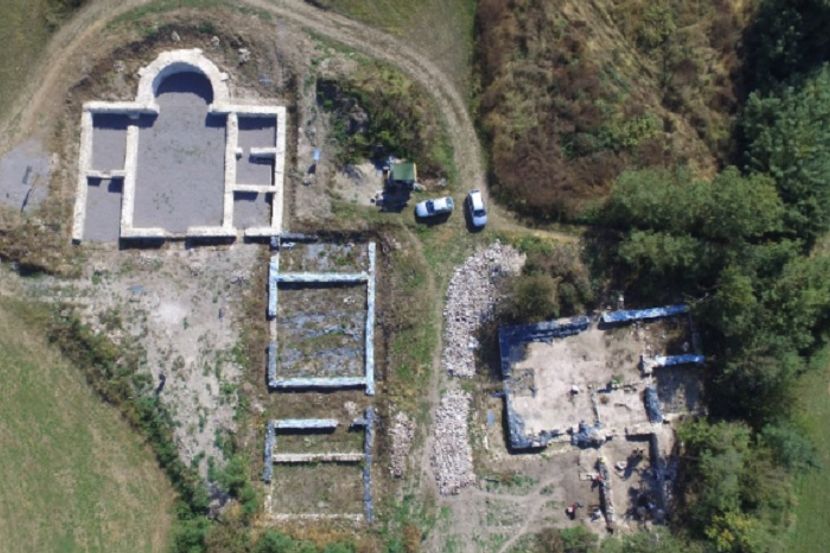
There are few things more frustrating for an archaeologist than finding a hole where something important used to be. One of those things is finding pieces of something that could have been important. At Anine, near Ćelije in central Serbia, archaeologists recently found destroyed Roman ruins. All they found were, basically, holes in the ground.
Some were between 30 centimeters and a meter wide. Others were around 40 centimeters deep. A paved path leading to the site had also been damaged. The pattern suggested that someone had been searching the ground with a metal detector. Perhaps they were looking for Roman coins, or they hoped to find something more valuable.
Whatever they were searching for, they left behind something much more damaging than an empty hole. They destroyed part of the story. And Anine is far from the only Roman site to suffer this fate. For almost 2,000 years, Roman ruins have been damaged by people looking for treasure, people needing building materials, armies fighting wars, farmers working their fields, and governments and developers simply needing the land.
The reasons for this destruction were different through the centuries, but the devastation remained constant.
Anine Was Once Part of Rome’s Military Machine
Today, as we watch these Roman ruins, it is difficult to imagine what stood at Anine around 1,700 years ago. The site covers roughly 40 hectares in Western Serbia. Archaeological research has revealed a large economic complex dating mainly to the 3rd and 4th centuries AD.
It was not simply a Roman villa. According to the lead archaeologist on the site, Anine functioned as a major collection and storage center for agricultural products from this region, which were then used to supply Roman troops along the Danube frontier. There were warehouses, representative buildings, and sophisticated infrastructure. There was even a hypocaust, the Roman system of heating rooms from underneath the floor. Roman coins and other objects have also been found, including a remarkable stone lion’s head. This was an important part of the Roman economic system.
Then Rome disappeared. The buildings remained. And the next generations had very different ideas about what those Roman ruins were worth.
When Roman Ruins Became Building Material
For someone living centuries after the Roman Empire, a fallen Roman wall did not necessarily look like an archaeological monument. It looked like free stone. This happened across the former Roman world.
At Anine itself, locals used stones from the ancient complex to build auxiliary structures. They were not necessarily trying to destroy history. They simply did not know what they were taking apart. The same basic process happened on a much larger scale in Rome.
The Colosseum survived the fall of the Western Roman Empire, but its enormous quantities of stone and marble made it extremely useful to later inhabitants. Parts of the structure were stripped, stone was reused, metal fittings were removed, and the marble disappeared into other buildings. The ancient monument effectively became a quarry.
This practice was so widespread that archaeologists have a name for the reuse of ancient architectural material: spolia. A Roman column could become part of a medieval church, a block from an imperial building could become part of a house, a decorative fragment could be placed into a completely different structure.
The Roman building was gone. But its pieces continued living in another world.
The Treasure Hunters
There is a major difference between taking a stone from an abandoned building and digging through an archaeological site with the hope of finding treasure. The first removes the object, and the other can destroy the entire context. Imagine finding a Roman coin beside a soldier’s belt buckle, inside a burned building, underneath a layer of roof tiles. This becomes part of a much bigger story.
Archaeologists care about where something was found, what surrounded it, and which layer of soil it came from. A metal detector does not record that story; it just produces a signal. And ruins Roman ruins. Yes, I did it on purpose.
As researchers have repeatedly pointed out, once archaeological layers are disturbed, the information contained in their original arrangement cannot simply be recovered. The object might eventually turn up in a collection, but the context is gone forever.
Dura-Europos: A City Survives a Siege, Then Gets Looted
One of the most dramatic examples comes from Dura-Europos in modern Syria. The city stood on the Euphrates and became an important Roman military base. Around AD 256, it was attacked by the Sasanian king Shapur I. And although the Romans desperately strengthened their defenses, the city fell.
Still, for the archaeologists, something remarkable happened: Dura-Europos was abandoned. Because later generations did not build another large city directly over it, enormous amounts of archaeological material survived underground. These were the Roman ruins of the highest value, with wall paintings, religious buildings, military remains, and ordinary objects from the lives of people who had lived there nearly two thousand years earlier. A real time capsule.
Then came the modern era, this century. During the Syrian Civil War, Dura-Europos was systematically looted. Oxford Academic’s archaeologist Simon James describes the looting as taking place on an industrial scale. Satellite images revealed enormous numbers of excavation pits across previously unexcavated areas. A city that had survived an ancient siege was being attacked again. This time, the enemy was not an army, but the antiquities market.

Palmyra: When Destruction Became the Point
Dura-Europos was damaged because people wanted to make money, but the destruction of Palmyra became something completely different. The ancient city in Syria was one of the great crossroads of the Roman Near East. Its monumental architecture reflected a mixture of local, Greek and Roman traditions. With that, it became one of the most recognizable ancient landscapes in the world.
Sadly, in 2015, Islamic State forces captured Palmyra and some of its monuments were deliberately destroyed. Parts of the Temple of Bel were blown up, the Temple of Baalshamin was also destroyed, and the famous Arch of Triumph suffered the same fate. UNESCO condemned the destruction, describing the attacks as a deliberate assault on cultural heritage.
This was not somebody taking stones home; it was a message. The Roman ruins represented a history that the attackers wanted to erase, but they could not erase everything. Photographs, excavation records, and archaeological documentation survived, and parts of Palmyra survived too.

Sometimes the Enemy Is the Plow
Not every Roman site is destroyed dramatically. Sometimes it happens one season at a time because all across Europe, Roman villas, roads, farms, and settlements lie beneath modern agricultural land. A farmer does not necessarily know what is underneath the field, and the plow simply does its job. Soon, archaeological layers become mixed together. The irony is that Roman agriculture itself created many of the landscapes that later helped hide these remains.
Roman villas were agricultural centers. Fields surrounded them, and farming was an essential part of the Roman economy. Centuries later, those same fields could become the reason the archaeological remains beneath them slowly deteriorated.
But agriculture can sometimes preserve sites too. A recently discovered Roman ruins turned out to be a Roman villa beneath farmland in Devon, England, was found remarkably well preserved, including a large mosaic and bathhouse. The difference is often what happened to the land afterward.
Sometimes the soil protects the Roman ruins, and sometimes it destroys them.
War Is the Great Destroyer of the Roman Ruins
Roman cities were attacked, burned, and abandoned during conflicts throughout the empire. Some sites were damaged during ancient wars, and others were damaged centuries later when modern armies fought over the same ground. Modern wars with shelling, military vehicles, and trenches had more devastating power than anything before. And once a site becomes a battlefield, preservation of Roman ruins is rarely the priority.
The Roman world has repeatedly suffered this fate because many ancient cities occupy strategically important locations. A Roman fort, Roman road, or a city was built somewhere for a reason, and those same strategic advantages could make the site important to armies centuries later.

The Most Dangerous Thing About Roman Ruins
Perhaps the strangest part of the story is that none of these people necessarily saw themselves as destroying history. The medieval builder saw stone, the farmer saw a field, the treasure hunter saw a potential coin, the soldier saw a strategic position, the developer saw a piece of land, but only the archaeologist sees the layers connecting all of them.
The Roman Empire fell more than 1,500 years ago, but Roman ruins have never really stopped being destroyed. Different centuries and different motives gave the same results. At Anine, the holes may look small, but remove enough of them, and eventually the story disappears.

Hello, my name is Vladimir, and I am a part of the Roman-empire writing team.
I am a historian, and history is an integral part of my life.
To be honest, while I was in school, I didn’t like history so how did I end up studying it? Well, for that, I have to thank history-based strategy PC games. Thank you so much, Europa Universalis IV, and thank you, Medieval Total War.
Since games made me fall in love with history, I completed bachelor studies at Filozofski Fakultet Niš, a part of the University of Niš. My bachelor’s thesis was about Julis Caesar. Soon, I completed my master’s studies at the same university.
For years now, I have been working as a teacher in a local elementary school, but my passion for writing isn’t fulfilled, so I decided to pursue that ambition online. There were a few gigs, but most of them were not history-related.
Then I stumbled upon roman-empire.com, and now I am a part of something bigger. No, I am not a part of the ancient Roman Empire but of a creative writing team where I have the freedom to write about whatever I want. Yes, even about Star Wars. Stay tuned for that.
Anyway, I am better at writing about Rome than writing about me. But if you would like to contact me for any reason, you can do it at contact@roman-empire.net. Except for negative reviews, of course. 😀
Kind regards,
Vladimir