
When History Rises from the Ground
Most archaeological discoveries begin with careful planning. Surveys, maps, excavation grids, everything measured and controlled. But not this time. No no. Like this wanted to happen. Sometimes, history simply appears, or reappears, like this Roman tomb.
After heavy rainfall in southern Italy, the ground shifted near the small town of Apollosa, near Benevento. A nearby stream overflowed, cutting into the soil and exposing something unexpected, large, and shaped stones that clearly did not belong to nature. Within days, it became clear what had been hiding there for nearly two thousand years.
A Roman tomb. Not fragments scattered across a field, but the remains of a monumental structure, one that had once stood proudly along one of the most important roads in the Roman world.

The Moment of Discovery
The discovery began almost by accident.
After the Serrentella stream flooded, blocks of limestone appeared along its banks. A local volunteer noticed the unusual shapes and reported them, triggering an archaeological investigation. What followed was a rapid and focused excavation. It was a Roman tomb.
Archaeologists recovered dozens of large stone blocks, each carefully carved and clearly part of a larger structure. As the pieces came together, a clearer picture emerged: this was a circular Roman mausoleum, dating to the early first century AD, during the age of Augustus.
For centuries, it had remained buried and forgotten. And then, in just a few days, it returned.
A Monument Built for Eternity
Even in its fragmented state, the tomb reveals its former grandeur. The structure was built from limestone and measured roughly twelve meters in diameter, making it a significant and highly visible monument.
This was not a modest burial. It was designed to be seen. Its location along the Via Appia, the famous Roman road often called the “Queen of Roads”, was no coincidence. This route connected Rome to southern Italy and carried soldiers, merchants, and officials across the peninsula.
Placing a tomb here meant something very specific. It meant that thousands of people would pass by it. And remember.
Gladiators in Stone
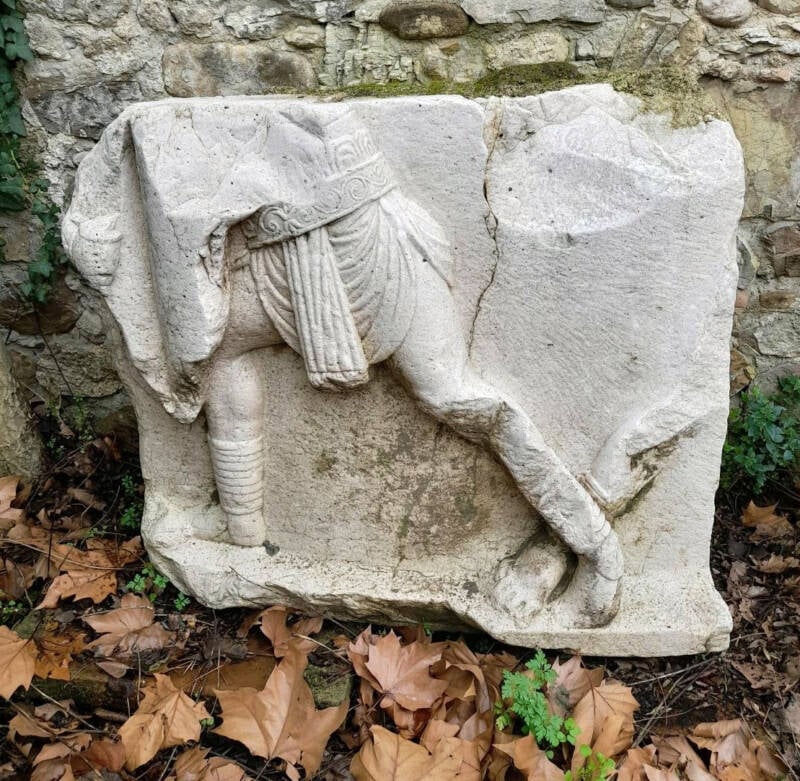
What truly sets this Roman tomb apart is its decoration. Carved into the stone blocks are scenes of gladiators in combat—figures locked in battle, captured in motion, frozen in time. This is highly unusual.
Roman tombs typically feature mythological imagery, religious symbols, or family representations. Gladiators, despite their importance in Roman culture, rarely appear in funerary art. And that raises an important question. Who was buried here?
Archaeologists believe the tomb likely belonged to a wealthy individual connected to gladiatorial games, perhaps a sponsor, or even a lanista, someone who trained and managed gladiators. In Roman society, sponsoring games was more than entertainment. It was power. It was an influence. And this tomb may have been designed to preserve that identity long after death.
Inside the Roman Tomb
The discoveries didn’t stop at the outer structure. Archaeologists also identified the entrance to an underground burial chamber, hidden beneath the monument itself. Inside, traces of painted decoration, including frescoes, were found on the walls. This detail adds another layer to the story. The tomb was not just impressive from the outside; it was carefully designed on the inside as well.
For the Romans, burial spaces were not empty chambers. They were places of memory, often decorated to reflect status, beliefs, and personal identity. Even in death, presentation mattered.
The Road of the Dead
To fully understand this tomb, you have to understand where it stood. Roman law forbade burials within city limits, which meant that the roads leading out of cities became lined with tombs and monuments. Over time, these roads turned into vast landscapes of memory. The Via Appia was the most famous of them all.
Along its edges, wealthy Romans built elaborate tombs, each competing for attention, each trying to leave a lasting impression. Travelers walking or riding along the road would pass by these monuments constantly, reading inscriptions and seeing names that refused to disappear.
The newly discovered tomb at Apollosa fits perfectly into this tradition. It was not hidden when it was built. It was meant to be seen.

Buried, Forgotten, and Found Again
At some point, the monument lost its original purpose. Over time, it was dismantled, its stones reused, and the site gradually disappeared beneath layers of soil. Later burials in the area suggest that it eventually became part of a simpler necropolis, used by people who likely had no idea what once stood there.
And then, centuries later, nature intervened. Eventually, the rain came. The ground shifted, and the tomb returned.
What Comes Next
Today, the recovered fragments are being studied and preserved, with plans to reconstruct the monument digitally and better understand its original form. But even now, many questions remain about this Roman tomb.
Who exactly was buried there?
What role did they play in Roman society?
And why choose such unusual imagery for their tomb?
These are the kinds of questions that make archaeology so compelling. Because every discovery answers something and raises a new question.
Conclusion: The Past Beneath Our Feet
The Roman tomb at Apollosa is more than just an archaeological find. It is a reminder.
A reminder that the past is still there, just beneath the surface. That entire story of people, power, and identity can lie hidden for centuries, waiting for the right moment to return. Sometimes, that moment comes through careful excavation. And sometimes, it comes with the rain, like this Roman tomb.

Hello, my name is Vladimir, and I am a part of the Roman-empire writing team.
I am a historian, and history is an integral part of my life.
To be honest, while I was in school, I didn’t like history so how did I end up studying it? Well, for that, I have to thank history-based strategy PC games. Thank you so much, Europa Universalis IV, and thank you, Medieval Total War.
Since games made me fall in love with history, I completed bachelor studies at Filozofski Fakultet Niš, a part of the University of Niš. My bachelor’s thesis was about Julis Caesar. Soon, I completed my master’s studies at the same university.
For years now, I have been working as a teacher in a local elementary school, but my passion for writing isn’t fulfilled, so I decided to pursue that ambition online. There were a few gigs, but most of them were not history-related.
Then I stumbled upon roman-empire.com, and now I am a part of something bigger. No, I am not a part of the ancient Roman Empire but of a creative writing team where I have the freedom to write about whatever I want. Yes, even about Star Wars. Stay tuned for that.
Anyway, I am better at writing about Rome than writing about me. But if you would like to contact me for any reason, you can do it at contact@roman-empire.net. Except for negative reviews, of course. 😀
Kind regards,
Vladimir