
You are about to see how I led Rome into Britannia and achieved what earlier rulers could not. I acted when a friendly British king lost his throne, and I used that moment to prove my strength and expand Roman power.
You will watch as I gathered tens of thousands of soldiers, crossed the sea, and faced fierce tribal warriors at the rivers of Medway and the Thames. You will see how victory, surrender, and firm control turned a bold invasion into lasting rule.
Key Takeaways
- You see how a political dispute gave Rome a reason to invade.
- You follow the key battles that broke organized British resistance.
- You learn how victory led to surrender, occupation, and long-term Roman control.
Claudius’s Motives and the Road to Invasion
Power Struggles in Britannia
You see a divided land before Rome ever lands on its shores. Tribal rivalries shape events, and the Catuvellauni push outward with force.
Two brothers, Caratacus and Togodumnus, lead this expansion. They challenge other tribes and shift the balance of power in the region.
Some tribes resist Rome. Others had ties that favored Roman interests. This tension creates an opening for outside action.
Rome watches these changes closely. A rising anti‑Roman power in the southeast does not go unnoticed.
Verica’s Fall and Rome’s Reaction
You can trace the spark of invasion to the removal of Verica, a ruler friendly to Rome. The Catuvellauni drive him from his kingdom and take control of his lands.
Claudius, newly on the throne, faces pressure to prove himself. A foreign campaign offers him a clear goal and a chance to gain military credit.
As the Catuvellauni continue their advance west, Rome moves quickly. Preparations begin under Aulus Plautius, who leads the full force.
You send a large army—about 40,000 soldiers, including infantry, cavalry, and auxiliaries—across the Channel. Several legions likely take part:
- Legio II Augusta under Vespasian
- IX Hispana
- XX
- XIV Gemina
The force sails in three divisions. Ancient writers disagree on the landing site, naming either Rutupiae or Noviomagus.
Once ashore, you rely on discipline, armor, and training. The Britons rely on numbers and resolve as they defend their homeland.
The clash begins at the River Medway. After two days of fighting, the Britons retreat to the Thames.
At the Thames, Roman forces break their resistance again. Togodumnus falls in battle.
With victory near, Plautius calls Claudius to witness the final stage. Claudius arrives with war elephants and Praetorian guards.
Tribes begin to submit. Eleven kings accept Roman authority. Caratacus escapes, but organized resistance collapses.
You complete the conquest and begin disarming the region. Claudius returns to Rome after a short stay, claiming success where earlier rulers failed.
Assembling the Invasion
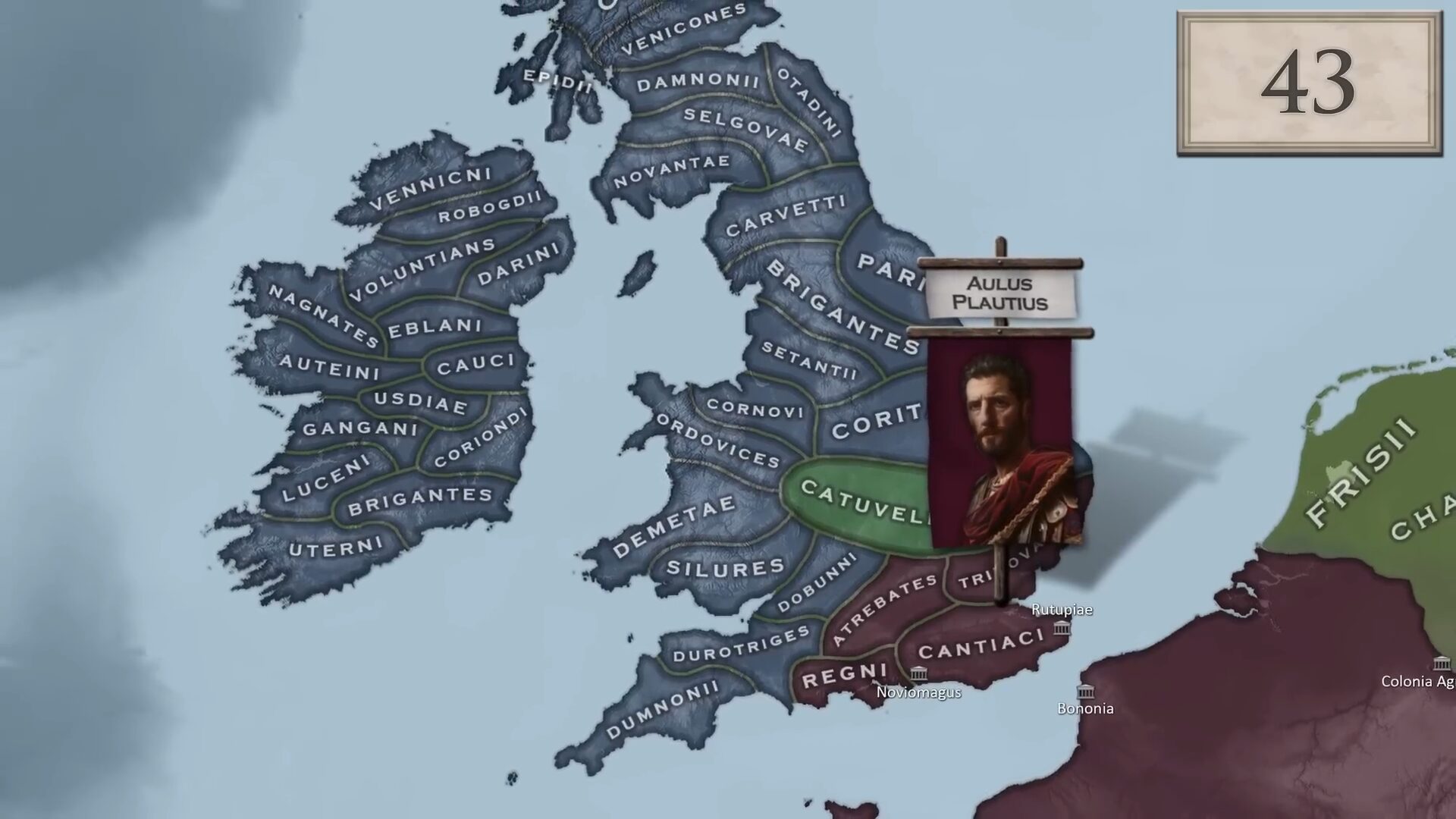
Claudius used the removal of the pro-Roman king Verica as his reason to act. The Catuvellauni had driven Verica out and expanded their power. You move quickly once that shift threatens Roman influence.
Leading Officers and Their Legions
You place Aulus Plautius in overall command of the invasion force. Under him, several senior officers take key roles:
- Vespasian, leading Legio II Augusta
- Gnaeus Hosidius Geta
- Titus Flavius Sabinus the Younger
Sources suggest that the IX Hispana, XX, and XIV Gemina legions may have joined the campaign. You cannot confirm each unit with full certainty, but multiple legions likely sailed.
You organize a force of about 40,000 troops, including:
- Heavy infantry
- Cavalry units
- Auxiliary forces
These soldiers prepare for a large overseas assault under firm command.
Supplying the Army and Preparing the Fleet
You gather hundreds of ships to move men and equipment across the Channel. Cassius Dio reports that the army arrives in three separate waves. Suetonius states the fleet departs from Bononia.
Cassius Dio claims the fleet sails east to west. Where you land remains uncertain.
Two main landing sites stand out:
| Proposed Landing Site | Key Detail |
|---|---|
| Rutupiae | Archaeology shows Roman presence from this period |
| Noviomagus | Lies in territory once ruled by Verica |
If you land at Noviomagus, you step directly into lands tied to the exiled king. If you land at Rutupiae, physical evidence supports your arrival there.
In either case, thousands of Roman soldiers disembark, fully armed and trained, ready to begin the campaign.
Crossing to Britannia
You watch Rome move after Verica loses his throne. The Catuvellauni push him out, and that shift gives Claudius his reason to act. He wants a military success, and Britannia offers it.
Aulus Plautius leads the force. You see a large army form, likely around 40,000 soldiers, with infantry, cavalry, and support troops.
Several legions may have joined:
- Legio II Augusta under Vespasian
- IX Hispana
- XX
- XIV Gemina
Some names appear in the record, like Gnaeus Hosidius Geta and Titus Flavius Sabinus the Younger. The sources do not clearly state which units each man commanded.
Cassius Dio writes that the army crossed in three separate groups. Suetonius says they left from Bononia. Dio claims they sailed from east to west.
Hundreds of ships likely carried them across the Channel.
Uncertain Points of Arrival
You face two main landing theories:
| Proposed Site | Key Detail |
|---|---|
| Rutupiae | Archaeology shows Roman presence around the time of invasion |
| Noviomagus | Location ties to lands once ruled by Verica |
If the fleet truly sailed from Bononia and moved east to west, Rutupiae raises questions. That route does not fully match Dio’s claim.
Yet material evidence places Romans near Rutupiae at the right time. That forces you to question Dio’s accuracy.
Noviomagus also makes sense. It sits in territory linked to Verica, whose removal may have sparked the campaign.
Reviewing the Written Record
You rely on two main ancient writers:
- Cassius Dio
- Suetonius
Dio describes three landing waves and an east‑to‑west sail. Suetonius points to Bononia as the departure point.
Their accounts do not fully align. Archaeology adds more tension by supporting a Roman presence at Rutupiae.
You weigh written testimony against physical evidence. Neither gives a complete answer.
What remains clear is this: Roman troops reached Britannia in force, organized and prepared for battle.
First Meetings With the Celtic Britons
Claudius moved into Britannia after the Catuvellauni removed King Verica, a ruler who supported Rome. You see how this gave Rome a reason to act. Claudius had just taken power, and he wanted a clear military success.
Aulus Plautius led the invasion. About 40,000 Roman troops—infantry, cavalry, and support units—sailed in what sources describe as three waves, likely from Bononia.
Historians debate the landing site. The main choices are:
- Rutupiae
- Noviomagus
Both locations show signs that fit the campaign. Once the Romans landed, thousands of soldiers stepped onto British soil and prepared to advance.
Tribal Unity and Armed Defiance
You face a coalition of Celtic tribes ready to defend their land. The Catuvellauni brothers, Caratacus and Togodumnus, led the resistance.
The first major clash came at the River Medway. Roman forces, including commanders such as Vespasian and Titus Flavius Sabinus, pushed across the river and engaged the Britons in close combat.
The battle lasted two days:
| Day | Result |
|---|---|
| Day One | No clear winner |
| Day Two | Britons retreat toward the Thames |
The Britons regrouped along the Thames but lost again. During this fight, Togodumnus suffered fatal wounds. His death weakened their position.
As Roman pressure increased, some tribes began to submit. Sources state that the Dobunni surrendered first, followed by others.
Differences in Arms, Training, and Battlefield Methods
You command an army that is well equipped and disciplined. Roman troops carry strong armor, organized formations, and clear chains of command.
The Britons fight with courage and strong motivation. They defend their homes and way of life. However, they lack the same level of coordination and military structure.
The contrast shows in battle:
- Romans: trained formations, combined infantry and cavalry, steady command.
- Britons: tribal warriors, brave but less unified, limited heavy equipment.
After victories at the Medway and Thames, Aulus Plautius calls Claudius to witness the final stage. The emperor arrives with Praetorian guards and even war elephants.
The display shocks many Britons. Eleven kings surrender. Caratacus escapes west to continue resistance later.
Claudius returns to Rome after about two weeks, claiming the conquest as his achievement. Roman control then spreads across southern Britannia, and Londinium rises within a few years.
The Clash at the River Medway
When you reach the River Medway, the first major fight begins. This is where Roman force meets British resistance in open battle.
Leaders of the British Resistance
You see Caratacus and Togodumnus, two brothers of the Catuvellauni tribe, leading the Celtic warriors. They stand at the front as Rome advances.
On the Roman side, commanders such as Vespasian and Titus Flavius Sabinus drive the attack forward. They push their troops toward the river crossing, ready to force a decisive fight.
Two Days of Intense Fighting
You watch the Romans charge through the river itself. Some accounts describe them pushing across the water with horses, striking at the waiting Britons near the banks.
The battle rages for an entire day. When night falls, neither side claims victory.
At dawn, the fighting resumes. The second day proves decisive.
Early signs suggest the Britons might gain ground, but they fail to hold it. By the end of the day, Roman pressure forces them into retreat.
Chase Toward the Thames
You follow the fleeing Britons as they pull back toward the River Thames. Roman troops pursue them without pause.
Another clash erupts along the wet banks of the Thames as the Britons try to regroup. The defense breaks under Roman assault.
During this desperate stand, Togodumnus suffers mortal wounds. He survives long enough to see the defeat before he dies.
The Romans now see victory within reach. They press forward as British resistance weakens and begins to collapse.
Decisive Moment at the River Thames
Roman Push and the Fall of Togodumnus
You watch the Britons fall back from the Medway and rush toward the Thames. The Romans chase them without pause.
Along the riverbank, the Britons try to regroup. They look shaken but still willing to fight. You see that they know the risk they took in facing Rome head-on.
The Romans strike again with force and order. Their infantry and cavalry press hard against a scattered defense.
In the chaos, Togodumnus suffers a fatal wound. He survives long enough to see his men break once more. Then he dies as the fighting ends.
Plautius sends word to Claudius after this clash. He wants the emperor present for the final stage of victory.
By this time, the Dobunni have already submitted. More tribes seem ready to follow.
What This Meant for the Catuvellauni
You now see the balance shift. With Togodumnus gone, Caratacus stands alone as leader.
Claudius arrives in Britain with war elephants and his guard. The sight stuns the Britons. They choose surrender over another fight.
Caratacus abandons the field and escapes, likely toward Wales. Other rulers submit.
- Eleven kings give in to Rome.
- The Catuvellauni lose control of their power base.
- Roman authority spreads across southern Britain.
You witness the start of direct Roman rule. Disarmament begins, and control tightens.
Claudius returns to Rome after about two weeks. He leaves with public praise and a completed conquest in hand.
Claudius’s Landing and Rome’s Public Victory
After the fighting near the Thames, I sent word to Emperor Claudius. I urged him to come and witness the final stage of the campaign. Several tribes had already yielded, including the Dobunni, and more seemed ready to follow.
Claudius accepted.
He arrived in Britain determined to claim the success that had eluded earlier rulers.
War Elephants and a Show of Imperial Power
When Claudius stepped onto British soil, you would have seen something rare in this land: war elephants.
- Massive animals moving across the shore
- Praetorian Guards surrounding the emperor
- Roman troops standing in tight formation
The sight carried a clear message. Rome stood in full strength.
The British forces, already shaken by defeat, now faced an emperor backed by trained soldiers and towering beasts. The display of force helped end open resistance without another major battle.
Tribal Surrenders and the Fate of Caratacus
With Claudius present, more leaders submitted.
According to reports, eleven kings handed over their authority and accepted Roman rule. Roman officers then began to disarm the remaining fighters and secure the region.
Caratacus, the surviving Catuvellauni leader, did not fall in this moment. He escaped Roman capture and likely fled west, possibly toward Wales, to continue resistance later.
Claudius stayed in Britain for only about two weeks. After securing submission, he returned to Rome.
You can see how this brief visit shaped his image. Rome celebrated him for achieving what others had failed to do—bringing Britain under imperial control, at least for the time being.
Securing the Conquest and Strengthening Power
Bringing Southern Britain Under Roman Rule
After the Britons gave in, you move fast to lock in control. You disarm local fighters and accept the surrender of multiple tribal rulers.
I tell you that eleven kings submit to Roman authority. Their lands now answer to Rome.
Caratacus escapes and looks for safety beyond our reach. Even so, you press forward and spread Roman influence across southern Britain, tightening your hold as more tribes fall in line.
Creating the City of Londinium
Within a few years of the invasion, you establish a new settlement that will become Londinium.
You found it about four years after the first landings. This city stands as a clear sign that Rome does not plan to leave. It marks a shift from invasion to long-term control.
Claudius Returns in Triumph
Once victory is clear, you send Claudius back to Rome. He spends little more than two weeks in Britain before departing.
He returns to loud praise and public honor. You watch him celebrate a success that earlier rulers failed to achieve.
Even though unrest will continue in the years ahead, you treat the conquest as complete and claim it as a Roman triumph.
Enduring Impact and Ongoing Defiance
You watch Rome tighten its grip after the first victories. Southern Britain falls under steady Roman control as more tribes submit.
You see eleven rulers yield their lands to imperial rule. Disarmament begins, and Roman authority spreads across the region.
Caratacus escapes capture. He withdraws, likely toward Wales, and waits for another chance to reclaim what he lost.
Within four years, you witness the rise of Londinium, a new Roman city that marks long-term occupation. Roman systems take root as influence expands.
Claudius returns to Rome after little more than two weeks in Britain. He receives public praise for achieving what earlier emperors could not.
Yet resistance does not end. You continue to face uprisings and unrest for decades after the initial surrender.
- Tribes rebel despite earlier submissions
- Roman forces respond to repeated revolts
- Control strengthens, but peace remains fragile
