
Introduction: Unearthing an Aristocratic Roman Home
New livestream tour brings a new light to the Palatine Hill. For centuries, Rome’s Palatine Hill has been a place of myth and power, where emperors once walked, and early republic aristocrats built elegant homes. Yet even among its many treasures, the recent opening of the House of the Griffins as one of the best-preserved Republican-era residences marks a rare chance to step inside a world that has been hidden underground for nearly two millennia. This remarkable site, with its frescoes and mosaics, is now accessible to the public in an innovative way: through livestreamed guided tours that reveal spaces too fragile and narrow for conventional visits.
Palatine Hill — Rome’s Cradle of Power
Perched above the Roman Forum and overlooking the iconic Colosseum, Palatine Hill has been central to Rome’s history since its earliest legends. Traditionally considered the birthplace of the city’s founders, Romulus and Remus, the hill was home to aristocrats during the Republic and then evolved into the imperial quarter in the Empire. Palatine ruins span centuries of Roman history, from humble dwellings to grand palaces of emperors like Augustus and Domitian.

The House of the Griffins — An Underground Time Capsule
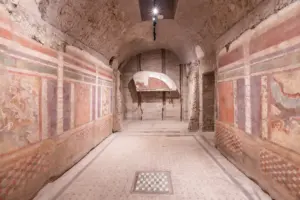
Beneath later imperial constructions lies the House of the Griffins, a dwelling dating back to the 2nd–1st century BC. Discovered during early 20th-century excavations, this aristocratic home was buried and largely forgotten as successive emperors built vast palaces above it. What sets this site apart are the well-preserved frescoes and mosaic floors, including mythological scenes, especially griffins, the mythical creatures symbolizing power and protection.
Because the underground corridors are narrow, steep, and extremely fragile, the site has never before been open to general visitors. Until now.
Technology Meets Antiquity — Livestreamed Tours
Starting in March, the House of the Griffins will be accessible through weekly livestream tours led by expert guides. Equipped with head-mounted cameras, guides navigate the tight subterranean passages while visitors follow the experience from above ground via live video feeds. Tours will be offered in both Italian and English, requiring a reservation and a special ticket in addition to the standard Colosseum-Palatine Hill entrance.
This blend of modern technology and ancient heritage allows broader public access without risking damage to delicate surfaces and pigments, an approach that museums and archaeological parks increasingly use to balance conservation with engagement.
Frescoes and Mosaics — Artifacts of Daily Life
The artwork in the House of the Griffins is significant for its style and preservation. Unlike the grand palaces of later emperors, whose decorations were designed to dazzle with scale, this Republican residence reveals the personal artistic choices of Rome’s elite before imperial dominance reshaped urban life. The frescoes depict elegant mythological motifs, and the mosaics reflect high craftsmanship, evidence that even early Roman aristocrats invested in artistic expression long before the Empire’s golden age.
The preservation of these surfaces offers scholars and enthusiasts alike a rare look at domestic art from a period when Rome was transitioning from a city-state republic to a world power.
Archaeology and Preservation Challenges
Opening archaeological sites to the public always carries risks. Fragile pigments, narrow stairways, and ancient humidity gradients can all contribute to deterioration if improperly managed. The livestream approach taken by the Colosseum Archaeological Park is part of a broader strategy funded by the European Union to protect lesser-known treasures while offering meaningful visitor experiences.
This effort is also a response to the enormous pressure that major attractions like the Colosseum and Roman Forum face — an attempt to redistribute foot traffic and draw attention to the broader archaeological landscape.
The House of the Griffins in the Context of Roman Life
To fully appreciate the House of the Griffins, it’s helpful to see it as part of the larger Palatine narrative. The hill was home not just to emperors and senators, but to generations of families whose lives bridged the Republic and the Empire. Nearby, the Domus Tiberiana and other imperial residences would later reflect a shift toward centralized power and monumental architecture, but in its own quiet way, the House of the Griffins reveals the artistry of ordinary elite life that predated those grander developments.
Planning Your Visit — What You Need to Know
The livestream tours begin in March and are limited to small groups to maintain an intimate experience and minimize crowding. Reservations and special tickets are required, and tours will be conducted weekly in both Italian and English. Because the site remains fragile, this controlled access model balances historical preservation with public interest.
Visitors interested in the broader Palatine experience, besides the livestream tour, should also explore other ruins and museums, such as the Palatine Museum, where artifacts and fragments from the hill are displayed.
Conclusion: A New Window into Ancient Rome
The opening of the livestream tour of the House of the Griffins marks an exciting moment for both archaeology and cultural tourism. Through innovative livestream tours, the public can now witness spaces once restricted to scholars — frescoed walls, mosaics, and subterranean corridors that connect us directly to Rome’s Republican past. In an era where digital technology increasingly enhances historical engagement, this project exemplifies how Rome’s ancient world continues to reveal itself in unexpected ways.

Hello, my name is Vladimir, and I am a part of the Roman-empire writing team.
I am a historian, and history is an integral part of my life.
To be honest, while I was in school, I didn’t like history so how did I end up studying it? Well, for that, I have to thank history-based strategy PC games. Thank you so much, Europa Universalis IV, and thank you, Medieval Total War.
Since games made me fall in love with history, I completed bachelor studies at Filozofski Fakultet Niš, a part of the University of Niš. My bachelor’s thesis was about Julis Caesar. Soon, I completed my master’s studies at the same university.
For years now, I have been working as a teacher in a local elementary school, but my passion for writing isn’t fulfilled, so I decided to pursue that ambition online. There were a few gigs, but most of them were not history-related.
Then I stumbled upon roman-empire.com, and now I am a part of something bigger. No, I am not a part of the ancient Roman Empire but of a creative writing team where I have the freedom to write about whatever I want. Yes, even about Star Wars. Stay tuned for that.
Anyway, I am better at writing about Rome than writing about me. But if you would like to contact me for any reason, you can do it at contact@roman-empire.net. Except for negative reviews, of course. 😀
Kind regards,
Vladimir