
The middle of the third century was a time of deep trouble for the Roman world. Political disorder, foreign invasions, and economic decline tore at the empire’s structure. Amid the chaos, commanders on distant frontiers gained authority as central control weakened. One of these men, Postumus, rose to power in Gaul and established an independent state that would challenge Rome’s authority for over a decade.
From his base on the Rhine, Postumus built stability and protection at a time when the empire’s leaders struggled to maintain order. His realm developed its own institutions and leadership structure, balancing loyalty to Rome with self-governance. Yet this fragile balance faced constant internal conflict, shifting alliances, and pressure from both invaders and rival emperors, until its eventual collapse and reunion with the Roman world.
Key Takeaways
- The empire’s weakness allowed regional powers to emerge in the west.
- A stable but short-lived state formed under strong military leadership.
- Renewed Roman control ended this period of separation.
Crisis of the Third Century
Invasions and Power Struggles Across the Empire
During the mid-3rd century, the Roman state faced constant attacks and internal revolts. Emperor Valerian led campaigns in the east while his son Gallienus defended the west. External enemies such as the Alamanni and Franks raided Roman territory, threatening both Italy and Gaul.
When Valerian was captured by Shapur I in the east, imperial control collapsed. Many commanders claimed the throne, creating local governments that acted independently. One of the most stable of these breakaway regions was the Gallic Empire, founded by Postumus after his troops revolted and declared him emperor.
Key Events and Figures
| Year | Event | Result |
|---|---|---|
| 258 | Valerian captured by Shapur I | Weakening of central power |
| 260 | Postumus proclaimed emperor in Gaul | Start of Gallic secession |
| 269 | Death of Postumus | Renewed instability |
| 274 | Aurelian reunites the western provinces | End of the Gallic Empire |
Postumus’s rule brought temporary order to Gaul, Britannia, and Hispania, but later power struggles among his successors—such as Victorinus and Tetricus—undermined stability again. Despite their conflicts, these leaders maintained Roman traditions, including a senate and consuls, showing how the western provinces still saw themselves as part of Rome.
Economic Hardship and Disease
Frequent wars and invasions hurt trade and production. Frontier regions lost access to key resources, and emperors debased the currency to pay troops, reducing the value of money and damaging trust in the economy. Cities that once thrived on commerce, like those in Gaul, faced shortages and inflation.
Plagues also struck the population, weakening armies and reducing manpower to defend the borders. The combined weight of disease, rebellion, and economic strain left the empire divided and vulnerable.
Main Consequences:
- Currency devaluation lowered purchasing power.
- Trade routes across provinces collapsed.
- Plague outbreaks reduced populations and military strength.
Although emperors like Aurelian later restored unity, the events of this period exposed serious weaknesses in imperial administration and the limits of central Roman control.
Rise of Postumus and the Gallic Empire
Turmoil and the Rise of Power
In 258, the Roman world split under pressure. Valerian ruled from the East while his son Gallienus handled the West. The empire faced constant invasions, revolts, and plagues. On the Rhine frontier, a commander named Postumus gained fame among the legions after defeating Germanic tribes.
When the imperial guardian Silvanus demanded Postumus hand over the spoils of victory, soldiers rebelled. They declared Postumus emperor and besieged Colonia, where Silvanus and Saloninus—Gallienus’s son—had taken refuge. Both men were captured and executed. The troops now saw Postumus as their legitimate leader.
Key Events:
| Year | Event | Outcome |
|---|---|---|
| 258 | Troops acclaim Postumus emperor | Beginning of Gallic independence |
| 259 | Fall of Colonia | Saloninus and Silvanus executed |
| 260 | Capture of Valerian by Shapur I | Weakened central government |
Break from Central Authority
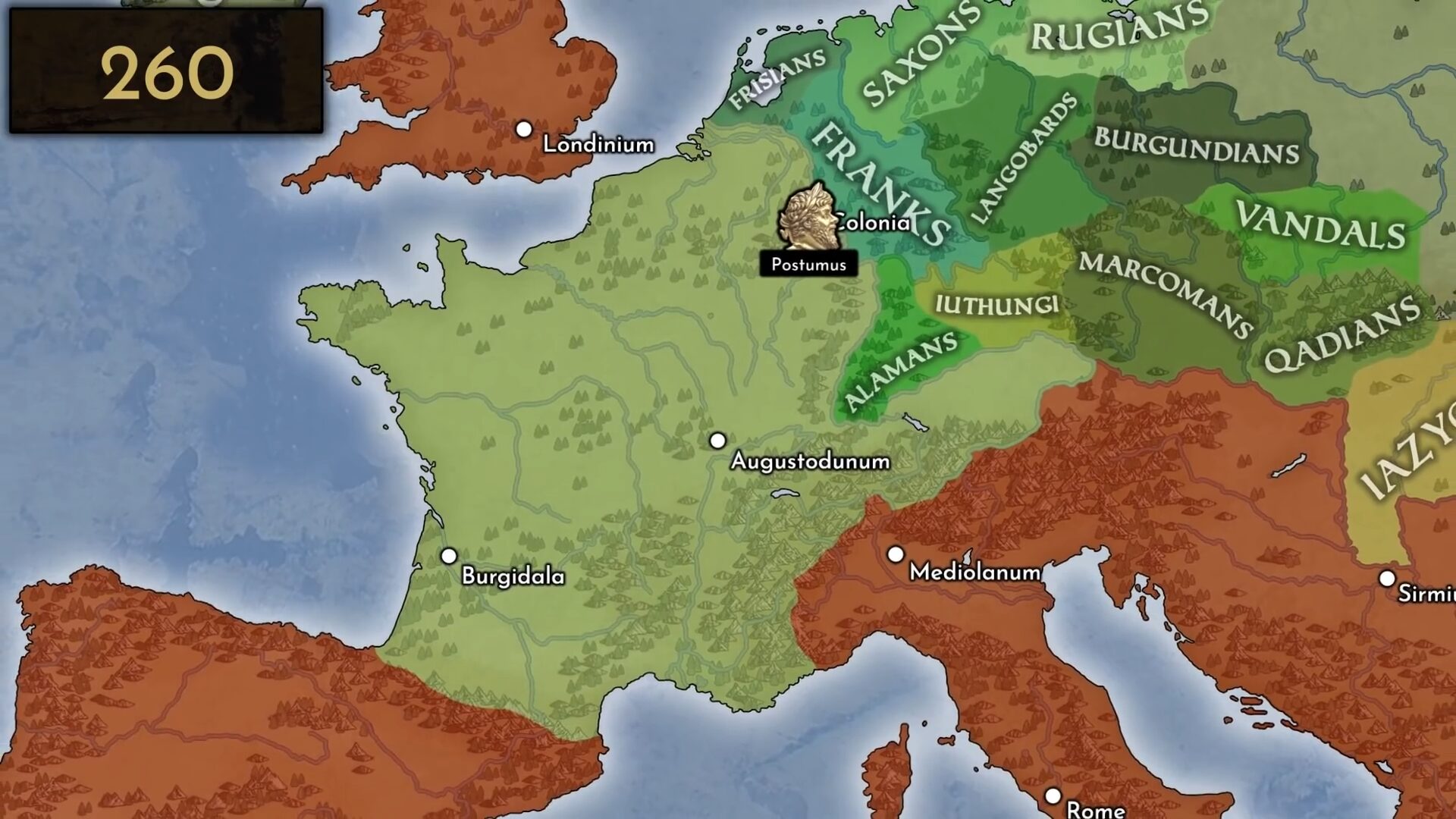
With control based in Colonia, Postumus took charge of Gaul, Britannia, and Hispania. These regions had struggled for attention from Rome and now saw in him a reliable protector. He built a Roman-style government, complete with a senate, consuls, and praetorian guard.
Postumus strengthened the Rhine frontier and earned the title Germanicus Maximus after defeating Frankish raiders. Unlike many usurpers, he did not march on Rome. His goal was to defend the western provinces, not replace the central emperor. This restraint allowed his state to enjoy a rare period of stability during the third-century crises.
Administrative Structure:
- Senate and yearly consuls
- Praetorian guard under local command
- Independent coinage system
Expansion and Military Success
Postumus’s authority extended across western provinces through both military victories and local support. He maintained the loyalty of the Rhine legions and repelled several invasions. Gallienus later attempted to retake these lands but failed after being wounded in battle.
Prominent figures like Victorinus rose under Postumus, serving as consul and praetorian tribune. However, over time, tension within the army grew. When Postumus prevented his soldiers from plundering Moguntiacum after suppressing a revolt, they turned on him and killed him.
The Gallic realm he created continued under new rulers, but its stability waned. His rule had proved that western provinces could stand apart when imperial protection failed, shaping the Roman world for decades to come.
Structure and Governance of the Gallic Empire
Roman Administration in Gaul
The Gallic Empire kept most of the Roman system to maintain order and legitimacy. It had a senate, annual consuls, and a praetorian guard. These institutions mirrored Rome’s own, giving the Gallic state a sense of continuity with imperial traditions rather than rebellion.
Government officials worked from Colonia Agrippina (modern Cologne), which served as the capital. The emperor and his council managed civil duties, issued decrees, and coordinated defenses along the Rhine. This setup gave the western provinces—Gaul, Britannia, and parts of Hispania—a stronger regional authority while still using Roman titles and customs.
| Office | Primary Function | Mode of Selection |
|---|---|---|
| Emperor | Supreme commander and head of state | Proclaimed by the legions |
| Consuls | Civil and administrative leaders | Yearly appointment |
| Senate | Advisory and legislative body | Local elites or military officers |
Command of the Rhine Armies
The Rhine legions were the backbone of Gallic power. They had first raised Postumus as emperor after clashing with Roman officials over war spoils. Their support gave stability and protection to the frontier provinces, especially against Frankish and Alamannic raids.
Loyalty of these troops shaped imperial policy. The rulers of the Gallic Empire relied heavily on them to enforce authority and defend against both external invasions and internal revolts. Yet, their influence also meant emperors had to balance military demands with fiscal limits, often leading to coin debasement and unrest.
The soldiers’ control of leadership succession showed how much the army defined politics. Their actions—electing, deposing, or even killing rulers—demonstrated that the Gallic Empire’s strength rested as much on its legions as on its Roman traditions.
Key Conflicts and Political Turmoil
Clashes with Foreign Foes
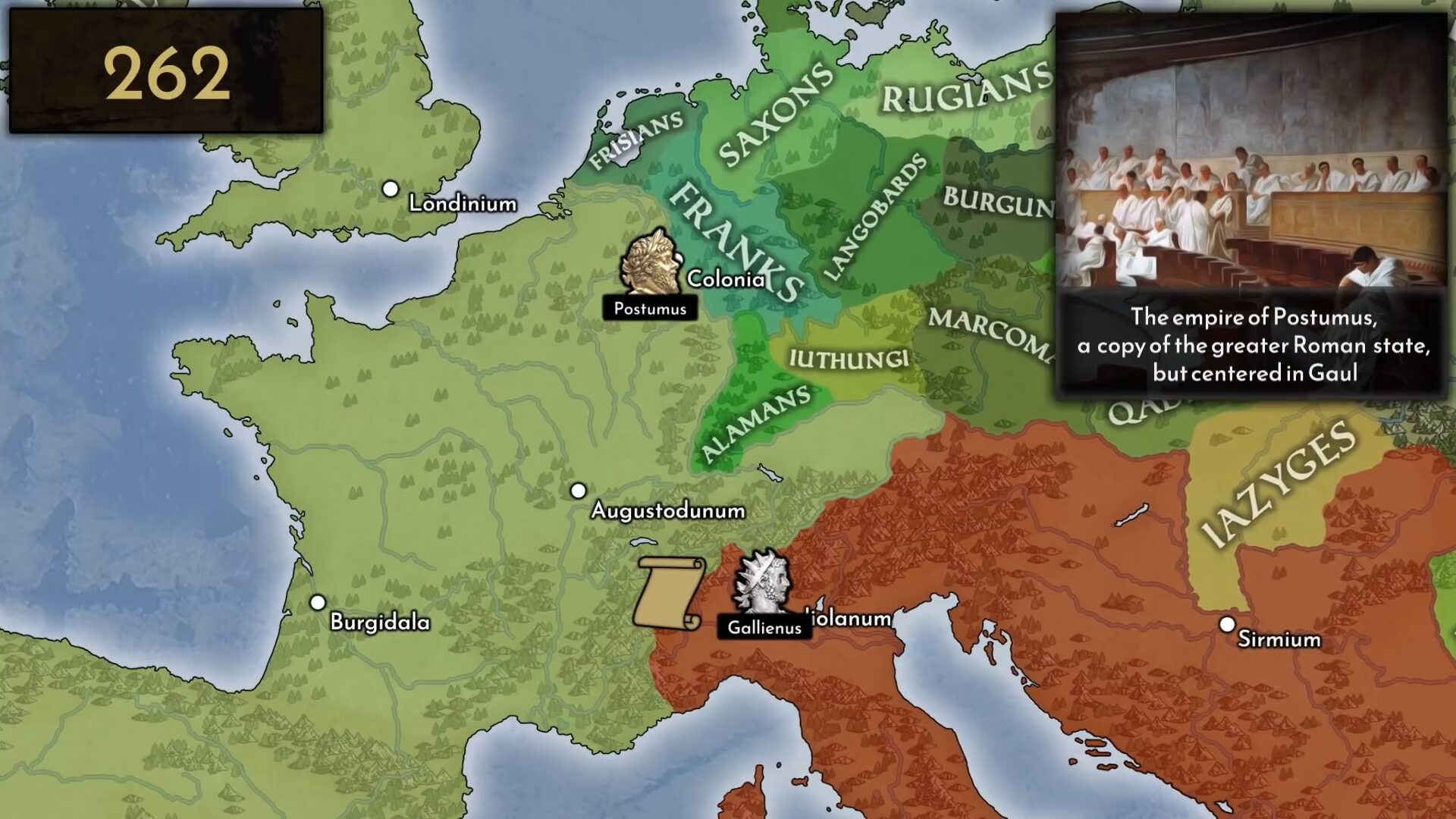
During the mid-third century, Roman defenses stretched thin as invaders pressed on multiple fronts. Gallienus halted a major Germanic raid near Mediolanum, keeping Italy secure for a time. Yet in the East, Valerian’s defeat and capture by the Persian king Shapur I caused lasting chaos. The empire’s border provinces faced constant attacks from the Alamanni and Franks, forcing local armies to take matters into their own hands.
Summary of Key External Threats
| Invader | Region Affected | Roman Response | Outcome |
|---|---|---|---|
| Alamanni | Northern Italy | Defeated near Mediolanum | Roman victory |
| Persians | Eastern Empire | Valerian captured | Major defeat |
| Franks | Gaul and Hispania | Countered by Postumus | Border secured |
Power Struggles and Civil Unrest
Valerian’s capture left Gallienus burdened with internal dissent. Usurpers rose in the provinces, and local commanders seized control. In Gaul, Postumus was declared emperor by the Rhine legions after a dispute over captured goods. The execution of Saloninus and Silvanus marked the start of a Gallic breakaway.
Postumus governed successfully for several years, establishing local Roman institutions such as a senate and praetorian guard. But after his death at the hands of mutinous soldiers, a rapid cycle of short-lived rulers followed. Frames of loyalty shifted constantly, as shown below:
Sequence of Gallic Rulers
- Postumus – Stabilized Gaul but slain by his own troops.
- Marius – Briefly ruled; overthrown soon after.
- Victorinus – Strengthened the domain; assassinated.
- Tetricus I and II – Attempted reforms; surrendered to Aurelian.
Gallienus’s Operations in Western Provinces
Gallienus tried to reclaim the western territories from Postumus. His commander Aureolus led an early campaign that failed to capture the Gallic leader. Later, Gallienus personally advanced into Gaul but suffered an injury during a siege, ending the effort.
These attempts drained Roman strength and led to further disloyalty within the ranks. Aureolus rebelled but was defeated and besieged at Mediolanum, where Gallienus was killed by his own soldiers. This event deepened the empire’s instability and opened the path for new leaders like Claudius II and later Aurelian to restore control.
Political turmoil, shifting loyalties, and the constant push of invasions defined the empire’s western crisis during this era.
Leadership Transitions and Instability
Death of Postumus
Postumus ruled effectively for several years, defending Gaul’s frontiers and maintaining order. His decision to keep peace with Rome and avoid campaigns into Italy frustrated his soldiers. When he stopped them from plundering Moguntiacum after defeating the rebel Laelianus, anger spread through the ranks. The troops turned on him and ended his life during the revolt in 269 CE.
| Key Details | Information |
|---|---|
| Cause of death | Killed by his own troops |
| Location | Moguntiacum (Mainz) |
| Triggering event | Restriction on sacking the city |
| Year | 269 CE |
Brief Successions
After Postumus’s murder, the army quickly chose Marius, a former soldier, as the next ruler. His time in power was extremely short, ending with his own death soon after. The instability caused Hispania to leave the Gallic domains, while Claudius II, ruling from Rome, sent limited forces to regain parts of southern Gaul. Control over Narbonensis returned to the central government, showing how fragile the Gallic regime had become.
Notable short-term emperors:
- Marius – ruled briefly, allowed troops to sack Moguntiacum
- Victorinus – restored some control but later murdered out of revenge
Rise of Tetricus
Following Victorinus’s death, his mother, Victoria, supported Tetricus, governor of Aquitaine, as the next emperor. His leadership brought some structure but faced new difficulties. Economic decline, reduced trade, and the loss of western provinces weakened his authority. Still, he fought back against internal revolts and barbarian incursions, naming his son Caesar to share power.
Tetricus eventually faced Emperor Aurelian’s campaign to reunite the empire. At the Catalaunian Plains, Tetricus surrendered before the battle, leading to a devastating defeat for the Gallic army. The Gallic territories were reintegrated into Rome, ending this period of division and military unrest.
Decline and Reintegration
Aurelian’s Return to the West
After restoring stability in the east, Aurelian turned his attention toward the western provinces still ruled by the Gallic emperors. He had already reasserted Roman control in Syria and Egypt, and now prepared to reclaim Gaul and Britannia.
- Tetricus I, leader of the Gallic realm, faced internal unrest and economic decline.
- Weakened by revolts and invasions, his forces struggled to maintain order.
Aurelian advanced methodically, reclaiming loyalty from border cities. Reports suggest that Tetricus secretly reached out to him, perhaps seeing the return to imperial unity as the only way to restore stability.
The Clash on the Catalaunian Fields
The two armies met on the Catalaunian Plains, a site already infamous for major Roman battles. Aurelian’s superior cavalry gave him the edge. Tetricus either surrendered before or during the fighting, leaving his troops without their commander.
The Rhine legions, despite his absence, fought fiercely to defend their independence. The result was catastrophic:
| Forces | Estimated Losses | Outcome |
|---|---|---|
| Gallic Army | Tens of thousands | Destroyed |
| Imperial Army | Heavy casualties | Victory |
The carnage shattered the Gallic military strength and left the Rhine frontier dangerously exposed to future incursions.
Fall of the Gallic Realm
With the defeat of the remaining forces, Aurelian quickly reabsorbed Gaul and Britannia into the Roman fold. A governor named Faustinus, who had risen in rebellion, fell soon after Aurelian’s advance.
Tetricus I and his son were captured but spared. During Aurelian’s triumph in Rome, they appeared alongside Queen Zenobia of Palmyra as symbols of restored unity. Tetricus later served as governor in southern Italy, showing Aurelian’s willingness to reward submission over destruction.
The Gallic Empire’s collapse marked the end of a major secession. Its fall revealed how fragile Roman authority had become, yet also how capable strong leadership could restore it. The legions that once defended an independent Gaul now stood once more beneath the Roman banners.
Legacy of the Gallic Empire
Influence on the Western Roman Realm
The Gallic Empire demonstrated how a well-defended and locally led government could sustain order when Rome’s authority weakened. Its leaders maintained Roman traditions such as a senate, consuls, and a praetorian guard, giving legitimacy to their rule.
Key traits of Gallic administration:
| Feature | Description |
|---|---|
| Political System | Modeled after Roman imperial institutions |
| Currency | Initially stable but later devalued due to military demands |
| Military Role | Focused on defending the Rhine frontier |
The region under Gallic control—Gaul, Britannia, and parts of Hispania—saw temporary peace and security. For a time, frontier communities trusted Gallic emperors more than distant rulers in Rome.
Model for Later Claimants to Power
The independence achieved by Postumus and his successors encouraged later Roman generals to build their own realms in Gaul. These rulers showed that military strength, local loyalty, and control of border armies could challenge central power.
Their rule became a pattern for later usurpers who relied on frontier troops to gain authority. Even after reunification under Aurelian, the idea of a separate western command persisted. Gaul continued to attract ambitious leaders who, like Postumus, aimed to protect their region while asserting imperial ambition.
